
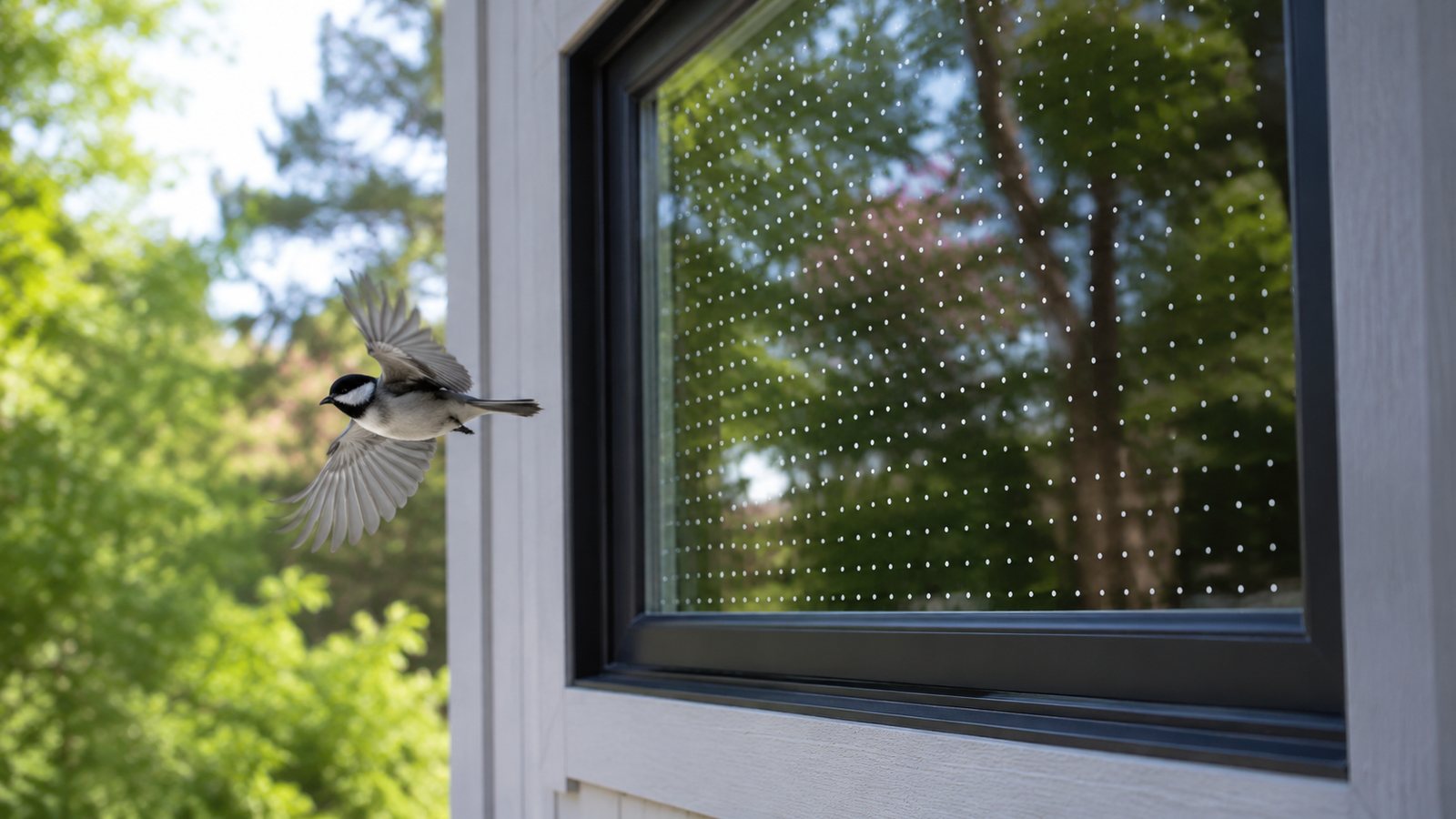
Begin with the window that’s caused a collision
Don’t wait for several strikes before making a change. A confirmed collision shows that the glass can appear like open habitat or a clear passage.
Inspect the full pane, any neighbouring panes, glass corners, railings, and the flight path from nearby feeders, water, trees, or shrubs.
Apply treatments to the outside surface
Indoor markings can disappear behind outdoor reflections. Cornell, Birds Canada, FLAP Canada, and American Bird Conservancy all recommend treating the outside of the glass for dependable daytime protection.
If an exterior application isn’t possible, an exterior screen, shade, or barrier in front of the glass may be an alternative. An inside curtain can help with see-through sightlines or nighttime light, but it’s not a complete answer to exterior reflections.
Cover the whole problem area
A bird doesn’t understand that one sticker represents danger. It sees the large untreated spaces around the sticker as possible routes.
Extend the pattern across the pane and any connected glass that forms the illusion. Sliding doors, paired windows, corners, and railings may require more than one panel to be treated.
Keep gaps no larger than two inches
Current home guidance commonly uses a two-inch by two-inch pattern. This close spacing helps protect small birds that may try to pass through a larger apparent opening.
FLAP Canada recommends visible markers on the exterior, covering the entire surface, with no more than two inches between them. Individual marks should also be large and contrasting enough to remain visible in changing daylight.
Use dots, lines, tape, or decals
The shapes don’t need to look like birds of prey. Rows of dots, short lines, squares, tape strips, or repeated decorative forms can all work when the spacing, contrast, and coverage are correct.
Choose a material designed for exterior exposure or check it often for peeling and fading. Replace missing markers before open gaps form in the pattern.
One or two decals aren’t enough
A single hawk silhouette or a few widely separated decals leave most of the glass looking open. The bird may simply aim between them.
A decorative pattern can still look attractive from indoors. The goal isn’t to cover every inch with opaque material, but to remove apparent flight openings larger than the recommended spacing.
Temporary paint and soap can work
Washable tempera paint, suitable paint markers, or a bar of soap can create an immediate outside pattern. These methods help while waiting for a longer-lasting treatment or during a seasonal collision period.
Use a clear, visible design and maintain the two-inch spacing. Reapply it after rain, cleaning, fading, or weather damage.
Exterior screens can provide strong protection
A full exterior insect screen makes the glass more visible and can reduce the force of an impact. It should cover the whole risky area and remain securely installed.
Some protective screens or netting systems are mounted away from the glass so a bird meets a flexible barrier first. Follow product guidance carefully and prevent loose material that could entangle wildlife.
Cord systems break up reflections
Closely spaced vertical cords, sometimes called BirdSavers or zen curtains, hang in front of the outside glass. They create a visible barrier while preserving much of the view.
Cornell notes that properly spaced cords can be effective. Measure the spacing carefully, secure the top, and keep the cords hanging straight across the full window.
Exterior film can change the appearance of glass
Opaque, patterned, or perforated exterior films can reduce reflection or make the pane visible. Check that the product is meant for bird-collision prevention and exterior use.
Be cautious with nearly transparent and ultraviolet-only products. Their visibility can change with shade, overcast weather, angle, and light level. A clearly visible high-contrast pattern is easier to assess.
Glass railings and corners need full coverage
Apply the same spacing principles to balcony railings, deck panels, greenhouse walls, sunrooms, and transparent corners. Birds may approach these surfaces from either side.
Condominium or rental rules may limit permanent changes. Temporary exterior markers, removable film, cords, or approved screens may provide options, subject to building permission and safe access.
Reduce transparent sightlines
Close a blind or curtain when birds can see through a room to another window. An interior covering may still leave reflections on the outside surface, so check the glass from outdoors too.
Move large indoor plants away from the direct line of sight. Treat opposite windows and glass doors that make the building appear like a tunnel.
Review feeder placement, but treat the glass
Birds Canada recommends placing feeders and bird baths within about three feet of a window so birds can’t build as much speed before a possible strike. Cornell has also long advised very close feeder placement for this reason.
Newer Cornell guidance stresses that distance alone isn’t enough and that windows near feeders should be made bird friendly. Birds may approach from elsewhere in the yard, and a startled bird can hit a reflection even when it didn’t launch directly from the feeder.
Don’t rely on a distant-feeder rule alone
Some guidance has used a “within three feet or farther than thirty feet” placement rule. It can be a reasonable starting point, but it shouldn’t be treated as a guarantee.
The dependable action is to treat the dangerous glass. Once the window is visible to birds, choose the feeder location based on predator safety, weather, cleaning access, and how birds use the yard.
Check bird baths and native plantings too
A bath or berry shrub can create repeated flights near a window even when no seed feeder is present. Examine the route between water, plants, perches, and glass.
Don’t remove valuable habitat automatically. Make the window safe, then adjust the attractant only when the flight path still creates a problem.
Turn off unnecessary lights at night
Artificial lights can draw migrating birds into built-up areas, especially in poor weather. Turn off decorative and unnecessary indoor lighting at night, close coverings where light shines through large panes, and support local lights-out efforts.
Daytime exterior glass treatment remains necessary because birds can collide with reflections after dawn even when the building was dark overnight.
Inspect treatments through the year
Look from outside during sun, shade, cloudy weather, and different seasons. Make sure the pattern remains visible and no large untreated gaps have appeared.
Snow, fallen leaves, changing vegetation, moved furniture, and new indoor plants can alter the view through or reflected in the glass.
Effective and ineffective approaches
| More effective | Not dependable by itself |
|---|---|
| Exterior dots or lines no more than two inches apart | One or two widely spaced decals |
| Full exterior screens or properly installed barriers | Interior curtains while reflections remain strong |
| Closely spaced exterior cords | A single hawk or owl silhouette |
| Visible exterior film made for collision prevention | Nearly invisible treatments that disappear in shade |
| Paint or soap patterns across the full pane | Small markings only at the collision point |
| Treated glass near feeders and baths | Relying only on feeder distance |
Check these spots at home
- Identify the glass connected to the collision or reflection problem.
- View the window from outside and find the false habitat or sightline.
- Choose an exterior treatment you can maintain.
- Cover the entire risky area with gaps no larger than two inches.
- Treat connected panes, corners, doors, and railings.
- Review feeders, baths, plants, and indoor sightlines.
- Check the treatment in different light and repair missing sections.
Frequently asked questions
What is the best way to stop birds from hitting windows?
Apply a high-contrast pattern to the outside of the full glass surface, with no gaps larger than about two inches, or use an effective exterior screen, cord system, or film.
Do bird window decals work?
Decals can work only when many are placed closely across the outside of the full problem area. One or two decals or a single hawk silhouette aren’t enough.
Should window markers go inside or outside?
They should normally be applied to the exterior surface because outside reflections can hide an interior treatment.
Does moving a bird feeder prevent window collisions?
Feeder placement can reduce impact risk, but it doesn’t replace treating reflective or transparent glass. Make nearby windows bird-safe regardless of feeder distance.