
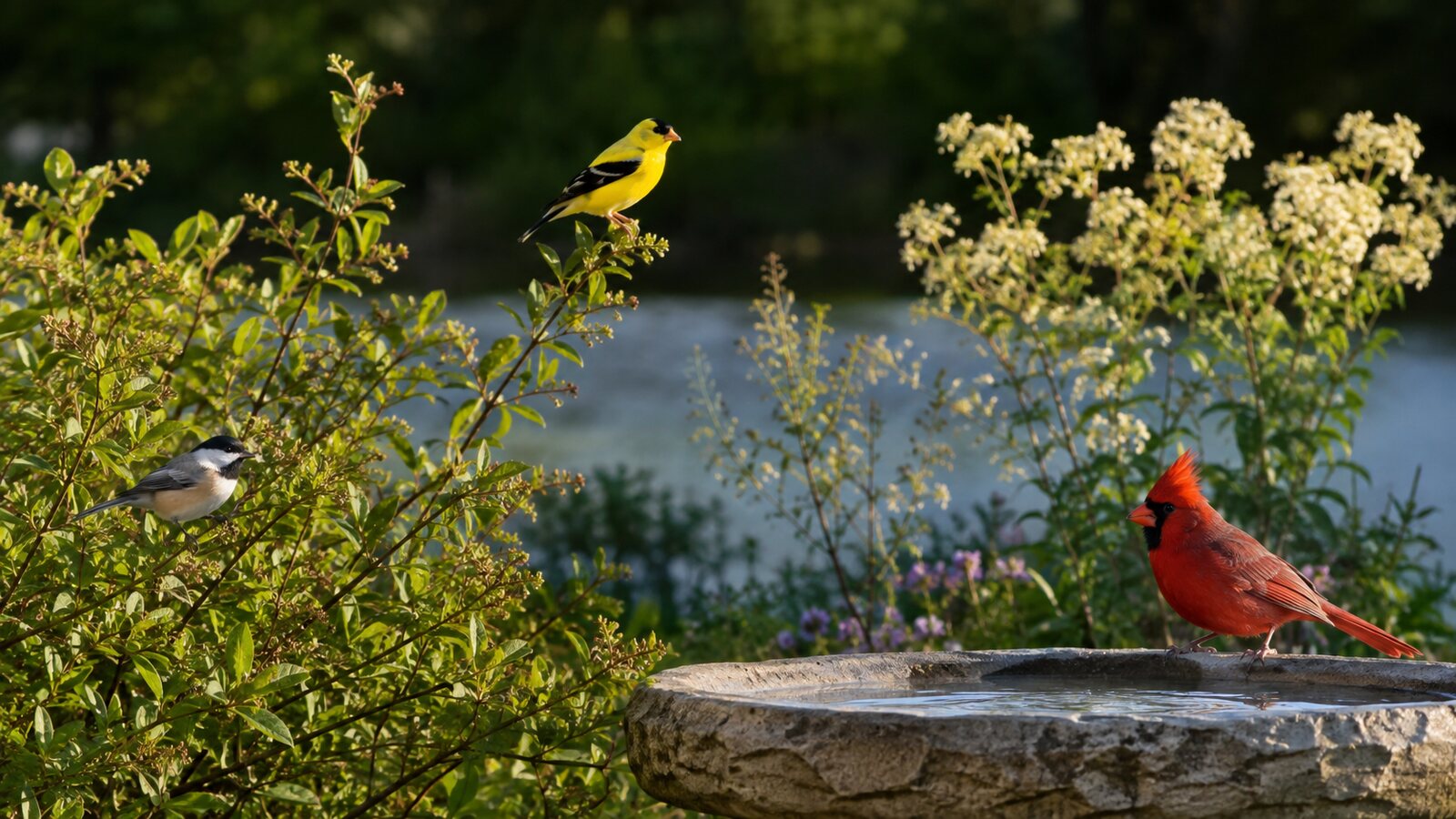
Backyard birds and bird watching
Bird identification, facts and backyard birding
Armchair Birder helps you identify North American birds, answer common bird questions, and make your backyard safer and more inviting for birds. Robin is the serious bird watcher in our house; I’m usually the one asking the next question and turning it into a page.
Find it quickly
Search Armchair Birder
Search by bird name, color, sound, food, behavior, or a question you have.
New to bird watching?
Start with the bird in front of you
You don’t need to know every bird name. Not even close. Start with the bird you can see. Notice its size, shape, colour, sound, and what it is doing. Those simple clues can take you a long way.
Identify Birds
Use colour, size, behaviour, habitat, and location to narrow down the bird you saw.
02Bird Facts
Find answers to short bird questions about sleep, flight, migration, senses, feathers, nests, food, and behaviour.
03Backyard Birds
Learn about feeders, birdseed, water, bird-friendly gardens, nesting, and safer backyards.
04Bird Watching
Get straightforward advice about binoculars, bird calls, photography, and getting started.
05Birds by Region
Explore birds across Canada and the United States through broad regional guides.
New bird guides
North America’s birds at the extremes
Meet birds that stand out for colour, unusual features, tiny bodies, or enormous wings.
Most beautiful birds
A visual guide to 12 colourful and striking North American birds.
Strangest-looking birds
Odd bills, bare heads, display sacs, lobed feet, crests, and more.
Smallest birds
See how tiny hummingbirds compare with Bushtits and kinglets.
Largest birds
Compare condors, pelicans, swans, cranes, eagles, and other giants.
Popular bird facts
Short answers to questions people ask about birds
Bird watching creates questions fast. Where do birds sleep? How high can they fly? Can they see colours we can’t? Start with one of these common questions, then open the full answer if you want to know more.
Where do birds sleep at night?
Most birds sleep in sheltered places rather than nests. Depending on the species, that might be a dense shrub, tree cavity, branch, reed bed, open water, or a communal roost.
Where birds sleepHow long do birds live?
There isn’t one average lifespan. Many small birds die young, but individuals that survive their first difficult years can live much longer. Some larger birds live for decades.
How long birds liveWhy do birds migrate?
Food and breeding opportunities are two big reasons. Birds move between places where seasonal conditions give them a better chance to feed, nest, and raise young.
Why birds migrateCan birds see colour?
Yes. Bird colour vision can be excellent, and many species can detect ultraviolet wavelengths that people can’t see at all.
How birds see colourHow high can birds fly?
Most everyday bird flight is fairly low, but migration can take birds thousands of feet above us. A few species have reached altitudes that overlap with aircraft.
How high birds flyWhy do birds sing in the morning?
The dawn chorus is closely tied to territory and attracting mates. Early morning is such a busy time for bird song that researchers are still studying all the reasons behind it.
Why birds sing at dawnAre birds dinosaurs?
Yes. Modern birds are living avian dinosaurs. They evolved within the theropod family tree, while the non-avian dinosaur groups died out about 66 million years ago.
Why birds are dinosaursCrow vs raven: what's the difference?
Ravens are bigger, heavier billed, and usually show a wedge-shaped tail in flight. Crows are smaller with a rounder tail, and their familiar caw sounds very different from a raven's deep croak.
Crow vs ravenBird identification guides
Turn a quick sighting into better clues
A few clues can go a long way. Start with size and shape. Then add colour, behaviour, habitat, location, season, and sound. When several clues point to the same bird, the identification gets much stronger.
Common birds of North America
Start with species people see and search for often, from crows and robins to woodpeckers, hummingbirds, finches, juncos, and Bald Eagles.
02How to identify a bird you saw
Use notes, photos, sounds, location, and a few clues that agree.
03Identify birds by size and shape
Study silhouette, posture, bill, wings, tail, legs, proportions, and flight style.
04Identify birds by sound
Listen for pitch, pace, rhythm, repetition, tone, and the habitat around the singer.
05Identify birds by behaviour
Use posture, feeding style, movement, climbing, swimming, flocking, and flight.
06Identify by colour and field marks
Use head patterns, wing bars, breast markings, rump patches, and tail details.
07Why birds change appearance
Compare male, female, juvenile, seasonal, moulting, worn, wet, and backlit plumage.
Backyard bird guides
Build a safer backyard routine
A feeder is only part of the picture. Good food, clean water, shelter, safer windows, and a yard that’s easy to maintain will do more for birds over time.
How to attract birds
Use water, food, plants, shelter, safer windows, and patient observation.
02Where to place a feeder
Balance nearby cover, visibility, weather, cleaning access, and bird safety.
03Choose the best birdseed
Compare sunflower, safflower, nyjer, millet, peanuts, suet, and seed mixes.
04Clean a bird feeder
Keep a regular cleaning schedule and act sooner when the feeder gets dirty.
05Stop seed from sprouting
Reduce waste with better food, smaller portions, trays, and regular cleanup.
06Why the feeder is quiet
Check natural food, migration, seed condition, predators, and recent changes.
07Attract birds to a bird bath
Make water shallow, easy to notice, safe to approach, and simple to keep clean.
08Place a bird bath
Balance partial shade, nearby cover, clear sightlines, windows, pets, and cleaning access.
09Make hummingbird nectar
Use the correct sugar-water ratio and avoid red dye and unsuitable sweeteners.
10Change hummingbird nectar
Keep nectar fresh with frequent replacement, careful cleaning, shade, and smaller batches.
11Place a hummingbird feeder
Choose a visible, shaded, sheltered location with safer windows and easy cleaning access.
12Why hummingbirds aren’t visiting
Troubleshoot season, nectar, placement, flowers, insects, predators, and territorial birds.
13Keep ants out
Use a water moat, prevent leaks, clean sticky surfaces, and block alternate paths.
14Keep bees and wasps away
Use a saucer feeder, repair leaks, relocate it, and avoid pesticides near birds.
15Choose native plants
Match regional range, sunlight, soil, moisture, mature size, and bird value.
16Compare plant types
Build habitat with trees, shrubs, flowers, grasses, vines, and lower cover.
17Why birds hit windows
Learn how reflections, clear sightlines, migration, and territorial behaviour create risk.
18Make windows safer
Use full exterior patterns, screens, cords, paint, or film that birds can see.
19Help after a window strike
Contact a rehabilitator promptly, contain a small bird safely, and give no food or water.
20Stop reflection attacks
Cover the outside reflection on windows, patio doors, chrome, and parked-car mirrors.
Common backyard sparrows
Put the identification method into practice
Compare eight familiar sparrows, then use five focused guides for pairs that look similar at first.
Identify backyard sparrows
Use breast pattern, crown, throat, tail, behaviour, habitat, sound, region, and season.
28Song Sparrow vs House Sparrow
Compare shape, streaking, bib, face, tail, buildings, shrubs, groups, and songs.
29White-crowned vs White-throated
Check throat, yellow lores, crown, age, bill, habitat, sound, and season.
30Chipping vs American Tree
Compare eye line, bill, breast spot, body shape, habitat, sound, and date.
31Song Sparrow vs Savannah
Check tail, bill, streaking, yellow near the eye, open grass, brush, and sound.
32Fox Sparrow vs Song Sparrow
Compare size, bill, chevrons, eye line, scratching, season, and regional form.
Common backyard finches
Identify colourful and streaked feeder visitors
Compare eight North American finches. Then work through five look-alike guides for red finches, small streaked feeder birds, and large northern grosbeaks.
Identify backyard finches
Use bill shape, streaking, wing pattern, red or yellow placement, behaviour, range, and date.
34House Finch vs Purple Finch
Compare male backs, female faces, breast streaking, bills, tails, habitat, sound, and season.
35House vs Purple vs Cassin’s Finch
Use range, crown shape, bill, red placement, female face, undertail, wings, and tail.
36Goldfinch vs Pine Siskin
Compare streaking, bill shape, winter colour, wings, tail, flight, calls, and feeder behaviour.
37Evening vs Pine Grosbeak
Use bill size, wing contrast, tail length, male and female plumage, food, calls, and winter movement.
38Redpoll vs Pine Siskin
Compare cap, facial pattern, bill, streaking, wing bars, yellow flashes, calls, and flock behaviour.
Common backyard woodpeckers
Recognize familiar tree-climbing birds
Compare eight North American woodpeckers. Then use five guides for black-and-white look-alikes, flicker forms, sapsuckers, confusing red names, and two large species.
Identify backyard woodpeckers
Use size, bill, back pattern, red placement, tail, sound, behaviour, tree signs, range, and season.
40Downy vs Hairy Woodpecker
Compare bill length, body scale, outer-tail spots, calls, drumming, branch size, age, and sex.
41Yellow-shafted vs Red-shafted Flicker
Check wing and tail lining, moustache, face, crown, nape, sex, range, and mixed features.
42Yellow-bellied vs Red-naped vs Red-breasted Sapsucker
Compare geography, red coverage, face stripes, nape, throat, wing patch, juveniles, and hybrids.
43Red-bellied vs Red-headed Woodpecker
Compare the whole head, barred or solid back, white wing patches, hidden belly colour, sex, age, and behaviour.
44Northern Flicker vs Pileated Woodpecker
Use size, brown or black plumage, crest, white rump, white underwings, ground feeding, excavation, and calls.
Common backyard chickadees
Recognize small, active feeder and forest birds
Compare six North American chickadees. Then use four visual guides and a sound guide to check range, habitat, head pattern, back, wings, sides, whistles, and calls.
Identify backyard chickadees
Use cap, eyebrow, bib, back, wings, sides, habitat, elevation, region, behaviour, and sound.
46Black-capped vs Carolina Chickadee
Compare range, song, pale wing edging, flank colour, photographs, call pace, and mixed birds.
47Mountain vs Black-capped Chickadee
Look for the white eyebrow, then check conifers, elevation, sides, wings, movement, and sound.
48Boreal vs Black-capped Chickadee
Compare cap, nape, cheek, bib, sides, wings, spruce habitat, range, lighting, and calls.
49Chestnut-backed vs Black-capped
Check chestnut versus gray back, sides, wings, Pacific forest, calls, and regional variation.
50Identify chickadees by sound
Compare whistles, call pace, pitch, scratchy notes, rasps, gargles, habitat, and range.
Common backyard nuthatches
Recognize compact birds that work along bark
Meet four North American nuthatches, then use five focused guides for face pattern, range, habitat, voice, size, season, and sound.
Identify backyard nuthatches
Compare White-breasted, Red-breasted, Pygmy, and Brown-headed by head pattern, underparts, forest, range, behaviour, and sound.
52White-breasted vs Red-breasted Nuthatch
Check the eyebrow, eye stripe, belly colour, body size, bill, habitat, voice, sex, and seasonal movement.
53Pygmy vs Red-breasted Nuthatch
Compare brown crown, striped face, underparts, size, western conifer habitat, calls, flocks, and season.
54Brown-headed vs Pygmy Nuthatch
Let east versus west lead, then check pine habitat, cap, nape, size, voice, and social behaviour.
55White-breasted vs Brown-headed Nuthatch
Compare size, crown, white face, bill, southeastern habitat, voice, feeder behaviour, and age.
56Identify nuthatches by sound
Compare nasal yanks, hornlike notes, piping, wheezy squeaks, pace, flocks, habitat, and region.
Common backyard titmice
Use the crest, face, habitat, region, and voice
Meet five North American titmice, then use focused comparisons for look-alikes, chickadee confusion, and birds calling from cover.
Identify common backyard titmice
Compare Tufted, Black-crested, Bridled, Oak, and Juniper Titmice by crest, face, habitat, region, behaviour, and sound.
58Tufted vs Black-crested Titmouse
Check gray versus black crest, forehead colour, voice, range, habitat, and central Texas hybrid-zone birds.
59Oak vs Juniper Titmouse
Let location and woodland type lead, then compare colour and voice.
60Identify titmice by sound
Compare whistles, rolling songs, scratchy calls, location, and visible clues.
61Bridled vs Juniper Titmouse
Use the bold face pattern, oak or juniper habitat, exact location, and voice.
62Tufted Titmouse vs Chickadee
Compare crest, black-and-white head pattern, size, voice, and feeder behaviour.
From Don
Bird watching can begin from a favourite chair
I’m Don, the narrator behind Armchair Birder. Robin is the serious bird watcher in our house. She follows the crows and local birds of prey; I’m usually the one asking the next question and turning it into a page.
We have a crow family that has visited for several generations, Robin experiments with food puzzles for them, and her bird photo collection will be making its way onto the site too. This site grows out of that everyday kind of watching.
Meet Don and RobinExplore the site
Choose the bird question you have
Use Armchair Birder as a quick reference or settle in for a deeper look at the birds you see every day.
Bird guides
Compare familiar North American species, look-alikes, calls, field marks, habitats, and regional clues when you want to go deeper.
North American bird guides
Learn about widespread species as well as the birds associated with particular climates, habitats, states, and provinces.
A better backyard for birds
Make thoughtful choices about food, water, shelter, window safety, and bird-friendly plants.