
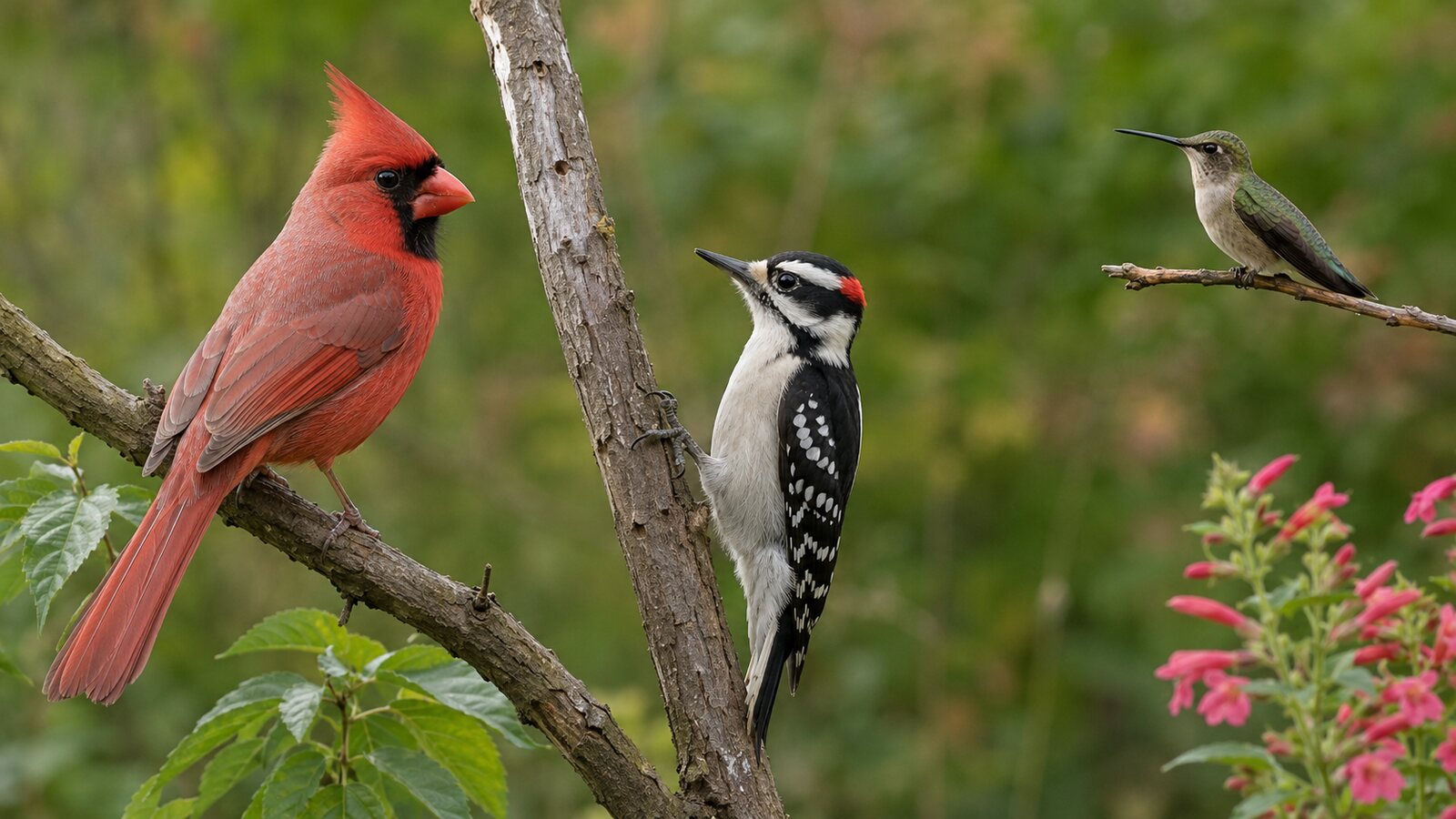
Is beak shape mostly about food?
Food is the obvious place to start.
A thick finch bill can crack and husk seeds. A hawk's hooked bill tears flesh. A hummingbird's long narrow bill reaches into flowers. A woodpecker has a strong chisel-like bill for working on wood.
Those are real adaptations.
They are just not the whole story.
Why is the simple “beak equals diet” rule incomplete?
Because a bill has to do almost everything a hand and mouth might do for another animal.
Birds use bills to gather food, preen feathers, carry nest material, feed young, defend themselves, manipulate objects, and interact with mates.
Researchers have also found that climate can influence bill size because an exposed bill can release body heat. In some groups, song and bill shape are connected too.
One tool. A lot of jobs.
Why do finches have thick beaks?
Many finches eat seeds that need gripping, cracking, or husking.
A deep, sturdy bill can generate force and handle hard food efficiently. That does not mean every finch eats the same seeds, but the general shape gives you a clue about feeding style.
Darwin's finches became famous because changes in food conditions could favour different bill sizes over generations.
Why do hummingbirds have long beaks?
Flowers are part of the answer.
A long bill lets the bird position its tongue deep inside a flower while hovering nearby. Different hummingbird species can have bills that match different flower shapes surprisingly well.
Still, hummingbirds do not live on nectar alone. They also eat small insects and spiders.
A beak that looks like a drinking straw has more than one job.
Why do hawks and eagles have hooked beaks?
Raptors often use their feet to capture and kill prey. The bill then helps tear food into manageable pieces.
The curved tip and sharp edges work well for that job.
Compare that with a duck. Same basic structure, completely different shape.
Why are duck bills broad and flat?
Many ducks feed in or around water and mud.
Their bills can help strain, grasp, nip, probe, or sort food. Fine structures called lamellae along the bill edges act somewhat like a sieve in species that filter small food items from water or sediment.
Not every duck feeds the same way, so even duck bills vary.
Why do woodpeckers have chisel-like bills?
Woodpeckers use the bill for excavation, communication, and feeding.
A strong pointed bill can remove bark, open wood, enlarge cavities, and drum on resonant surfaces.
The tongue often does the fine work after the bill opens the route to insects.
Our do birds have tongues? page gets into some of those remarkable designs.
Can a beak help a bird stay cool?
Yes.
A bill has a blood supply and no insulating feathers covering most of its surface. That makes it a place where heat can move between the body and the surrounding air.
Research on several bird groups has linked bill size with climate. Bigger exposed surfaces can help release heat, while smaller ones may reduce heat loss in cold conditions.
So even temperature can leave an evolutionary fingerprint on a bird's face.
Does beak shape affect bird song?
It can.
The bill helps shape sound as it opens and closes. Physical differences in bill length, depth, and movement can influence how quickly or at what frequencies some birds sing.
That means feeding, climate, and communication can tug on the same piece of anatomy in different directions.
Can you identify a bird by its beak?
Sometimes the beak is one of your best clues.
A hooked raptor bill, crossed crossbill, spoonbill, hummingbird bill, or thick cardinal bill can narrow things down quickly.
Still, do not identify from the bill alone. Add size, body shape, plumage, habitat, behaviour, sound, and location.
That is the same approach we use in identifying birds by size and shape.
Frequently asked questions
Is a beak the same as a bill?
In everyday birding, the words are often used interchangeably. Some people prefer “bill” for certain shapes, such as ducks, but there is no simple biological line separating the terms.
Why do birds have beaks instead of teeth?
Modern birds lost true teeth deep in their evolutionary history. The bill handles food before swallowing, while the digestive system, including the gizzard in many species, does work that chewing would otherwise do.
Do bird beaks keep growing?
The keratin covering of the bill grows and wears continually. Normal feeding and preening help keep it in shape.
Can a bird's beak change over evolution?
Yes. Bill size and shape can evolve when environmental conditions favour birds that feed, regulate heat, or reproduce more successfully with certain traits.
Keep following the question
Beaks connect bird anatomy to food, behaviour, and identification. Continue with do birds have teeth?, do birds have tongues?, or return to the Bird Facts hub.