
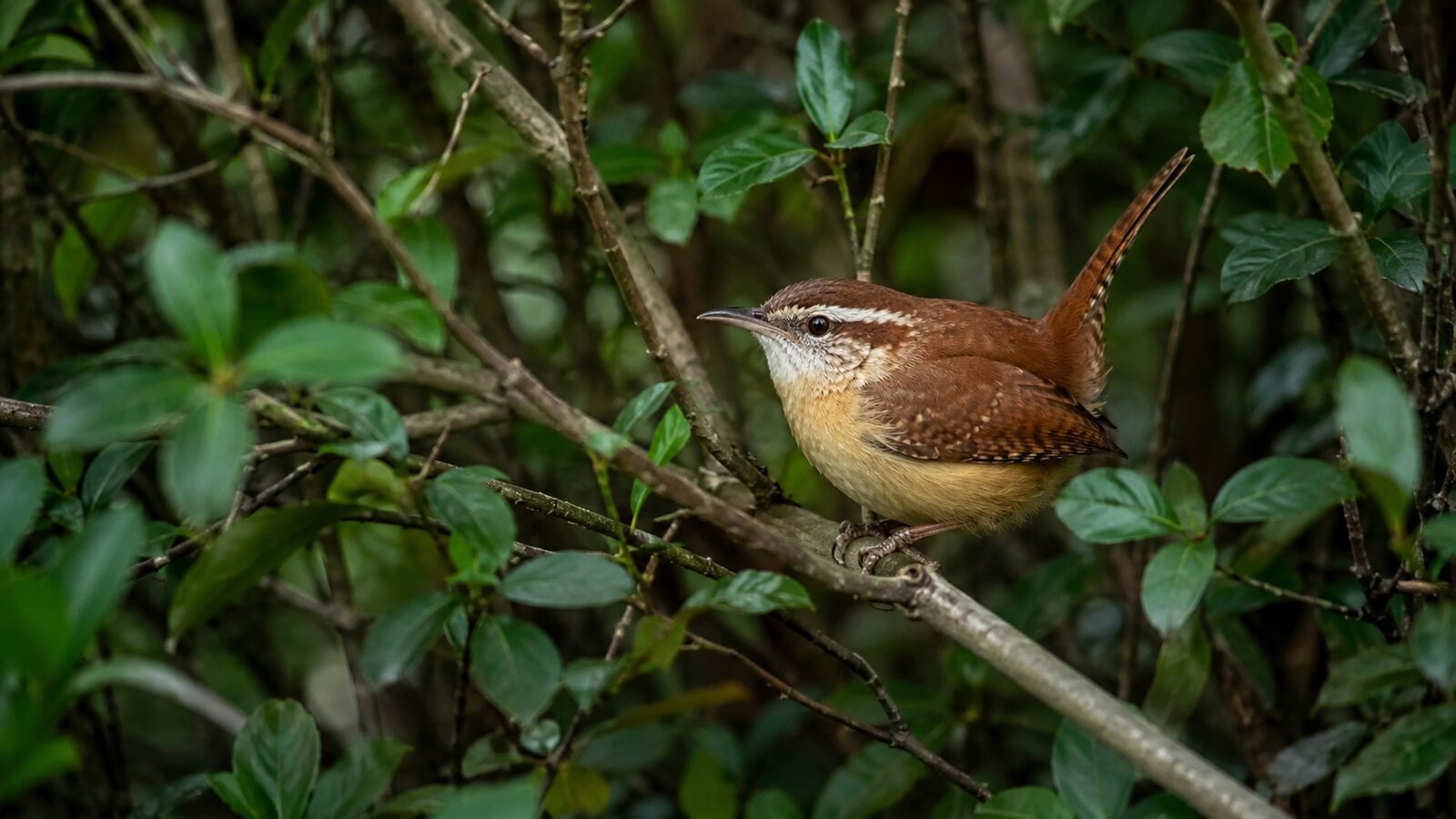
How to identify a Carolina Wren
Carolina Wrens have round bodies, large heads, long slightly downcurved bills, and long tails that are often cocked upward. The upperparts are reddish brown, while the throat is white and the belly is warm buff.
The white eyebrow is long and bold. Dark bars cross the wings and tail. Males and females look alike. Juveniles resemble adults but can appear softer and less sharply marked.
Size and similar wrens
Adults are about 12 to 14 cm long, with a wingspan around 29 cm. They are larger and heavier than House Wrens.
House Wrens are plainer brown and lack the bold eyebrow. Bewick’s Wrens have grayer underparts and more obvious white corners on the tail. Habitat, range, voice, and the exact face pattern help settle the identification.
What does a Carolina Wren sound like?
The male sings a strong series of repeated three-part whistles. People often hear it as tea-kettle, tea-kettle, tea-kettle. Different males use many variations.
Pairs also give chatter, scolding notes, and other calls. The voice can sound much too large for the bird.
What do Carolina Wrens eat?
Most food is insects and spiders found in bark, leaf litter, vines, and low tangles. They also take small frogs, lizards, berries, and other foods at times.
Carolina Wrens may visit feeders for suet, peanut pieces, and sunflower chips, especially in cold weather. See which birds eat suet and the backyard bird seed guide.
Range, habitat, and winter survival
Carolina Wrens are year-round residents across the southeastern United States and much of the East. They have expanded northward but can lose ground after severe winters.
Look in brushy woods, vine tangles, forest edges, parks, and wooded neighbourhoods. Dense cover close to the ground is a strong clue.
Nesting around homes
Carolina Wrens use natural cavities and sheltered spaces. Around homes they may nest in flowerpots, shelves, mailboxes, boots, or other tucked-away places.
The nest is a domed mass of leaves, grass, bark, and other material with a side entrance. A clutch commonly contains four to six eggs. Check before moving stored items during nesting season.
Frequently asked questions
Do Carolina Wrens visit bird feeders?
They sometimes visit for suet, peanut pieces, and sunflower chips, especially where dense cover is nearby.
Do female Carolina Wrens sing?
Males give the familiar loud song. Females make calls and often join their mates in coordinated vocal exchanges.
Do Carolina Wrens migrate?
No regular long-distance migration occurs. Most remain in their territories throughout the year.
More familiar birds
Use the House Wren vs Carolina Wren comparison, then browse Common Birds or Backyard Birds.