
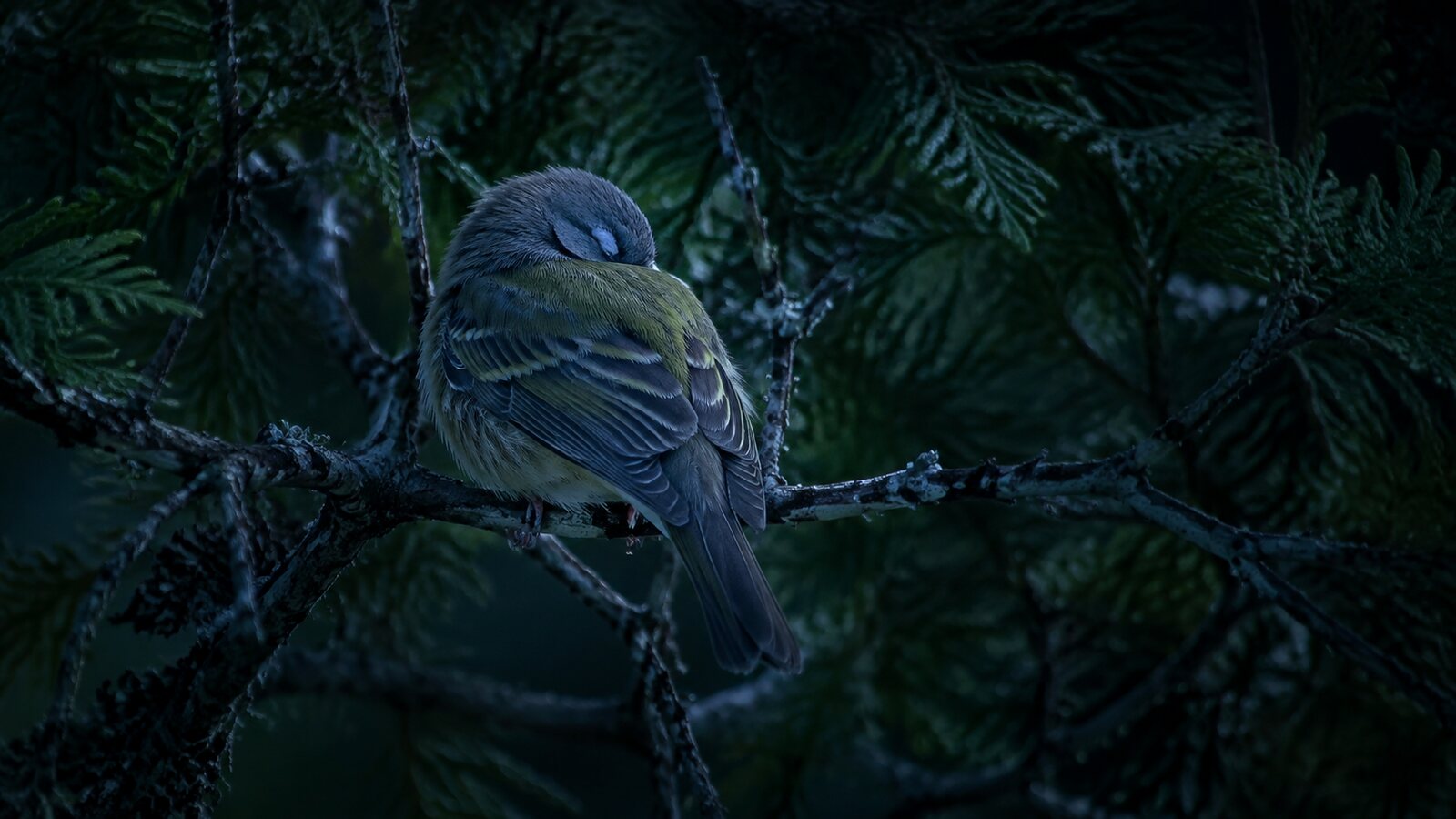
First, birds really do sleep
It sounds obvious, but bird sleep is stranger than it first appears.
Most birds sleep every day. Some tuck their bills into back feathers. Some roost in cavities. Ducks may sleep in groups on water. A few species can rest one side of the brain more deeply while the other side stays more alert.
Then there are birds that sleep in very short bursts, and seabirds that can sleep while flying.
If you are wondering about the physical locations, start with where birds sleep at night. This page is about what may be happening inside the brain once they get there.
Do birds have REM sleep?
Yes.
REM stands for rapid eye movement. It is one of the sleep stages most closely associated with vivid dreaming in people. Birds also show REM sleep, although their sleep architecture is not identical to ours.
Research on zebra finches has recorded slow-wave sleep, REM sleep, and an intermediate stage. The amount of each stage changes through the night.
So the old idea that complex sleep belongs only to mammals does not hold up very well.
Does REM sleep prove birds dream?
No.
This is the important distinction. REM sleep gives scientists a reason to ask about dreaming. It does not let us climb inside the bird's experience.
With a person, a sleep researcher can wake someone during REM sleep and ask what was happening. A zebra finch cannot answer that question.
That leaves scientists studying brain activity, body movement, sleep stages, learning, and behaviour before and after sleep. We can get close to the machinery. The subjective experience remains out of reach.
Do songbirds replay songs while they sleep?
This is where the question gets especially interesting.
Songbirds learn complicated vocal patterns. Young birds listen to tutors, practise, make mistakes, sleep, and practise again.
Studies of zebra finches have found activity in song-related brain circuits during sleep. Research has also shown that sleep affects how young birds develop their songs.
It is tempting to picture a young finch dreaming about yesterday's singing lesson.
Maybe it is. We just cannot say that with certainty.
Could a bird dream about places?
Possibly.
Birds remember locations. Chickadees keep track of hidden food. Migrants navigate over huge distances. Pigeons can learn complex visual information. Crows remember people.
Sleep helps animals process memory. That raises an interesting question: could a sleeping bird be replaying places, routes, calls, or social experiences in some form? We do not yet know.
Again, the evidence tells us about neural processing. It does not give us a little movie of the bird's dream.
Do birds twitch in their sleep?
They can.
Small movements, changes in posture, eye movements, and muscle activity can occur during sleep. Young animals in many groups are especially active sleepers.
A twitching bird is not automatically having a nightmare. Sleep contains several changing brain and body states, and movement by itself tells us very little about dream content.
Can birds have nightmares?
We do not know.
If birds have subjective dreams, unpleasant dreams are possible. But there is no good way to ask a wild bird what frightened it while asleep.
That is a good place to resist the urge to turn an interesting possibility into a fact. The unknown part is still unknown.
Can birds sleep with one eye open?
Some can.
Birds are capable of unihemispheric slow-wave sleep, which means one side of the brain can be in a deeper sleep state while the other remains more alert. The eye connected mainly with the more alert hemisphere can stay open.
This gives a bird a way to rest while keeping some watch for predators or changes around it.
It sounds like a superpower. For a duck sleeping near danger, it is simply practical.
Do all birds sleep the same way?
Not even close.
A chickadee roosting in a cavity, a duck sleeping in a flock, an owl resting through daylight, and a frigatebird taking brief sleep during flight live very different lives.
Sleep patterns reflect those lives. Predation risk, migration, breeding, age, habitat, and whether a species is active by day or night can all change when and how it sleeps.
That also means we should be cautious about taking findings from one laboratory species and assuming every bird dreams the same way.
Does sleep help birds learn?
Yes, there is strong evidence that sleep is involved in learning and memory in birds.
Song learning provides one of the clearest examples. Young zebra finches do not simply practise continuously toward a finished song. Their performance changes across sleep and waking periods, and those overnight changes appear to be part of the learning process.
That is fascinating even if we never learn whether the bird experiences a dream at all.
What might birds dream about?
This is where science has to hand the question back to imagination.
Food? A mate? A rival? Yesterday's song? A hawk?
We do not know.
What we do know is that birds remember, learn, recognize, navigate, and process complicated sensory information. Their sleeping brains are not simply switched off.
Sleep can get stranger still. Researchers have directly recorded Great Frigatebirds sleeping in flight.
Frequently asked questions
Do birds dream?
They may. Birds have REM sleep and show sleep-related brain activity tied to learning, but scientists cannot directly confirm a bird's subjective dream experience.
Do birds have REM sleep?
Yes. REM sleep has been recorded in many birds and studied in detail in zebra finches.
Do birds dream about singing?
Sleeping songbirds show activity in song-related brain circuits. It may be a form of neural replay, but we cannot say what the bird consciously experiences.
Can birds sleep with one eye open?
Some birds can keep one hemisphere more alert while the other sleeps more deeply, allowing one eye to remain open.
The most interesting answer is still "we don't know"
Bird sleep gives us plenty of reasons to think dreaming is possible. It just does not give us the bird's side of the story.
Continue with where birds sleep, how smart birds are, or return to Bird Facts.