
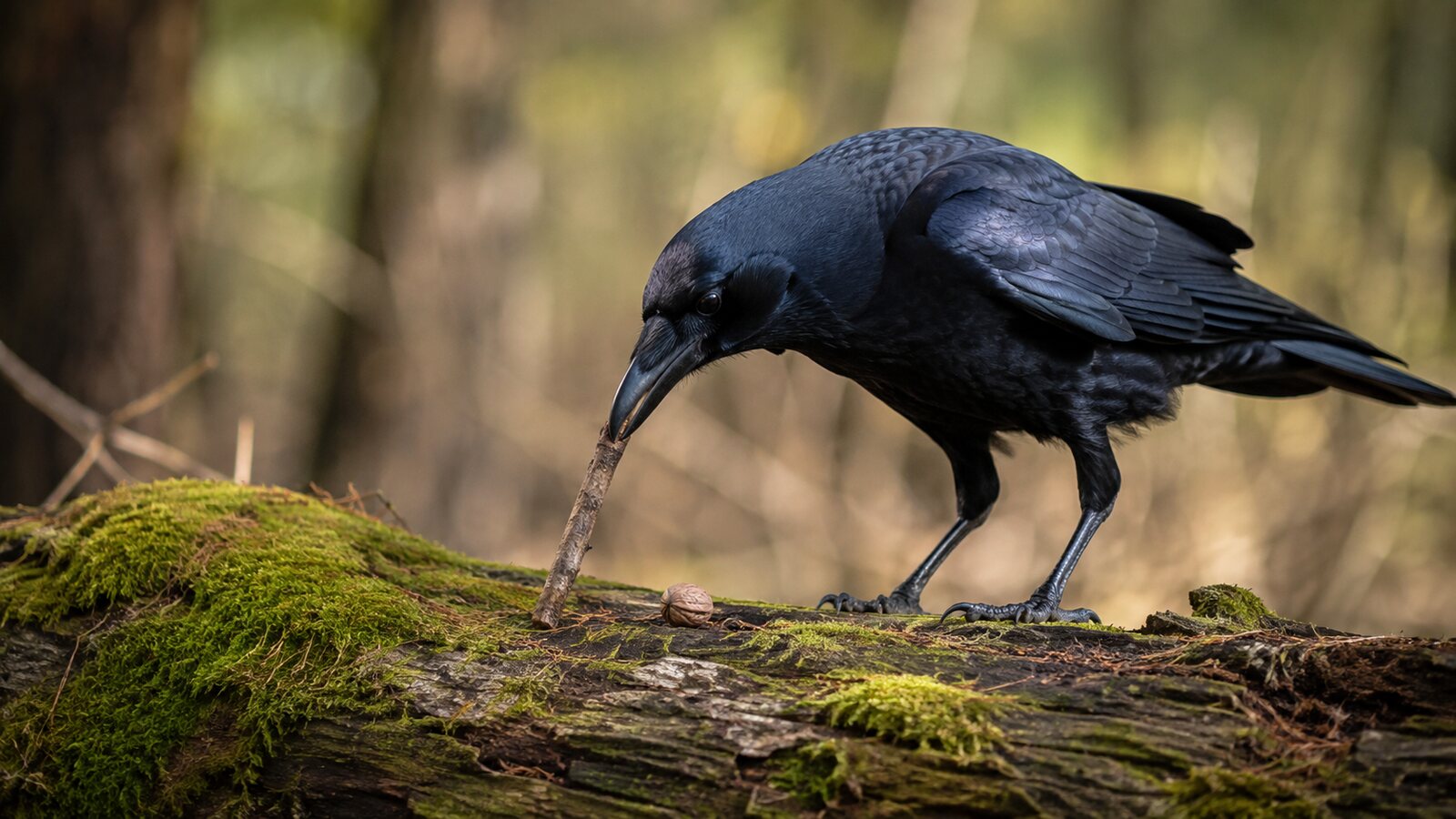
“Bird-brained” did not age very well
For a long time, people assumed a small brain meant limited intelligence.
Birds kept ruining that idea.
Crows solved puzzles. Parrots learned labels for colours and shapes. Jays remembered what kind of food they had hidden and where they put it. Pigeons distinguished huge numbers of visual patterns. Hummingbirds kept track of changing nectar sources.
Scientists also learned more about the structure of bird brains. They are not miniature mammal brains, and comparing size alone misses a lot.
Bird brains can pack in a lot of neurons
A 2016 study examined neuron numbers in 28 bird species. Songbirds and parrots had very high neuron densities, with large corvids and parrots packing forebrain neuron counts comparable to some primates with much larger brains.
That does not mean a crow is simply a tiny monkey with feathers.
It means physical brain size is a poor shortcut for intelligence. Evolution found a different way to build a capable information-processing system.
What counts as intelligence in a bird?
That question is harder than it sounds.
Scientists test bird intelligence in several ways. They look at problem solving, memory, learning, tool use, counting, self-control, social skills, and whether a bird can apply what it learned to a new task.
No species wins every category.
A bird that remembers hundreds of food caches may be astonishing at spatial memory and ordinary at a different laboratory puzzle. Intelligence is shaped by what the animal actually needs to do.
Are crows smart?
Very.
Crows and their relatives, the corvids, are among the best-studied intelligent birds. They solve novel problems, learn from one another, remember people, and adjust behaviour when circumstances change.
American crows have even been shown to remember human faces associated with danger. You can read more in do birds recognize people?
Other corvids are impressive too. Ravens, jays, and magpies have all played important roles in bird-cognition research.
Crows and ravens are close relatives but not the same bird. Our crow vs raven page shows the easiest field clues.
How smart are parrots?
Parrots changed the conversation about bird intelligence.
The best-known example is Alex, an African Grey Parrot studied for decades by researcher Irene Pepperberg. Alex learned labels for colours, shapes, materials, quantities, and other concepts. The point was not that he could imitate human sounds. Parrots have always been famous for that.
The interesting part was whether he understood something about what those labels meant.
Research with Alex and other parrots showed abilities that were once expected mainly from primates.
Can birds use tools?
Some can, and a few are excellent at it.
New Caledonian Crows are famous tool users. They shape sticks and plant material to reach food in places their bills cannot access directly. Other birds use bait, probes, or objects in simpler ways.
Tool use is not the only sign of intelligence, but it is easy to appreciate because we can watch the problem unfold.
A bird faces an obstacle. It changes the environment. Food appears.
Tool use is one kind of solution. The guide to how birds solve problems also looks at trial and error, social learning, persistence, and the limits of what a successful puzzle tells us.
Can birds count?
Some birds can distinguish quantities and learn numerical order.
Pigeons, parrots, and corvids have all been used in number-related studies. Researchers have tested whether birds can choose the larger group, learn a sequence, or match a particular quantity.
We should be careful about saying a pigeon “does math” in the same way a person does. Still, the ability to process numerical information is real.
Do birds have good memories?
Some have extraordinary memories for the things that matter to them.
Food-storing birds are the obvious example. Chickadees and jays hide food in many locations and later retrieve it. Their memory is not just a party trick. It is dinner.
Birds also remember migration routes, nest areas, social partners, threats, and productive feeding sites.
The broader guide to what birds remember covers routes, songs, places, threats, and familiar individuals. For the backyard version, see how birds remember feeders.
Can birds learn from other birds?
Yes.
A bird does not need to discover every danger or food source by itself. Watching flockmates can provide information. Alarm behaviour spreads. Young birds learn songs. Social species observe how others respond to unfamiliar situations.
Crow face-recognition experiments are especially interesting here because reactions to dangerous people can spread socially through a local population.
Can birds plan ahead?
Some experiments suggest that certain birds can make decisions that involve a future need rather than only an immediate reward.
Research with corvids has been important in this area, although scientists debate exactly what mental process different tasks demonstrate.
That debate is healthy. Animal cognition is easy to oversell.
A clever result is more interesting when we describe exactly what the bird did instead of turning it into “this raven thinks just like a person.”
Which bird is the smartest?
There probably is not a fair single answer.
Crows, ravens, jays, magpies, and parrots belong near the top of almost any conversation about advanced bird cognition. Pigeons are far more capable than their reputation suggests. Chickadees are memory specialists. Some woodpeckers, herons, gulls, and other birds show remarkable innovation too.
The test matters.
Ask a chickadee to remember dozens of tiny food locations and it may look brilliant. Ask the same bird to solve a task designed around parrot manipulation and you are measuring something else.
Are bigger birds smarter?
Not necessarily.
Absolute brain size is only part of the story. Neuron number, neuron density, brain organization, life history, social complexity, development, and the demands of a species' environment all matter.
A Black-capped Chickadee weighs about as much as a few coins and still performs memory feats that would be extremely inconvenient for me before my first coffee.
Do intelligent birds get bored?
In captivity, cognitively complex birds can need substantial mental stimulation. That is well known with parrots and corvids.
For wild birds, life itself supplies constant decisions: where to feed, when to hide, what to avoid, whom to follow, where to sleep, and how to respond when conditions change.
Watching those decisions is one reason birding never gets old. A common bird can still do something you did not expect.
Do birds dream because they are intelligent?
Those are separate questions, but they meet in interesting ways.
Birds have REM sleep, and sleeping songbirds show neural activity connected with learned song. Sleep also supports memory and learning.
Whether birds consciously experience dreams is still unknown. See do birds dream?
Frequently asked questions
How smart are birds?
Bird intelligence varies widely, but some birds show impressive problem solving, memory, tool use, counting, social learning, and recognition abilities. Corvids and parrots are especially well studied.
What is the smartest bird?
There is no single scientific winner because intelligence has many forms. Crows, ravens, jays, magpies, and parrots consistently perform well in cognition studies.
Are crows smart?
Yes. Crows can solve unfamiliar problems, remember human faces, learn socially, and in some studies show sophisticated reasoning.
Are bird brains really small?
Many bird brains are physically small, but songbirds and parrots can pack very high numbers of neurons into that space. Brain size alone does not tell us how capable a bird is.
A small head can hold a lot
That sparrow outside may not solve a crow puzzle. It does not need to.
Bird intelligence comes in many forms, shaped by the problems each species faces. Continue with bird memory, bird problem-solving, recognition of people, or return to Bird Facts.