
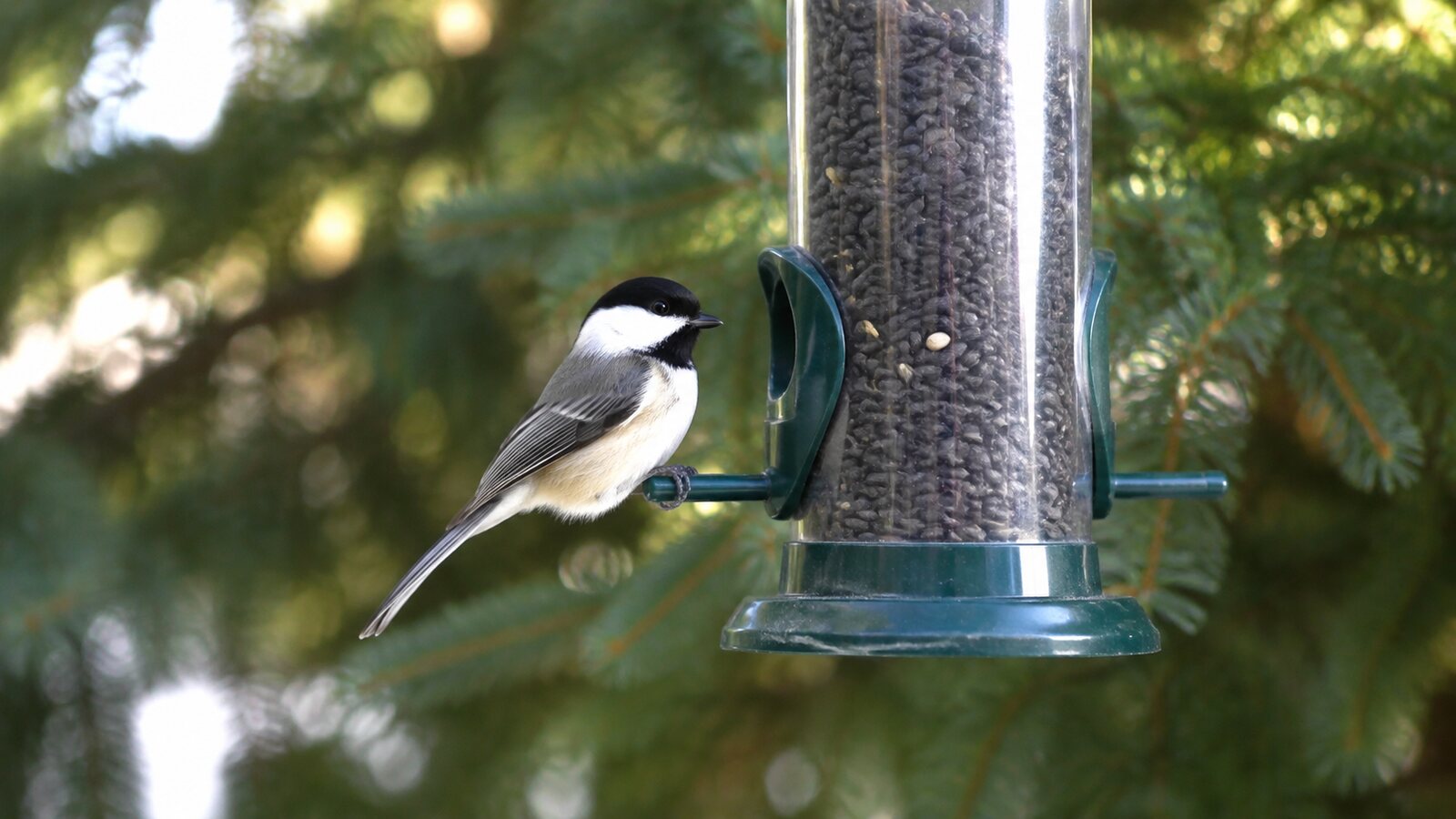
A feeder becomes part of the neighbourhood
Put up a new feeder and nothing may happen for a while. Then one chickadee finds it.
After that, things can change quickly.
Birds revisit places where they have found food before. They also watch other birds. A feeder that stays clean and stocked becomes one predictable stop among many natural feeding sites.
That does not mean every bird visits on a fixed schedule. Wild birds move through a landscape full of changing choices. Your feeder is one of them.
How do birds remember where a feeder is?
Spatial memory is a big part of the answer.
Birds can learn the relationship between a food source and the landmarks around it: a fence, tree, house, hedge, deck, or other familiar feature. They do not need a street address. The landscape itself provides clues.
Researchers studying food-caching birds have shown just how precise avian spatial memory can be. Black-capped Chickadees, for example, hide food in many separate places and later retrieve it. Their brains are built for keeping track of locations that matter.
A backyard feeder is a much easier problem than hundreds of tiny seed caches.
Those two memory jobs are related but distinct. See how birds remember hidden food for caching, landmarks, cache theft, and forgotten seeds.
Do chickadees remember feeders?
Very likely, and chickadees are a great species to think about when talking about bird memory.
They naturally cache food. A chickadee may take a seed, fly off, hide it, and return later. Studies of chickadee memory show that they remember where food has been stored and use those memories flexibly when hiding and retrieving more food.
That ability makes a fixed backyard feeder easy to incorporate into the bird's regular route.
Chickadees also tend to investigate new objects readily. Often they are among the first birds to find a feeder, and other species may follow their activity.
How long do birds remember a bird feeder?
There is no universal number of days or months.
Different birds have different memory systems, and the importance of a place matters. A feeder used every day for an entire winter is not the same as one a migrant visited twice in September.
What we can say is that bird memory can last far longer than a few minutes. Food-caching species remember many locations, migrants return to seasonal areas, and some crows remember human faces for years.
Bird memory is not one thing. It is shaped around the problems each species needs to solve.
Do birds know when you refill the feeder?
They can learn your routine.
If the feeder is filled at roughly the same time each day, birds may start appearing when they hear or see the usual cues. The back door opens. A seed container rattles. You walk toward the same corner of the yard.
Eventually, those events can predict food.
That is one reason birds sometimes seem to be waiting for you. They may not understand a clock the way we do, but they are very good at learning patterns.
Some may also learn the people involved. See do birds recognize people?
Will birds find a feeder if I move it?
Usually.
A short move across the yard is generally easy for birds to discover, especially if the feeder remains visible. Moving it to the other side of the house can take longer because the birds are still checking the old location.
If you need to relocate a feeder, you can move it gradually or place it where birds travelling through the yard can see it. Nearby cover helps too, as long as the feeder is not tucked so deeply into shrubs that birds miss it.
Our bird feeder placement guide covers the safety side of choosing a spot.
Do birds forget an empty feeder?
Not right away.
A familiar feeder may still get checked after it runs empty. But birds are practical. If nothing is there day after day, they will spend more time at places that are producing food.
That can make it look as though the birds have forgotten you. They probably have not. Their priorities have simply shifted.
Natural food changes with the season too. A quiet feeder in summer or early fall can be perfectly normal when insects, seeds, berries, and other food are plentiful elsewhere.
If activity suddenly drops, see why birds stopped visiting your feeder.
Will birds come back after a feeder has been gone?
Often, yes.
Resident birds may continue moving through the same territory even without the feeder. When it returns, they can rediscover it quickly. Migratory birds are less predictable because they may be somewhere else entirely when you put the feeder back.
A clean feeder with fresh seed has a better chance of holding attention once birds return. Old, damp, or spoiled food can make a familiar feeder much less attractive.
Do birds tell other birds about feeders?
Not in the human sense of giving directions.
But birds absolutely watch one another.
A small group dropping repeatedly into one yard is a visual clue. Calls and flock movement can bring more birds into the area. Some species travel in groups, so when one individual finds food, nearby flockmates are already close enough to notice.
This is especially obvious in winter mixed flocks. A few chickadees can bring nuthatches, kinglets, or woodpeckers along through the same patch of habitat.
Can moving a feeder confuse birds?
For a little while, perhaps.
Birds that have learned the old location may continue landing nearby or looking toward the missing feeder. That is exactly what you would expect from an animal using memory.
They also update. Once the new location starts paying off, it becomes part of the new map.
Do hummingbirds remember feeders too?
Yes. Hummingbirds repeatedly visit profitable flowers and feeders and can be extremely persistent about a good food source.
Their feeding lives depend on tracking many small nectar sources that change through the day and season. A sugar-water feeder in a fixed location is memorable.
If hummingbirds suddenly disappear, memory is rarely the whole explanation. Migration, nesting, natural flowers, insects, territorial behaviour, nectar freshness, and feeder placement can all affect visits. See why hummingbirds are not visiting your feeder.
Does a feeder make birds dependent on people?
For most common backyard birds, feeders are one food source among many.
They continue searching trees, shrubs, lawns, seed heads, bark, flowers, and other natural places. Even regular feeder visitors can disappear for stretches when wild food is abundant.
Remembering a feeder is not the same as being unable to survive without it.
Frequently asked questions
Do birds remember bird feeders?
Yes. Many birds remember reliable food locations and use spatial memory, landmarks, and repeated experience to return to feeders.
How long do birds remember a feeder?
There is no single time limit for all birds. Memory varies by species and situation. Food-caching birds such as chickadees have especially strong spatial memory for food locations.
Will birds find a feeder if I move it?
Usually, especially if the move is short and the feeder remains visible. A large move may take longer because birds have learned the old location and surrounding landmarks.
Do birds forget a feeder if it is empty?
Not immediately. Birds may keep checking a familiar location for a while, but they will spend more time elsewhere if the feeder stays empty and other food is available.
Your feeder is one stop on a much bigger map
Birds remember where food has paid off before. Then they keep checking the rest of the neighbourhood too.
Continue with what birds remember, whether birds recognize people, memory for hidden food, or return to Bird Facts.