
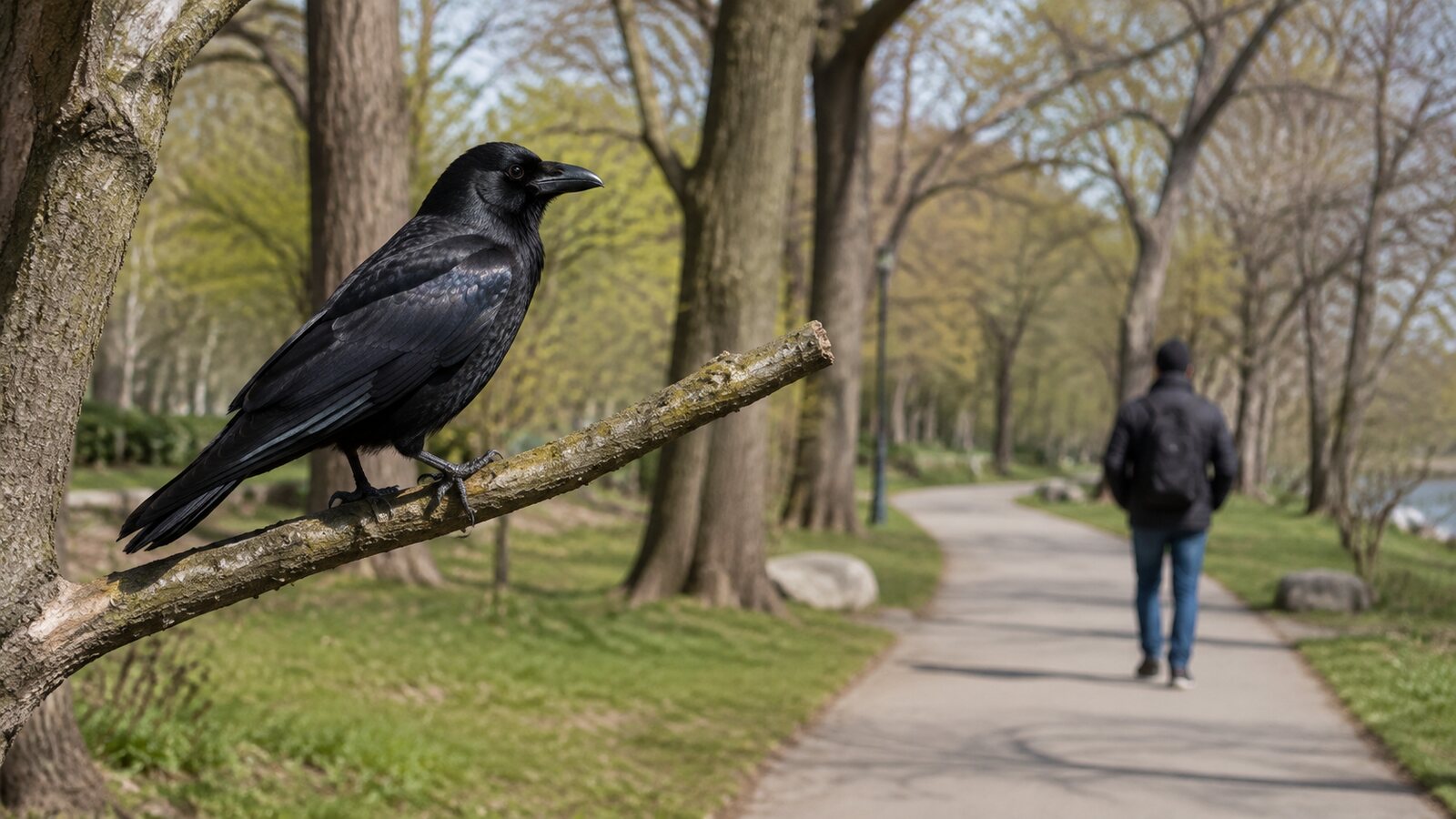
Crows made this question much easier to answer
For years, people who worked around crows had the same feeling: these birds seemed to know exactly who had bothered them.
Researchers at the University of Washington put that idea to a real test. They wore distinctive masks while trapping and banding wild American crows. Later, people wearing the same threatening masks walked through the area without trapping anything.
The crows reacted.
They scolded, mobbed, and paid much more attention to the face associated with the earlier capture. Neutral masks did not get the same response. Follow-up work showed that the reaction could last for years.
Northern Mockingbirds have also learned to distinguish individual people who repeatedly approached their nests. These controlled studies are stronger evidence than a backyard impression that a bird seems to know someone. They show that at least some familiar North American species can learn about particular humans.
Do birds recognize your face or your routine?
Possibly both.
Recognition does not have to work exactly the way it does for us. A bird can combine several clues. Your face may matter. So can the way you walk, the door you come through, the time you appear, the bucket in your hand, or the sound of the feeder lid opening.
If you fill a feeder at roughly the same time every morning, local birds have plenty of chances to learn the pattern. They may arrive before you finish. That does not prove every chickadee is studying your face, but it does show how quickly birds can connect a person or routine with food.
For more on remembering food locations, see do birds remember bird feeders?
Do birds know who feeds them?
Many birds can learn that a person is connected with food.
Think about what happens around a busy backyard. The feeder hangs in the same place. The same door opens. A person steps outside. Seed appears. Birds that watch from nearby trees get repeated chances to connect those events.
That kind of learning is basic survival. Wild food is not evenly spread around the landscape, and reliable sources are worth remembering.
Some birds may become surprisingly relaxed around a familiar person. Others never do. Individual temperament matters, and so does the species.
Can chickadees recognize people?
Chickadees are bright little birds with excellent spatial memory, especially when it comes to finding food they have hidden. Backyard observers often report that chickadees become comfortable with familiar people and routines.
That does not mean we have the same kind of face-recognition evidence for chickadees that we have for crows. It is safer to say they can learn familiar situations and may distinguish people using several cues.
There is no need to make the claim bigger than the evidence. Chickadees are impressive enough already.
Do hummingbirds recognize people?
Hummingbirds can learn feeder locations and become accustomed to the people who maintain them. Anyone who has refilled a popular hummingbird feeder has probably had a bird hover nearby as if the service is taking far too long.
That behaviour tells us the bird understands the feeder, the place, and the routine. Whether a particular hummingbird is recognizing your face, your shape, your movement, or the whole combination is harder to prove.
So yes, a hummingbird can become familiar with you. Just be careful with the stronger claim that it knows your face in the same tested way a crow does.
Do birds remember people who scared them?
Crows certainly can.
The University of Washington work is interesting because the birds were not simply reacting to a person who was actively chasing them. They remembered the visual cue tied to the original bad experience.
That makes sense from a survival point of view. If an animal has already learned that one individual is dangerous, forgetting immediately would be costly.
Other birds can also learn to avoid places, objects, predators, and situations that have frightened them. How long that memory lasts depends on the species and the strength of the experience.
Can birds tell a friendly person from an unfriendly one?
Sometimes, but birds are not reading character.
They are learning from experience. A person who repeatedly fills a feeder creates a very different history from someone who repeatedly approaches a nest too closely or tries to catch a bird.
Over time, that history can change the bird's response.
It is tempting to turn this into a story about birds knowing who is "good" or "bad." The simpler explanation is better. Birds remember what happened around certain people and adjust their behaviour.
Do birds recognize voices?
Some birds are very good at distinguishing sounds, including individual calls from members of their own species. Birds that live around people also hear our voices constantly.
It is reasonable that voice can become one cue among several, especially for birds that have repeated contact with the same humans. Domestic and captive birds provide obvious examples. In wild birds, the evidence varies by species.
Faces get most of the attention because crow experiments are so memorable. Sound belongs in the conversation too.
Can birds recognize themselves in a mirror?
That is a different question.
Recognizing a person is different from recognizing yourself in a mirror. Mirror self-recognition is a much narrower test, and the evidence in birds is mixed and complicated.
A robin or cardinal attacking a window reflection is not failing an intelligence test. During breeding season, the reflection can look like another bird inside its territory.
If that is happening at your house, see why a bird is attacking your window.
Why are crows so good at recognizing people?
Crows live long enough for memory to matter, and they have complicated social lives. They also share cities, campuses, parks, farms, and neighbourhoods with us.
Being able to sort harmless people from dangerous ones can save energy and reduce risk. Reacting to every person as a threat would waste time. Ignoring a genuinely dangerous person would be worse.
Crows also learn socially. One bird's alarm can influence others, which means information about a threat may spread beyond the individuals that experienced it first.
If you are hearing those neighbourhood calls yourself, our why do crows caw? page looks at what the birds may be communicating.
Our local crows learn the routine
Several generations of crows visit our home regularly. Robin has watched them learn feeding routines and investigate food hidden in simple dog puzzle toys. Individual birds approach differently, and their confidence can change with experience.
That is a personal observation, not a controlled test of face recognition. It fits the broader pattern, though: birds can connect people, places, objects, and repeated events. The focused guide to bird problem-solving looks at what a puzzle can and cannot show.
Does this mean every bird in your yard knows you?
No.
Some may barely notice you. Some may know your routine extremely well. A resident crow, chickadee, jay, or hummingbird that sees you repeatedly has a much better chance to learn about you than a migrant that passes through for a few days.
That variation is part of what makes backyard bird watching fun. The birds are not interchangeable. Neither are their experiences with us.
Frequently asked questions
Do birds recognize people?
Some birds can recognize individual people. American crows have been shown experimentally to remember human faces associated with danger, and familiar backyard birds may also learn to recognize people through appearance, behaviour, location, and routine.
Do birds know who feeds them?
Birds can learn that a particular person, place, or routine predicts food. Whether they identify the person by face alone varies by species and situation.
Can birds recognize human faces?
At least some species can. Research with American crows showed that they could distinguish and remember particular human faces for years.
Do birds remember people who scare them?
Some do. Crows are especially well studied and can remember people associated with threatening experiences long after the event.
Birds notice more than we give them credit for
You may be watching the birds in your yard. They may be watching you right back.
Continue with what birds remember, how birds remember feeders, how smart birds are, or return to Bird Facts.