
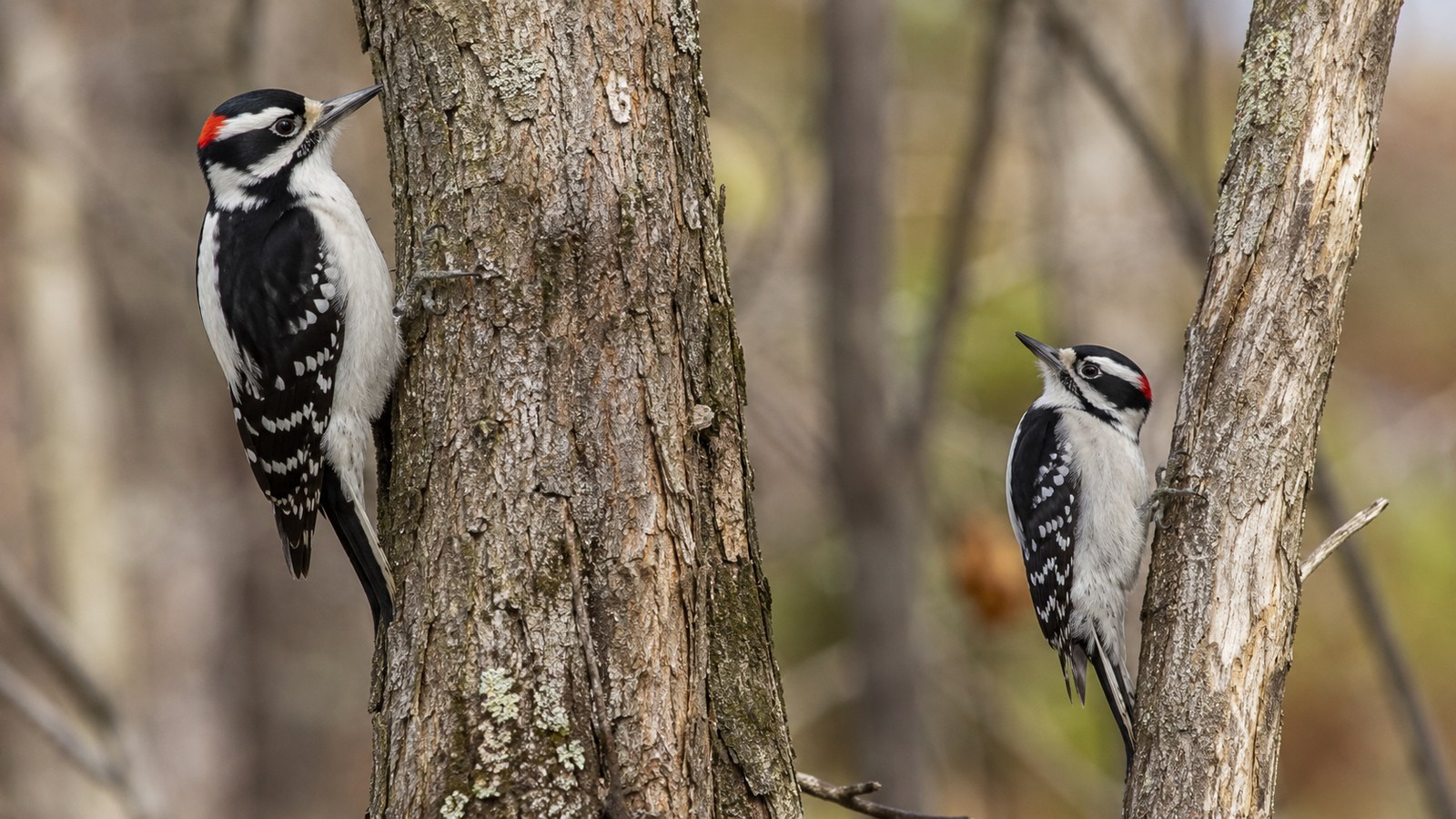
How to identify a Hairy Woodpecker
Hairy Woodpeckers have square-looking heads, stiff tails, and sturdy bodies built for climbing large trunks. The bill is nearly the length of the head and looks much more powerful than a Downy’s bill.
Eastern birds are crisp black and white with heavily spotted wings. Many western birds have less wing spotting, and Pacific birds can look brownish or smoke-stained below. Young males may show red on the crown rather than the back of the head.
Hairy Woodpecker vs Downy Woodpecker
A Hairy Woodpecker is roughly one-third larger than a Downy Woodpecker. Adults measure about 18 to 26 cm long, with a wingspan of 33 to 41 cm.
Bill proportion is the strongest close-range clue. Hairy bills are almost head length; Downy bills look short. Hairy outer tail feathers are usually plain white, while Downies often show black spots. See Downy vs Hairy Woodpecker before relying on size alone.
What does a Hairy Woodpecker sound like?
The call is a sharp, strong peek. It is lower and more forceful than the Downy Woodpecker’s call.
Hairy Woodpeckers also give a rapid whinny that stays on one pitch or drops only slightly. Their fast drum advertises territory and attracts a mate.
What do Hairy Woodpeckers eat?
More than three-quarters of the diet is insects, especially wood-boring beetle larvae, bark beetles, ants, and moth pupae. They also eat some fruit and seeds.
They visit feeders for suet and sunflower seed. A larger suet cage with a tail prop can be easier for them to use. Read which birds eat suet and which birds eat sunflower seed.
Range, habitat, and movement
Hairy Woodpeckers occur across much of North America in mature deciduous, coniferous, and mixed forests. They also use woodlots, parks, wooded suburbs, orchards, burned forest, and areas with bark-beetle outbreaks.
Most are year-round residents. Local movement may follow food supplies, but the species is not a regular long-distance migrant.
Nesting and behaviour
The pair excavates a cavity in a dead tree or dead section of a living tree, often where the wood has softened. A clutch usually contains three to six white eggs.
Hairy Woodpeckers work trunks and large branches, bracing with stiff tail feathers. They do not regularly use thin weed stalks and reeds in the way Downy Woodpeckers can.
Frequently asked questions
Do Hairy Woodpeckers visit feeders?
Yes. They take suet and sunflower seed, though they may be less frequent in small yards than Downy Woodpeckers.
Do female Hairy Woodpeckers have red heads?
Adult females lack the small red patch found on adult males. Juveniles can show red on the crown.
Do Hairy Woodpeckers migrate?
Most remain within the same broad area throughout the year.
More familiar birds
Compare Downy Woodpecker, Pileated Woodpecker, or use the guide to common backyard woodpeckers.