
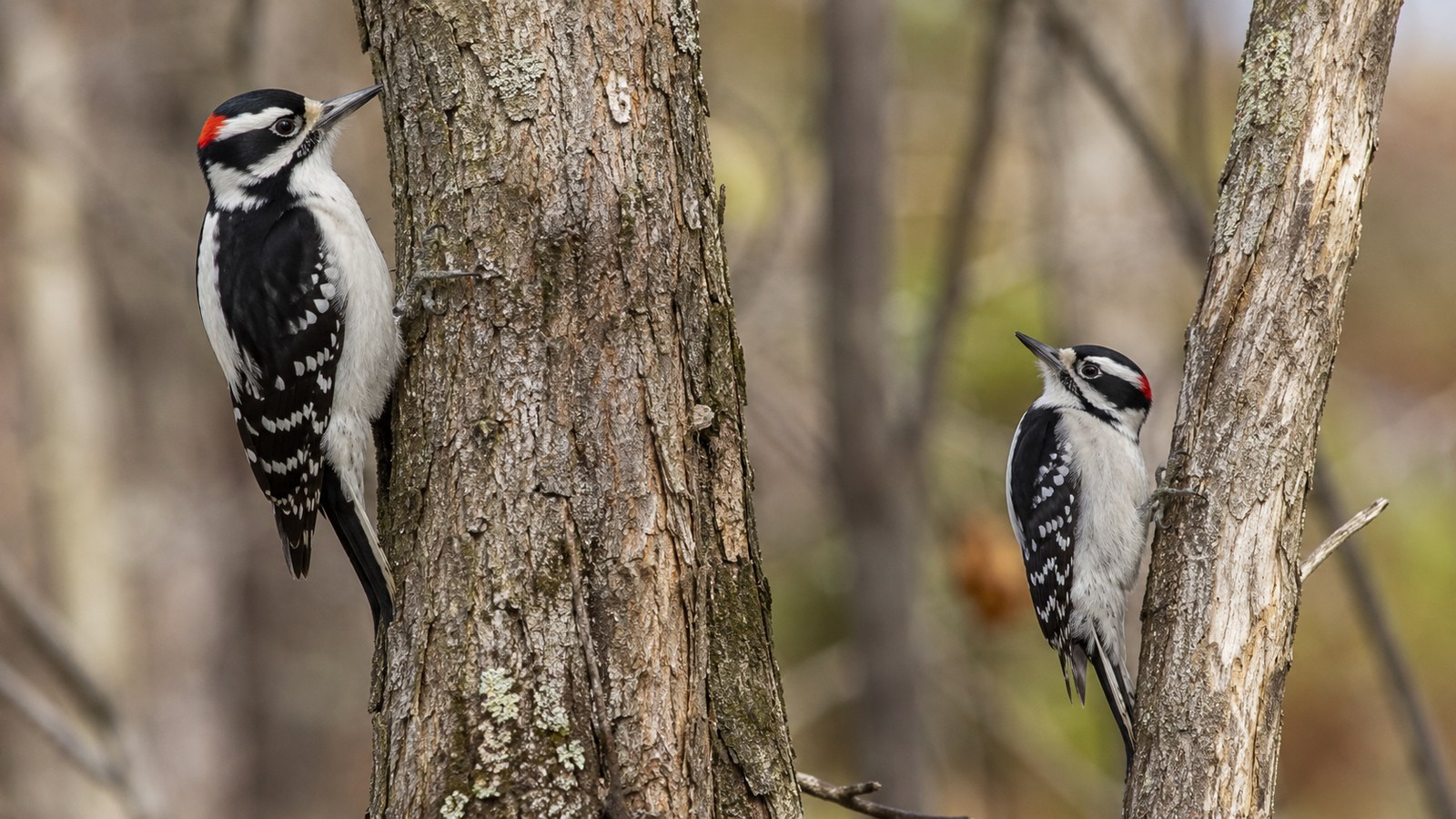
Why these two birds cause so much confusion
Downy and Hairy Woodpeckers share an unusually similar black-and-white pattern. Both have a white stripe down the centre of the back, white underparts, black wings marked with white, striped faces, and stiff tails. Adult males of both species usually have a small red patch at the back of the head.
The birds aren’t simply male and female versions of one species. They differ in size, bill proportion, voice, behaviour, and some tail details. A dependable identification comes from comparing several of those features rather than searching for a single perfect mark.
Downy Woodpecker vs Hairy Woodpecker comparison
| Feature | Downy Woodpecker | Hairy Woodpecker |
|---|---|---|
| Overall size | Small and compact | Noticeably larger and more substantial |
| Bill proportion | Bill much shorter than head length | Bill nearly as long as the head |
| Head impression | Small, gentle, and compact | Larger, squarer, and more powerful |
| Outer tail feathers | Often white with dark spots or bars | Usually clean white |
| Call | Softer, more delicate sharp note | Stronger, sharper, more forceful note |
| Long vocal series | Typically descends in pitch toward the end | More even or steady in pitch |
| Foraging position | Often small branches, twigs, shrubs, reeds, and weed stems | Often trunks and larger branches |
| Feeder impression | Small beside feeder ports and cages | Longer-bodied with a larger head and bill |
| Adult male | Small red patch at back of head | Small red patch at back of head |
| Adult female | No red patch | No red patch |
The bill-to-head comparison is the best starting point
Look at the bird from the side. Imagine the distance from the base of the bill to the back of the head. A Downy bill occupies only part of that distance and can look delicate or undersized. A Hairy bill extends much farther and looks like a strong chisel.
Don’t compare bill length when the bird faces directly toward or away from you. Foreshortening can make a long bill look short. Wait for a side view, take a photograph if possible, or use the next available clue.
Use size only when you have a reference
Hairy Woodpeckers are larger than Downy Woodpeckers, but a single bird on a distant trunk can be misleading. A small bird close to you may look larger than a bigger bird farther away.
Feeders create Sources and further reading. Compare the bird with the same suet cage, feeder roof, branch, or fence post. Downy Woodpeckers appear compact, while Hairy Woodpeckers look longer, heavier, and more powerful. Another familiar bird on the same feeder can also provide scale.
Outer-tail spots help but not mandatory
Downy Woodpeckers often have black spots or bars on the white outer tail feathers. Hairy Woodpeckers usually have clean white outer tail feathers. This difference can be excellent when the tail is spread, angled toward you, or photographed clearly.
Tail marks aren’t always visible. The white feathers may be hidden beneath central tail feathers, shaded by the body, worn, stained, or too distant to inspect. A Downy without visible spots isn’t automatically a Hairy. Return to bill proportion, size, voice, and behaviour.
Compare the head and body impression
A Downy Woodpecker often looks compact with a small head, rounded body, and short bill. The Hairy Woodpecker looks more angular, with a larger head, stronger neck, longer bill, and a body that appears stretched along the trunk.
Posture changes with movement. A fluffed Hairy can look round, and a stretched Downy can look long. Use the general impression only after watching the bird through several positions.
Listen to the single call
Both species give sharp calls, but the Hairy Woodpecker usually sounds stronger, more piercing, and more emphatic. The Downy Woodpecker often sounds softer and more delicate. Volume depends on distance, wind, and the bird’s direction, so tone and quality matter more than loudness alone.
Record several calls if possible. A phone recording made from a respectful distance can preserve rhythm and tone better than a written memory. Compare sound with range, habitat, and visual clues rather than accepting an automatic suggestion as proof.
Compare the whinny and rattle
Downy Woodpeckers give a descending series that tends to fall in pitch near the end. Hairy Woodpeckers produce a more forceful rattling series that stays more even. Hearing the entire phrase is better than hearing one or two notes.
Descriptions such as whinny, rattle, or roll are approximate. Focus on whether the series descends, how long it lasts, how fast the notes arrive, and whether the quality is soft or sharp.
Drumming can help too
Both species drum to communicate. A Hairy Woodpecker’s drumming can sound stronger because the bird is larger, while a Downy may produce a faster, lighter impression. The surface changes the sound dramatically. Metal flashing, a hollow limb, siding, or a resonant dead branch can amplify either bird.
Don’t identify the species from volume alone. Record the tempo, duration, number of bursts, habitat, and any visual evidence. Drumming is communication and doesn’t necessarily mean the bird is feeding on the surface.
Watch branch and trunk size
Downy Woodpeckers can use thin branches, small saplings, shrubs, reeds, and seed heads that wouldn’t comfortably support a larger woodpecker. They often appear nimble and may forage in mixed flocks with chickadees and nuthatches.
Hairy Woodpeckers commonly work larger branches and trunks in mature woodland, though they also visit feeders and smaller trees. Habitat and perch size are tendencies, not rules. Either species can appear in a backyard with suitable trees.
Compare feeder posture
At a suet cage, a Downy may fit neatly against the feeder and look small relative to the wire squares or roof. A Hairy often extends farther above and below the same feeder and may reach the food with a noticeably longer bill.
Photographs taken at a familiar feeder are especially valuable. Keep the feeder dimensions or manufacturer information if you use it as a size reference later.
Male and female markings
Adult males of both species usually have a red patch at the back of the head. Adult females lack the red patch. That difference identifies sex within a species, but it doesn’t separate Downy from Hairy.
The amount and shape of red can vary with angle and feather position. A hidden red patch doesn’t prove the bird is female. Bill, size, tail, and other clues remain necessary.
Juveniles can show red on the crown
Young Downy and Hairy Woodpeckers may show red on the crown rather than the neat adult male patch at the back of the head. Young females can also show crown colour. This can create confusion with other black-and-white woodpeckers or lead a beginner to expect an adult pattern.
During the breeding season, pay extra attention to bill proportion and body size. A crown patch is an age clue, not a separate species.
Regional variation matters
Downy Woodpeckers in parts of the Pacific Northwest can appear darker or dingier below than many eastern birds. Hairy Woodpeckers vary geographically in wing spotting, underpart colour, and size. Western birds can look less heavily spotted above.
The same clues work across Canada and the United States. Compare bill length and body size first. Then check the outer tail feathers and listen to the voice.
Don’t let a feeder label decide the bird
Both species may visit suet, sunflower, peanuts, or other suitable feeder foods. A bird on a small feeder isn’t automatically Downy, and a bird in mature woods isn’t automatically Hairy.
Food and setting change probability, but field marks must confirm the choice. Keep feeders clean and use photographs or notes to compare repeat visitors over time.
A seven-clue worksheet
| Clue | What to record |
|---|---|
| Bill | Much shorter than head, about half head length, or nearly as long as head |
| Size reference | Feeder, branch, fence post, nearby bird, or photograph with scale |
| Outer tail | Dark spots visible, clean white, hidden, or uncertain |
| Perch | Weed stem, twig, small branch, large branch, or trunk |
| Voice | Soft or sharp call, descending series, steady rattle, or not heard |
| Head | Red nape, no red, juvenile crown red, or uncertain |
| Context | Location, date, habitat, flock associates, feeder type, and behaviour |
When the identification should remain uncertain
A distant black-and-white woodpecker with a hidden bill and tail may not provide enough evidence. Record it as “Downy/Hairy Woodpecker” or “small black-and-white woodpecker” rather than forcing a species.
An honest uncertain record preserves the details. A later call, side view, photograph, repeat visit, or direct size comparison may settle the question.
More about Downy Woodpeckers
Once the identification points to Downy, continue with our full Downy Woodpecker species guide for calls, food, nesting, range, feeders, and lifespan.
Frequently asked questions
What is the best difference between a Downy and Hairy Woodpecker?
Bill proportion is the best starting clue. A Downy bill is much shorter than its head, while a Hairy bill is nearly as long as the head.
Do Downy Woodpeckers always show spots on the outer tail?
No. The spots may be hidden, faint, worn, or difficult to see. Their presence supports Downy, but their apparent absence doesn’t prove Hairy.
Are males and females different?
Adult males of both species usually have a small red patch at the back of the head. Adult females lack it. Juveniles can show red on the crown.
Can sound separate the two species?
Yes, as supporting evidence. Hairy calls are generally sharper and stronger, while Downy calls sound softer. The Downy’s longer series typically descends more clearly.
Full species guides
Continue with the Downy Woodpecker guide or Hairy Woodpecker guide.