
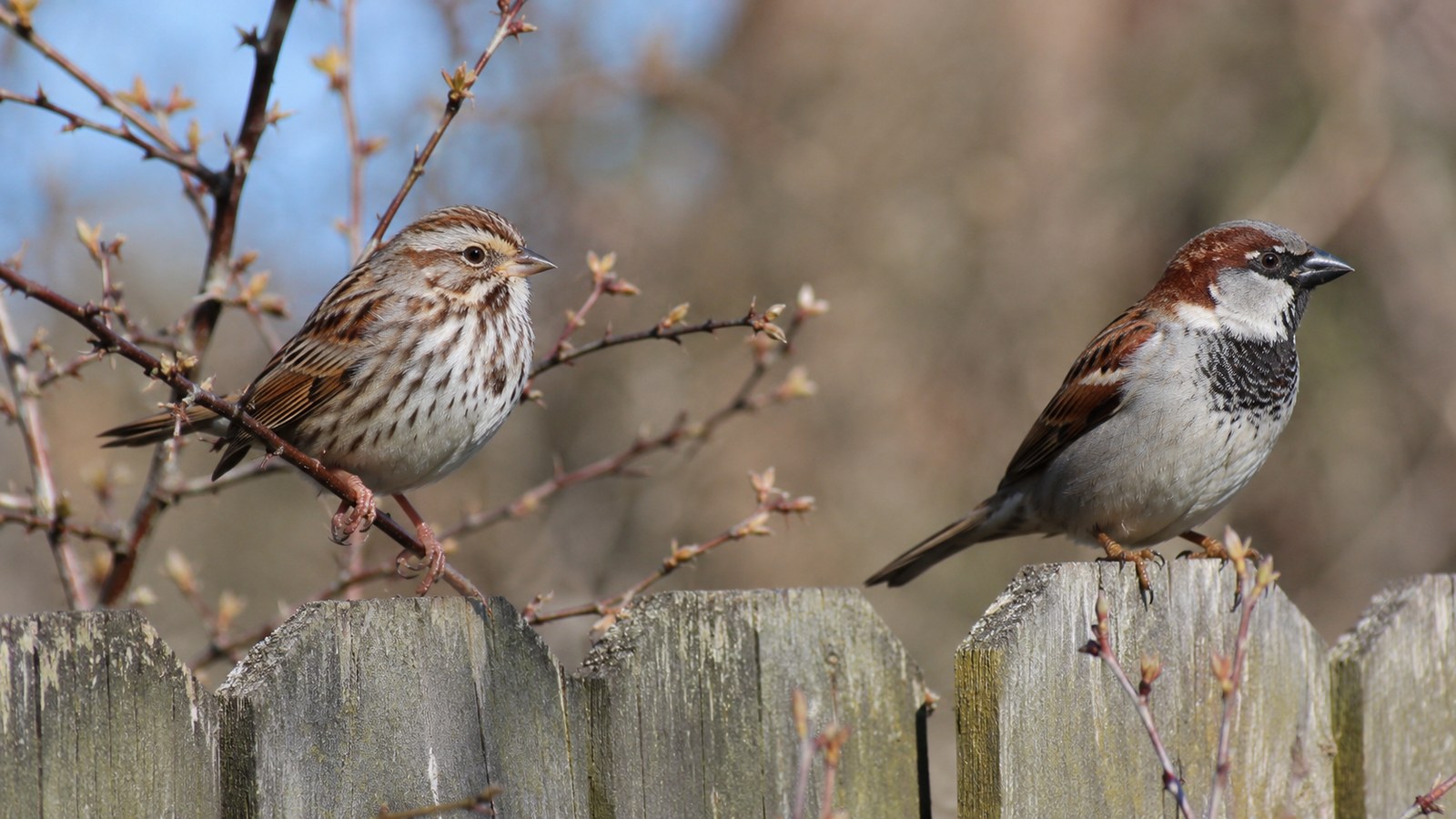
House Sparrow at a glance
Look for a chunky, full-chested sparrow with a large rounded head, stout seed-eating bill, and relatively short tail. Breeding males have a gray crown, white cheeks, chestnut around the head and neck, and a black bib. Females are plainer buff-brown with a pale eyebrow and mostly plain underparts.
How to identify a House Sparrow
Start with shape. House Sparrows look heavier and rounder than many native sparrows. The chest is full, the head is large and rounded, the bill is short and stout, and the tail looks relatively short.
That build can be more dependable than brown colour. Many small birds are brown, especially females and young birds. A stocky bird hopping under a restaurant table or flying into a hole behind a sign is already giving you two strong clues before you study the feathers.
What does a male House Sparrow look like?
A breeding male has a gray crown, pale cheeks, warm chestnut on the sides and back of the head, and a black bib running down the throat and upper chest. The back is streaked brown and black.
Outside peak breeding plumage, males can look duller and the black bib may seem less clean. Wear, season, lighting, and age change the first impression, so keep the stocky shape and heavy bill in the checklist.
What does a female House Sparrow look like?
Females are much plainer. They are buffy brown overall, with a pale eyebrow, streaked brown back, and dingy gray-brown or buff underparts. They do not have the male's gray crown, chestnut head pattern, or black bib.
A female is often confused with native sparrows or a female House Finch. Look at bill depth, body shape, breast pattern, tail length, and where the bird is spending its time.
How big is a House Sparrow?
Cornell lists a length of about 5.9 to 6.7 inches, a weight around 0.9 to 1.1 ounces, and a wingspan about 7.5 to 9.8 inches.
That is close to the general size of a Song Sparrow or Dark-eyed Junco, but the House Sparrow tends to look chunkier and shorter-tailed. Direct comparison at a feeder makes the difference much easier to see.
What does a House Sparrow sound like?
The voice is simple and repetitive. Males often give repeated cheep or chirrup notes around a nest site. Flocks can keep up a nearly constant background of chirps and chatter.
The sound is less varied than the full song of a Song Sparrow. When a brown bird is hidden in a hedge beside a building, that repeated cheeping can be a strong clue.
What do House Sparrows eat?
Seeds and grains make up much of the diet. Around people they also eat livestock feed, crumbs, discarded food, and many common feeder seeds. In summer they take insects too, and insects are important food for growing young.
Because they are comfortable around people, they can learn quickly where food is dependable. That is one reason they are so common around outdoor eating areas, barns, feed lots, and busy backyard feeders.
Where do House Sparrows live?
Buildings are the biggest habitat clue. House Sparrows thrive in cities, towns, suburbs, farmyards, barns, shopping areas, parks, and other places shaped by people. They are much less likely in large undisturbed forests or grasslands far from buildings.
In North America, this is an introduced species. Cornell notes that House Sparrows were released in Brooklyn, New York, in 1851 and spread rapidly. They are now common across most of the continent except Alaska and the far north of Canada.
Are House Sparrows native to North America?
No. House Sparrows are Old World sparrows and are not close relatives of native New World sparrows such as Song Sparrows, White-crowned Sparrows, and Dark-eyed Juncos.
The shared word sparrow can hide that family difference. If you are working through a mystery brown bird, our backyard sparrow guide sorts them by shape, breast pattern, head pattern, habitat, sound, and season.
How do House Sparrows nest?
They strongly favour cavities and sheltered spaces in human structures. Eaves, wall gaps, signs, light fixtures, barns, and nest boxes can all become nest sites. The nest itself is a bulky collection of dry vegetation and other available material.
Cornell lists clutches from one to eight eggs and multiple broods in a year. A productive pair can therefore put a lot of effort into one nesting area over a season.
Do House Sparrows compete with native birds?
Yes. They can be aggressive around nest holes and nest boxes and may displace native cavity nesters. That is one reason bluebird and Tree Swallow nest-box programs monitor boxes rather than putting them up and forgetting about them.
If your goal is to support a native cavity-nesting species, use a box design and monitoring routine recommended for that species and your region. Avoid turning a nest box into an unmanaged competition site.
House Sparrow vs Song Sparrow
A Song Sparrow usually looks longer-tailed and shows heavy dark streaks on a pale breast, often gathering near the centre. A House Sparrow is stockier, with a deeper bill and shorter-looking tail. Adult male House Sparrows have the obvious black bib; females are mostly plain below.
Habitat helps too. House Sparrows crowd around buildings and busy human spaces. Song Sparrows are more often tied to shrubs, brush, wet edges, gardens, and low cover. The Song Sparrow vs House Sparrow page compares the two directly.
How long do House Sparrows live?
Cornell reports an oldest recorded House Sparrow of at least 15 years and 9 months. Most wild birds will not reach that age, but the record shows that an individual can survive many breeding seasons.
Frequently asked questions
Is a House Sparrow a true sparrow?
It is a sparrow, but it belongs to the Old World sparrow family. It is not closely related to native New World sparrows such as Song Sparrows and White-crowned Sparrows.
How can I tell a female House Sparrow from a Song Sparrow?
Female House Sparrows are stocky with a stout bill, pale eyebrow, plain buff underparts, and a shorter-looking tail. Song Sparrows normally show obvious coarse streaking across the breast and a longer rounded tail.
Do House Sparrows migrate?
Most North American House Sparrows stay close to the same developed areas year-round rather than making long seasonal migrations.
Why are House Sparrows always around buildings?
The species has lived closely with people for centuries. Buildings provide cavities and ledges for nesting, while farms, streets, patios, and feeders provide dependable food.
More familiar birds
Compare the Song Sparrow and House Sparrow, work through the common backyard sparrow guide, or continue with the House Finch, another familiar bird around homes and feeders.