
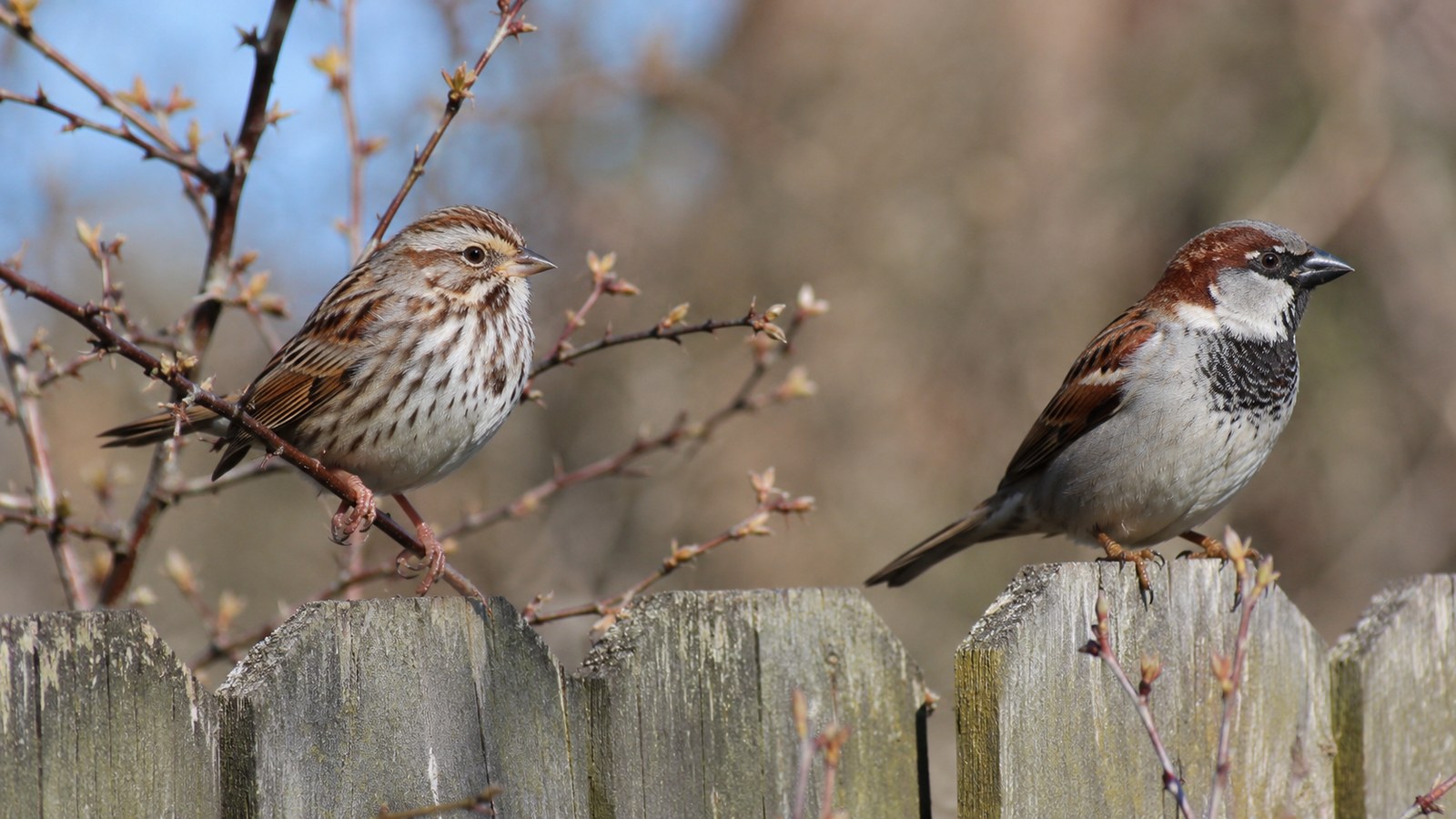
The names make them sound more alike than they’re
Song Sparrow and House Sparrow are both small seed-eating birds that can appear around yards and feeders, but they’re not close relatives. The Song Sparrow belongs to the native New World sparrow family. The House Sparrow is an introduced Old World sparrow strongly associated with people and buildings.
That family difference shows in their structure and appearance. A Song Sparrow looks longer and more lightly built, while a House Sparrow looks rounder, fuller in the chest, and shorter-tailed.
Side-by-side comparison
| Feature | Song Sparrow | House Sparrow |
|---|---|---|
| Overall build | Medium-sized sparrow, rounded head, relatively slender body | Chunkier body, fuller chest, large rounded head |
| Tail | Fairly long and rounded | Looks shorter in proportion to the stocky body |
| Bill | Conical, but less massive-looking | Short, deep, and stout |
| Breast | Usually coarse dark streaks on a pale background, often gathering at the centre | Male with black bib; female and young birds mostly plain buff below |
| Head | Brown or rusty crown stripes, gray areas, dark eye line, broad moustache stripe | Male with gray crown, chestnut head sides, pale cheek; female with pale eyebrow |
| Habitat | Shrubs, wet edges, marsh borders, brush, gardens, low cover | Buildings, streets, farms, patios, shops, parks, and busy human spaces |
| Social behaviour | Often single or in loose groups; sings from shrubs or other exposed perches | Frequently forms conspicuous, noisy groups near people |
| Sound | Varied song, often opening with clear notes before trills or buzzes | Simple repeated cheeps or chirrups |
| North American status | Native | Introduced |
Shape can solve the identification before colour
Start with the silhouette. Song Sparrows have rounded heads and long rounded tails that extend clearly behind the body. They often look alert and lengthened when perched in a shrub.
House Sparrows have deeper bodies, broad chests, large rounded heads, and stout bills. Their tails aren’t tiny, but they look shorter because the body is so compact. This difference still helps in shade, dull plumage, or a distant view.
Compare the breast pattern
A typical Song Sparrow has thick dark streaks on the pale breast and flanks. The streaks often converge into a central dark spot, but the mark can vary or disappear in a poor view. The overall streaked breast is more important than the single spot.
An adult male House Sparrow has a black throat and bib. The bib may appear larger during breeding season and can look less crisp in worn or dirty urban plumage. Female and immature House Sparrows have mostly plain buff or gray-buff underparts without the Song Sparrow’s coarse streaking.
Adult male House Sparrow is usually the easier one
The male combines a gray crown, chestnut sides of the head and neck, pale cheeks, black bill in breeding condition, and dark bib. That pattern is unlike the striped, streak-breasted Song Sparrow.
Distance can hide the chestnut and gray, but the stocky shape and bib still help. Check whether the bird is gathering with other House Sparrows around buildings or food scraps.
Female House Sparrow causes more confusion
A female House Sparrow is brown and buff, with a pale eyebrow behind the eye, a plain face, stout bill, and relatively plain breast. She lacks the male’s black bib and strong head colours.
Compare her with a Song Sparrow by asking three questions. Is the breast heavily streaked? Does the tail look long and rounded? Does the face show multiple rusty and gray stripes rather than one simple pale eyebrow? A mostly plain breast strongly supports House Sparrow.
Juvenile House Sparrows resemble females
Young House Sparrows are plain brown and buff and can look softer or less tidy than adults. Their thick bills, compact shape, short-looking tails, plain underparts, and close association with adult House Sparrows help.
Young Song Sparrows are also streaked below. Don’t use age as a reason to ignore the breast pattern. Watch family groups and compare several birds when possible.
Song Sparrow faces are striped, not plain
A Song Sparrow usually has rusty or brown stripes on the crown, a dark line through the eye, gray or pale areas around the face, and a broad dark moustache or malar stripe beside the throat. The face looks layered.
Regional forms differ in darkness and colour. Western coastal birds can be large and dark, while some southwestern birds are smaller and paler. The striped face, streaked breast, and long tail remain a more reliable combination than exact shade.
Habitat often points in the right direction
House Sparrows thrive beside people. Look for them around rooflines, shop fronts, barns, livestock areas, patios, transit stations, car parks, and outdoor eating spaces. They readily feed on crumbs and spilled seed.
Song Sparrows favour low vegetation, brushy edges, gardens, marsh margins, streamside shrubs, hedges, and wet thickets. They can live near houses, but they usually remain connected to shrubs or natural cover rather than the building itself.
Watch how the bird uses cover
A Song Sparrow often slips into low vegetation, returns to an exposed branch to sing, or feeds close to cover. It may pump or flick its long tail as it moves through shrubs.
House Sparrows hop confidently on pavement, roofs, picnic areas, feeding trays, and building ledges. A group may burst from a hedge or eave together and return quickly once people pass.
The sounds are very different
Song Sparrow songs vary by individual and region, but they’re structured and musical, often beginning with a few clear notes followed by a mix of trills, buzzes, and changing phrases. The call is often a short sharp note.
House Sparrows give repeated cheeps, chirps, and chirrups. Their vocal activity can be constant around a colony, but the phrases are generally simpler than a Song Sparrow’s full song.
Don’t let the feeder decide the species
Both birds can visit feeders or eat spilled seed beneath them. Feeder attendance doesn’t make a bird a House Sparrow. Study the body, breast, face, tail, behaviour, and surrounding habitat.
Song Sparrows may be more likely to remain beneath or beside shrubs, while House Sparrows often crowd feeding surfaces and gather in larger groups. These tendencies support, but don’t prove, the identification.
Use date and range carefully
House Sparrows are widespread around developed areas in southern Canada and the United States, although they’re absent from some far northern areas. Song Sparrow distribution and seasonal movements vary by region, but the species is widespread across much of North America.
Use a current regional checklist or Merlin list for the observation date. A bird’s absence from one neighbourhood doesn’t make the other species automatic.
Photographs can preserve the best clues
Take the photograph before moving closer. Even a distant image may show the ratio of tail to body, the depth of the bill, breast streaking, bib, head pattern, and whether nearby birds are the same species.
Don’t judge colour from one heavily processed image. Exposure, shadows, phone sharpening, and warm or cool white balance can change browns, grays, and chestnut tones.
What to check first
- Is the breast heavily streaked? Song Sparrow becomes more likely.
- Is it an adult male with a dark bib? House Sparrow becomes more likely.
- Is a brown bird plain below with a pale eyebrow and stout build? Consider female or young House Sparrow.
- Does it have a long rounded tail and layered striped face? Consider Song Sparrow.
- Is it tightly associated with buildings and noisy groups? That supports House Sparrow.
- Is it using shrubs, wet edges, or brush and singing a varied song? That supports Song Sparrow.
- Make sure the clues agree before naming it.
What to record during a brief view
- Stocky or slender body
- Long or short-looking tail
- Streaked, plain, or bibbed breast
- Striped face or simple pale eyebrow
- Stout or moderate conical bill
- Single bird or noisy group
- Shrub habitat or direct building association
- Varied song or repeated cheeps
Frequently asked questions
What should I look at first when comparing a Song Sparrow and a House Sparrow?
A Song Sparrow usually has coarse streaks across a pale breast and a longer rounded tail. A House Sparrow is stockier and shorter-tailed; adult males have a black bib, while females have mostly plain buff underparts.
How can I tell a female House Sparrow from a Song Sparrow?
A female House Sparrow is stocky with a stout bill, pale eyebrow, plain buff breast, and relatively short tail. A Song Sparrow normally shows obvious breast streaking and a longer rounded tail.
Do Song Sparrows always have a central breast spot?
The breast streaks often converge into a central spot, but the spot may be weak or hard to see. Use the full streaking pattern, shape, tail, face, habitat, and sound rather than requiring that one mark.
Are Song Sparrows and House Sparrows closely related?
No. Song Sparrows are native New World sparrows, while House Sparrows are introduced Old World sparrows. Their shared common name doesn’t mean they belong to the same bird family.
Full species guides
Continue with the full Song Sparrow guide or House Sparrow guide.