
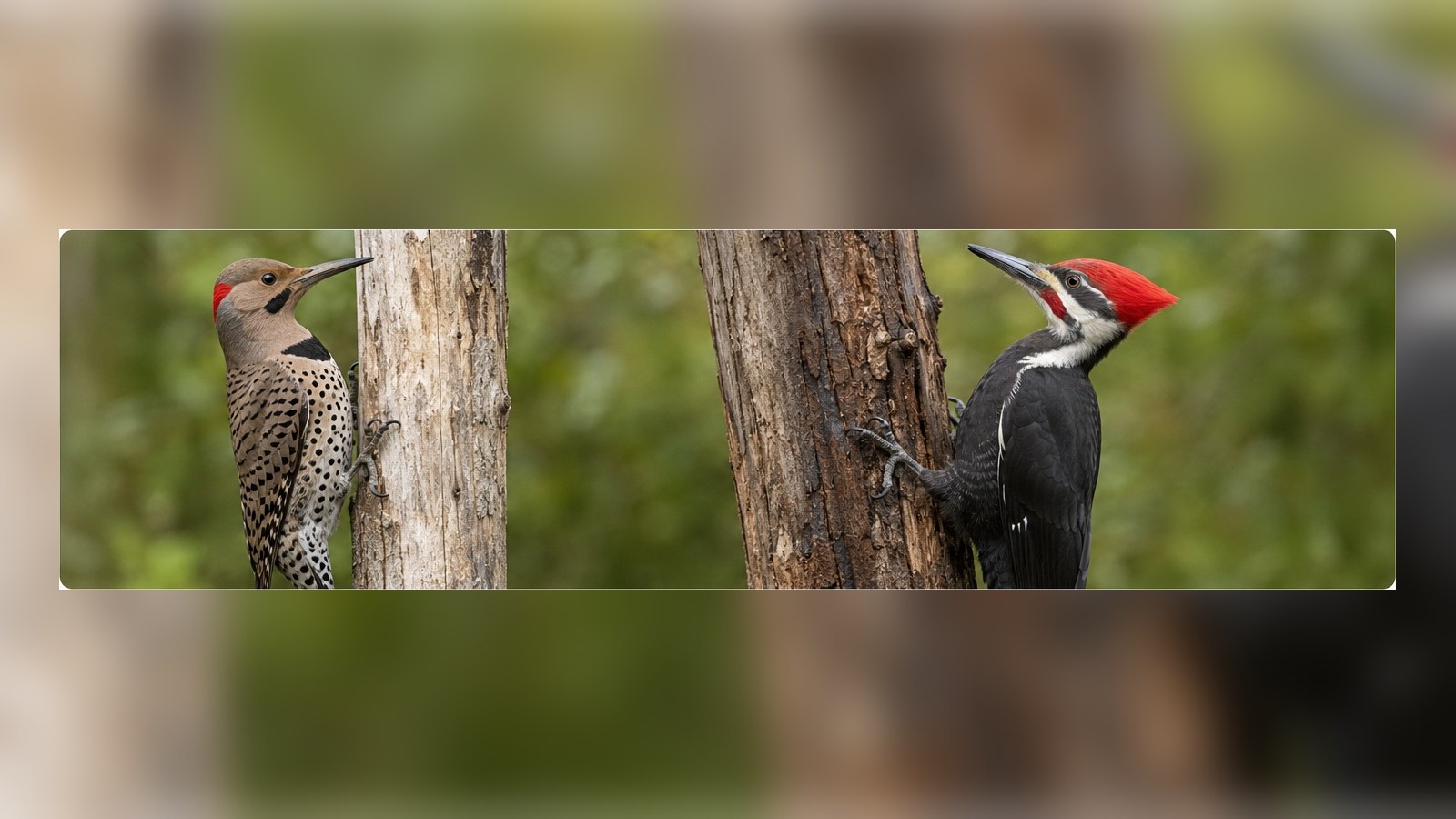
Why beginners sometimes connect these birds
Northern Flickers and Pileated Woodpeckers are among the most conspicuous woodpeckers across much of Canada and the United States. Both are large, loud, show red on the head, use strong undulating flight, and can give long ringing calls that carry through woods and neighbourhoods. If you already know it is a flicker, the Northern Flicker species guide goes deeper into food, calls, nesting, migration, and the two regional forms.
Their plumage isn’t truly similar once the whole bird is seen. Confusion usually comes from a brief silhouette, a distant call, a large bird crossing the yard, or a flash of red disappearing behind a trunk. Behaviour and broad colour pattern normally resolve the sighting quickly.
Northern Flicker vs Pileated Woodpecker comparison
| Feature | Northern Flicker | Pileated Woodpecker |
|---|---|---|
| Overall size | Large woodpecker, but clearly smaller and slimmer | Very large, crow-sized impression |
| Main colour | Warm brown or tan with dark bars and spots | Mostly black |
| Head | Grey or brown crown with smaller red or black regional marks | Long pointed red crest |
| Underparts | Spotted belly and dark breast crescent | Mostly dark body without flicker spots or breast crescent |
| White flight mark | Bright white rump | Broad white areas beneath dark wings |
| Wing and tail colour | Yellow or salmon-red lining depending on regional form | Black and white without coloured shaft lining |
| Feeding | Frequently on ground probing for ants | Usually excavates large trees, stumps, logs, and fallen wood |
| Tree signs | Smaller probing marks and nest cavity | Large elongated or rectangular feeding excavations |
| Voice | Long, ringing, fairly even repeated call | Loud resonant series with changing emphasis or rhythm |
Size becomes obvious with a reference point
A Northern Flicker is already a substantial bird, larger than a Hairy Woodpecker and smaller than a Pileated Woodpecker. A Pileated can create a crow-sized impression, with a long neck, broad wings, long bill, and extended pointed crest.
Don’t judge size from an isolated distant bird. Compare it with a feeder, trunk width, fence rail, crow, robin, or another bird on the same plane. A close flicker may look enormous, while a distant Pileated may appear modest.
Brown plumage points toward Northern Flicker
Northern Flickers are unusual among familiar woodpeckers because they’re broadly brown or tan. The back is darkly barred, the belly is covered in black spots, and a bold black crescent crosses the upper breast. The rump appears white, especially during flight.
Light can make brown plumage look grey, but the spotted underparts and breast crescent remain strong clues. A flicker perched with its belly hidden may still show the barred brown back, long slightly curved bill, white rump, and coloured wing lining.
Mostly black plumage points toward Pileated
Pileated Woodpeckers are mostly black with strong white stripes along the face and neck. The red crest rises from the head and sweeps backward into a sharp point. The body lacks the flicker’s spotted belly and black breast crescent.
When the bird opens its wings, broad white areas appear beneath them. A perched bird can hide much of this white, so the face stripes, crest, large size, and tree work matter more.
White rump versus white underwings
The Northern Flicker’s white rump is a bright patch at the base of the tail. It often flashes during takeoff and undulating flight, even when other details disappear. The yellow or salmon-red colour beneath the wings and tail may also show.
The Pileated Woodpecker doesn’t show that isolated white rump patch. Instead, white appears as broad underwing areas against otherwise dark wings. Record where the white was located rather than writing only “large woodpecker with white in flight.”
The red marking is very different
A Pileated Woodpecker has an obvious long red crest in both sexes. The crest changes shape as the bird raises, lowers, or turns its head, but it remains much larger than the red marks on a Northern Flicker.
Northern Flicker head markings vary by regional form and sex. Yellow-shafted birds often have a red nape crescent, while Red-shafted males have a red moustache stripe. Those smaller patches don’t form a long triangular crest.
Ground feeding is one of the strongest behaviour clues
Northern Flickers commonly walk or hop across lawns, fields, open woodland, and bare soil while probing for ants and other insects. A large spotted brown woodpecker feeding on the ground is strongly suggestive of a flicker.
Pileated Woodpeckers may descend low on stumps or fallen logs, but they’re not regular lawn-foraging birds. They usually brace against substantial wood and strike deeply into it while searching for ants and other insects.
Large excavations support Pileated Woodpecker
Pileated Woodpeckers can leave large, deep, elongated, or roughly rectangular openings in dead wood. Fresh pale chips may collect below the tree or log. The bird’s powerful blows and body size match the scale of the work.
A hole doesn’t prove which bird made it. Other animals can enlarge cavities, and weather changes edges over time. Use fresh activity, hole shape, surrounding chips, habitat, and an actual sighting or sound before assigning a species.
Flicker tree work is usually less dramatic
Northern Flickers do climb trunks and excavate nest cavities, but much of their feeding happens on the ground. Their tree marks can overlap with those of other woodpeckers and shouldn’t be identified from size alone.
A flicker may inspect dead limbs, drum on resonant surfaces, or perch conspicuously on a trunk, pole, roof, or fence. The white rump, spotted belly, breast crescent, and brown back are better clues than a feeding hole.
Calls can sound surprisingly similar
Both birds give long repeated ringing or laughing series. A Northern Flicker call can sound relatively even in rhythm and tone. A Pileated Woodpecker’s series often feels more resonant and may change emphasis or rhythm as it continues.
Distance, echoes, wind, and habitat can blur the difference. Use the call to locate the bird, then confirm size, colour, crest, rump, underwings, and behaviour. A phone recording can preserve pace and tone for later review.
Drumming helps with context
Both species drum for communication. A Pileated Woodpecker can produce a powerful series on a large resonant trunk, while a flicker may choose trees, metal, siding, or other loud surfaces. The object can make a smaller bird sound surprisingly forceful.
Record the number of bursts, tempo, duration, surface, habitat, and any visible bird. Volume alone is unreliable because resonance and distance alter it.
Compare flight shape and route
Northern Flickers often show bounding flight with obvious wingbeats and glides. The white rump and coloured underwings can be visible as the bird crosses an open area or drops to the ground.
Pileated Woodpeckers also use undulating flight, but the bird appears larger, longer-necked, and more powerful. White underwing patches may flash, and the red crest can remain visible in a close crossing view.
Male and female Pileated Woodpeckers
Both sexes have the large red crest. Males usually have red extending onto the forehead and a red moustache stripe along the cheek. Females have a darker forehead and a dark moustache stripe.
These sex differences are supporting details. The overall black body, white face and neck stripes, huge size, and red crest identify Pileated Woodpecker before the cheek colour is assessed.
Male and female Northern Flickers
Male Northern Flickers have a moustache stripe, black in the Yellow-shafted group and red in the Red-shafted group. Females lack the male moustache. Yellow-shafted birds usually show yellow beneath the wings and tail, while Red-shafted birds show salmon-red.
The regional form doesn’t change the central comparison with Pileated. Both flicker groups remain brown, spotted, white-rumped, and strongly associated with ground feeding.
Juvenile birds
Young flickers can look duller or less crisp, with developing head markings. Young Pileated Woodpeckers resemble adults in their broad black, white, and red pattern but may look softer or less sharply marked.
Age can affect fine details, not the fundamental difference. A juvenile flicker remains a brown spotted bird with a white rump, while a young Pileated remains a very large black bird with a crest and bold white facial pattern.
Habitat and range across North America
Northern Flickers occupy open woods, edges, parks, fields, farms, neighbourhoods, and forest clearings across most of Canada and the United States. Their ground-feeding habit brings them into visible open places.
Pileated Woodpeckers need larger trees and woody material. They occur through much of forested Canada and the eastern United States, with western populations extending through suitable forests toward the Pacific. Wooded suburbs can support them where mature trees and dead wood remain.
An eight-clue field note
| Clue | What to record |
|---|---|
| Size | Robin-sized, crow-sized, comparison object, distance, and viewing angle |
| Main colour | Brown and spotted, mostly black, backlit, or uncertain |
| Head | Long red crest, smaller red or black patch, crown colour, face stripes |
| Underparts | Spots, breast crescent, plain dark body, or hidden |
| Flight marks | White rump, white underwings, yellow lining, red lining, or not seen |
| Behaviour | Lawn feeding, trunk climbing, deep excavation, drumming, or feeder use |
| Tree signs | Large fresh excavation, small probing, chips, cavity, or uncertain maker |
| Context | Location, date, habitat, sound, photographs, nearby birds, and flight route |
When to leave the identification open
A distant dark silhouette with a ringing call may remain uncertain. Record “large woodpecker,” the estimated size, flight path, call rhythm, habitat, and any white or red marks. A later view may provide the rump, underwings, crest, or underpart pattern.
Don’t use a loud call or large hole alone. A few clues should agree. Honest uncertainty preserves the observation and prevents one dramatic feature from overpowering everything else.
Frequently asked questions
Which bird has the white rump?
Northern Flickers show a bright white rump in flight. Pileated Woodpeckers instead show broad white areas beneath their dark wings.
Which bird is more likely on a lawn?
Northern Flickers commonly feed on lawns and open ground for ants. Pileated Woodpeckers usually work large wood.
Does every Pileated Woodpecker have a red crest?
Yes. Adult males and females both have a long red crest. They differ in forehead and moustache colour.
Can a Northern Flicker look black in poor light?
Backlighting can darken any bird, so use shape, white rump, spotted underparts, breast crescent, behaviour, and later views. A true Pileated remains much larger and carries a long crest and white face stripes.