
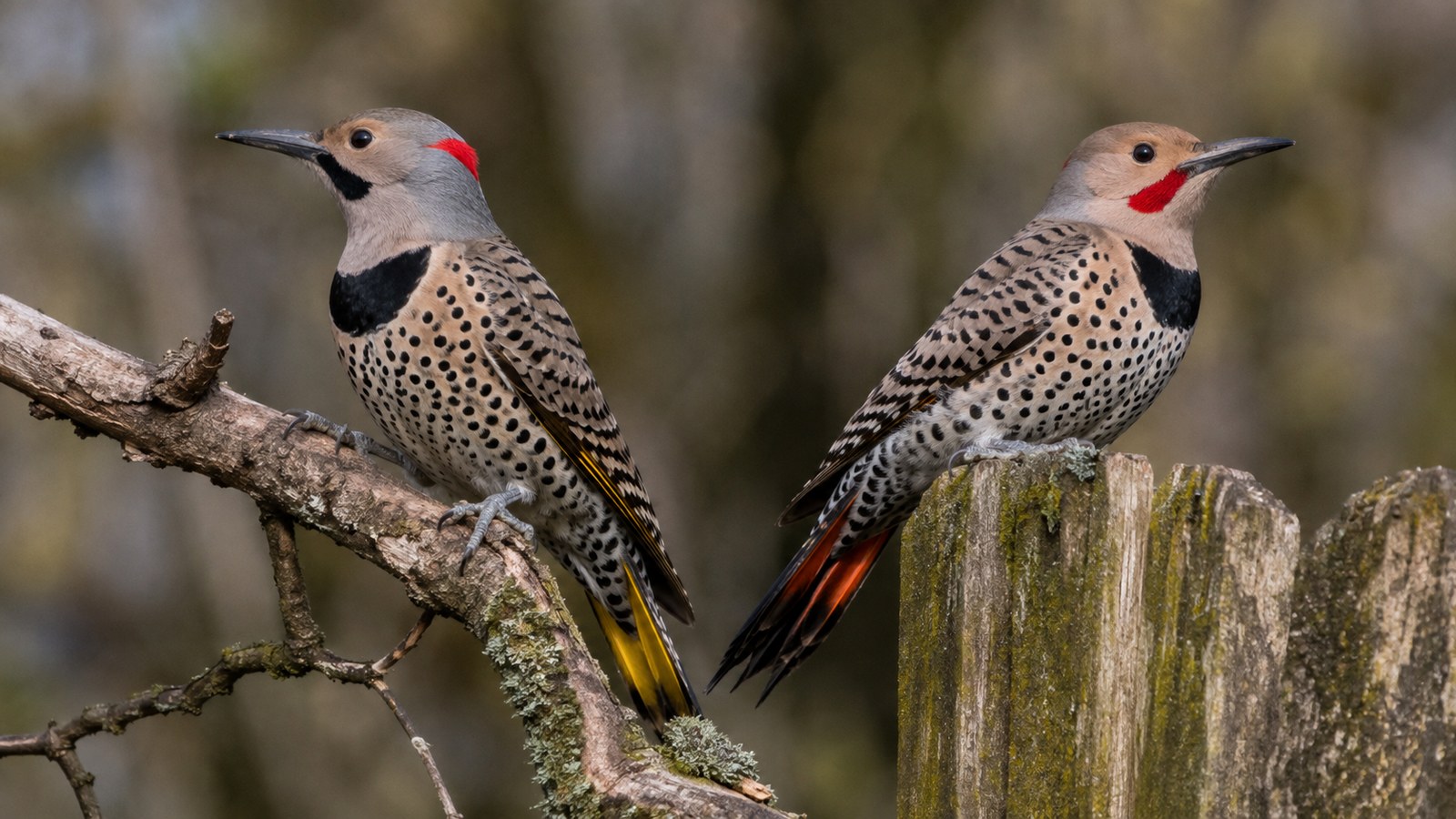
They’re two forms of the same species
Yellow-shafted and Red-shafted Flickers are regional groups of the Northern Flicker. They share the same basic body shape, spotted underparts, dark breast crescent, barred brown back, white rump, ground-feeding habits, and loud calls. The names describe the colour running through the shafts and undersides of their large flight and tail feathers.
This shared structure is important. Before choosing a form, first confirm that the bird is a Northern Flicker. A large brown woodpecker walking on a lawn, probing for ants, showing a black crescent across the upper breast, and flashing a white rump in flight is a strong Northern Flicker candidate. The full Northern Flicker species guide covers food, calls, nesting, migration, and everyday behaviour.
Side-by-side comparison
| Feature | Yellow-shafted | Red-shafted |
|---|---|---|
| Wing and tail lining | Lemon yellow | Salmon-red or rosy red |
| Male moustache stripe | Black | Red |
| Female moustache stripe | Absent | Absent |
| Face | Usually tan or warm brown | Usually greyer |
| Crown | Usually grey | Usually brown |
| Nape | Usually has a red crescent | Usually lacks a red crescent |
| Main range | Eastern and much of central North America, extending across boreal Canada | Western North America from Alaska and western Canada through the western United States |
| Shared clues | Large brown woodpecker, black breast crescent, spotted belly, barred back, white rump, long bill, ground feeding, loud call | |
Confirm the bird is a Northern Flicker
Northern Flickers are large for woodpeckers. They look longer-bodied and more gently coloured than the strongly black-and-white Downy, Hairy, and sapsucker species. Their brown back is crossed by dark bars, their pale belly is covered with dark spots, and a bold dark crescent sits high on the breast.
The white rump is one of the best shared field marks. It often appears as the bird flies away in a bounding flight. A perched flicker may also expose the white rump while shifting position, but it can remain hidden beneath folded wings.
Flight-feather colour is the strongest starting clue
The yellow or red colour is often most obvious when the bird opens its wings, lands, takes off, preens, or spreads its tail. A brief flight across a lawn may reveal more than several minutes of a perched back view.
Light can change the apparent shade. Yellow may look golden, and red may look orange, pinkish, or deep salmon. Photograph sequences help because one frame may catch the open wing. Record the general family of colour rather than trying to choose an exact paint-chip shade.
Compare the male moustache stripe
Adult males show a coloured stripe along the side of the face below the cheek. On a Yellow-shafted male, this moustache stripe is black. On a Red-shafted male, it’s red. The stripe is often visible while the bird is on the ground or clinging sideways to a trunk.
This clue applies to adult males. Females of both forms lack the bold moustache stripe. A bird with no stripe isn’t automatically one form or the other. Female identification depends more heavily on shaft colour, face, crown, nape, and range.
Compare the face and crown
A typical Yellow-shafted Flicker has a warmer tan face and a contrasting grey crown. A typical Red-shafted Flicker has a greyer face and a browner crown. These differences may help on a perched bird when the wing lining is hidden.
Face and crown shades can be affected by shadow, wet feathers, wear, soil, camera exposure, and individual variation. Treat them as supporting evidence. A clear view of the flight-feather colour should carry more weight.
Check the nape
Yellow-shafted Flickers usually show a red crescent at the back of the head. Red-shafted Flickers usually lack this red nape crescent. The patch can be hidden by posture or the angle of the head, so watch the bird turn rather than deciding from one frozen view.
The nape clue combines well with the face and crown. Tan face, grey crown, red nape, and yellow shafts form a strong Yellow-shafted set. Grey face, brown crown, plain nape, and red shafts form a strong Red-shafted set.
How to identify females
Female flickers are sometimes harder because they lack the male moustache stripe. Begin with the colour beneath the wings and tail. Then compare the warm tan versus grey face, grey versus brown crown, and red versus plain nape.
Don’t use the absence of a moustache as a species-level clue. It tells you that the bird may be female or young, but it doesn’t choose Yellow-shafted or Red-shafted. A location record and a photograph of the nape can become especially handy.
Juvenile birds may look less tidy
Young Northern Flickers share the broad pattern of adults but may look duller, softer, or less crisply marked. Their facial features can be developing, and feather wear or active moult can make the pattern look uneven.
Use the stable large-scale clues: spotted underparts, breast crescent, white rump, brown barred back, ground feeding, and the colour in the flight feathers. Age should make you more cautious about a small or incomplete head mark, not less confident about the entire identification process.
Range helps, but not a wall
Yellow-shafted Flickers dominate eastern North America and extend westward across the boreal forest of Canada. Red-shafted Flickers dominate western North America. Migration can move birds beyond the places where a visitor expects them, and individual birds may wander.
Location changes probability, but it doesn’t replace field marks. A western bird with yellow shafts deserves careful documentation. An eastern bird with red shafts also deserves a second look. Check several features and consider whether the bird may come from the broad contact zone.
Intermediate and hybrid flickers
The two forms interbreed where their ranges meet. Their offspring may combine features from both groups or show intermediate colours. A bird may have orange rather than clearly yellow or red shafts, a weak or partial nape crescent, or a moustache and crown pattern that don’t match the expected package.
Intermediate birds aren’t mistakes. Record each visible feature separately. Write “orange wing lining,” “partial red nape,” “grey-tan face,” and “male red-black moustache” rather than forcing a perfect label. A well-documented intergrade is a good observation.
Watch for the Gilded Flicker in the desert Southwest
In parts of the southwestern United States and northwestern Mexico, a yellow-winged flicker may be a Gilded Flicker rather than a Yellow-shafted Northern Flicker. Gilded Flickers are strongly associated with desert habitats and giant cacti. They’ve their own combination of head colour, moustache, wing lining, and range.
This possibility is regional and shouldn’t complicate most Canada and United States sightings. It becomes relevant when the bird is in Sonoran Desert habitat. Use a current regional guide rather than assuming every yellow-winged flicker belongs to the eastern Yellow-shafted group.
Behaviour shared by both forms
Northern Flickers spend more time on the ground than many other woodpeckers. They probe lawns, open soil, woodland edges, and other places where ants and insects are available. Their long, slightly curved bills suit this feeding style.
They also perch on trunks, branches, poles, fences, roofs, and utility structures. Both forms drum for communication and may choose resonant metal or hollow surfaces. Behaviour confirms the species but rarely separates the two regional forms by itself.
Calls and drumming
Both forms give loud, ringing calls and long repeated series. Their voices are better for confirming Northern Flicker than for deciding Yellow-shafted versus Red-shafted. The regional forms sound broadly similar.
Record the call if the bird remains hidden. Sound can guide you to a trunk or lawn where shaft colour and head pattern become visible. Keep a respectful distance from nesting or displaying birds.
A seven-clue field note
| Clue | What to record |
|---|---|
| Wing and tail lining | Yellow, red, orange, hidden, or uncertain |
| Moustache | Black, red, mixed, absent, or hidden |
| Face | Warm tan, grey, intermediate, or uncertain |
| Crown | Grey, brown, mixed, or hidden |
| Nape | Red crescent, plain, partial, or not seen |
| Shared flicker clues | White rump, spotted belly, breast crescent, barred brown back, ground feeding |
| Context | Location, date, habitat, sex, age, photographs, call, and behaviour |
When to leave the form uncertain
A flicker seen only from behind may show the white rump but hide the wing lining, face, crown, nape, and moustache. Record it simply as Northern Flicker. Species-level certainty is still a good result.
Use “Northern Flicker, form uncertain” or “Yellow-shafted/Red-shafted intergrade” when the evidence supports that wording. Honest uncertainty is better than ignoring mixed features.
Frequently asked questions
Are Yellow-shafted and Red-shafted Flickers separate species?
No. They’re regional groups within the Northern Flicker. They meet and interbreed in a broad contact zone.
What is the easiest difference to see?
The colour beneath the wings and tail is the strongest starting clue. Look during takeoff, landing, flight, tail spreading, or preening.
Do female flickers have moustache stripes?
Females of both mainland forms lack the adult male moustache stripe. Use shaft colour, face, crown, nape, and range.
Why did my flicker show orange wings?
Light can alter colour, but orange can also indicate an intermediate bird from the Yellow-shafted and Red-shafted contact zone. Record the head and nape features too.