
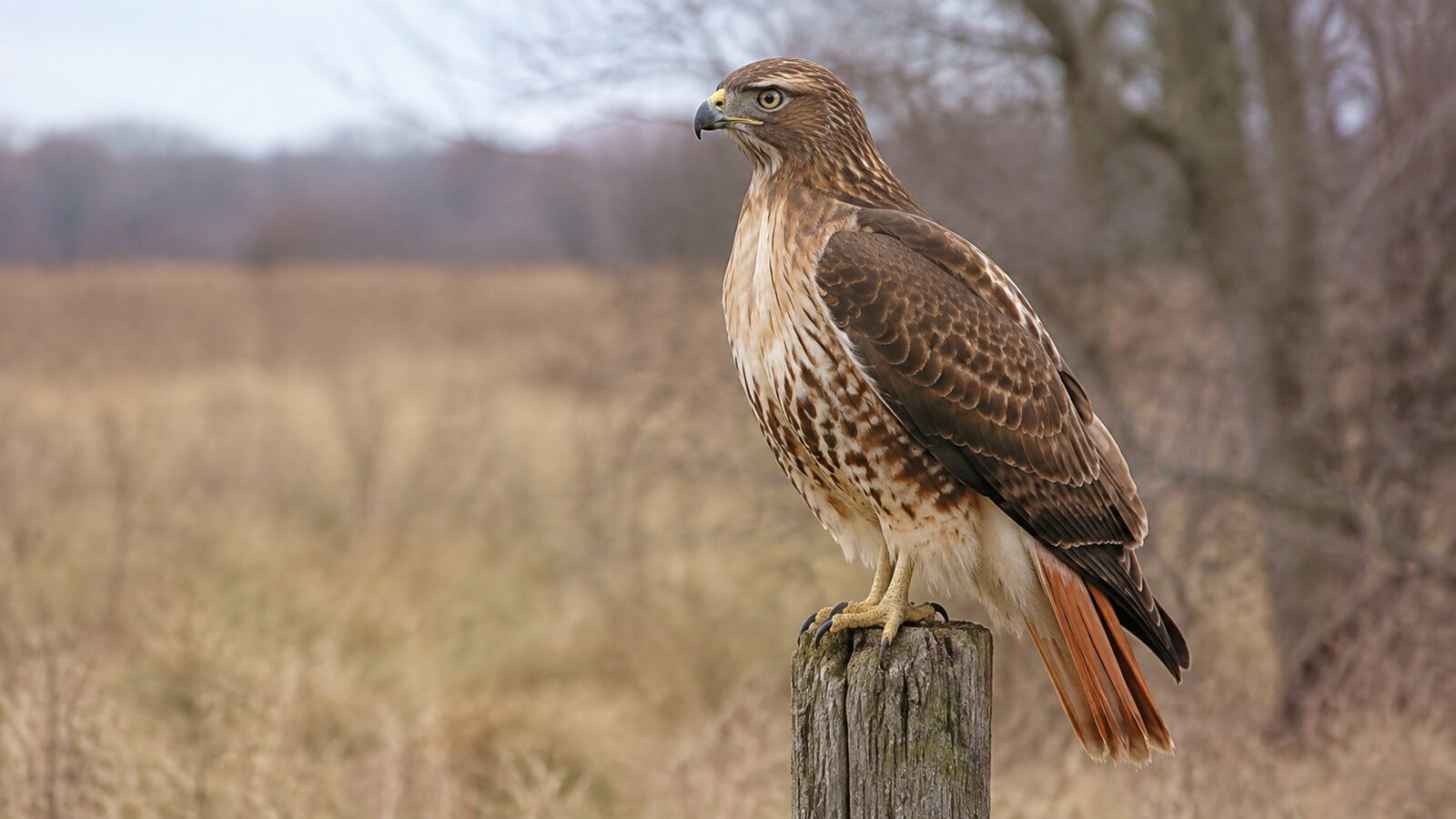
Red-tailed Hawk at a glance
Look for a large, broad-bodied hawk with wide rounded wings and a fairly short, broad tail. Many light adults are brown above and pale below with a darker band of streaks across the belly. Adults usually show a rusty red tail. Young birds have a brown, finely banded tail instead.
How to identify a Red-tailed Hawk
Start with the build. Red-tailed Hawks are big, heavy hawks with broad chests, broad rounded wings, and a tail that looks fairly short for the size of the bird. When they soar, the wings often form a wide shallow curve rather than the long flat plank shape of an eagle.
Colour varies a lot across North America, so one exact brown pattern will not fit every bird. A common light form has a brown back, pale breast, and a band of darker streaks across the belly. That belly band is one of the better field marks when the bird is perched or gliding close enough to see it.
The famous red tail belongs to adults. It can glow warm orange-red in good light, but it may look dull brown when the bird is backlit. Young Red-tailed Hawks do not have the adult red tail. Their tail is brown with narrow dark bands, which is one reason young hawks can take longer to identify.
How big is a Red-tailed Hawk?
It is one of the larger hawks most people see regularly. Cornell gives males a length of about 17.7 to 22.1 inches and females about 19.7 to 25.6 inches, with a wingspan around 44.9 to 52.4 inches.
Females are larger than males, but the difference is hard to judge unless two birds are together. In the field, compare the hawk with a crow, gull, fence post, or utility pole rather than trying to estimate inches from a distant silhouette.
What does a Red-tailed Hawk sound like?
The classic call is a rough, descending scream that Cornell describes as a hoarse kee-eeeee-arr. It is often given while the bird is soaring.
That sound has become so familiar in movies and television that it is sometimes used for other birds of prey. If a large hawk gives the call in real life, still check shape and field marks before deciding on the species.
What do Red-tailed Hawks eat?
Small and medium-sized mammals make up much of the diet. Voles, mice, rats, rabbits, hares, and ground squirrels are common prey. Red-tailed Hawks also take birds, snakes, and carrion when the opportunity fits.
This diet explains why roadsides, farm fields, pastures, and open parks can be such good places to spot them. A pole or bare branch gives the hawk a lookout over the ground below.
Where do Red-tailed Hawks live?
They use an enormous range of open and partly open habitats across North America. Look over grasslands, desert country, scrub, fields, pasture, roadsides, parks, and broken woodland.
Robin is usually the one in our house who notices a bird of prey first. A big hawk sitting above an open patch is exactly the sort of sighting where it pays to stop, look at the body shape, and wait for the bird to turn or fly.
How do Red-tailed Hawks hunt?
Two styles are especially easy to notice. One is patient perch hunting: the hawk sits on a pole, tree, fence post, or other lookout and watches the ground. The other is soaring in broad circles while scanning open country below.
When a target appears, the hawk can drop quickly. Broad wings give it lift for long periods of soaring, while strong feet and talons handle the catch.
How do Red-tailed Hawks nest?
Nests are usually high in tall trees where the pair has a broad view, but Red-tailed Hawks can also use cliff ledges and large human-made structures. Both birds help build or repair the stick nest.
Cornell lists one to five eggs, with one brood in a season. Incubation is about 28 to 35 days, and the young remain in the nest for roughly 42 to 46 days after hatching.
Pairs may return to a nest used before and repair it instead of starting over. Our broader guide to whether birds reuse nests looks at the same question across many bird families.
Red-tailed Hawk vs Red-shouldered Hawk
A Red-shouldered Hawk is generally slimmer and more tied to wooded habitat, often near water. Adults show reddish barring below and a strongly banded tail. Red-tailed Hawks are heavier, more often seen in open country, and many light birds show the familiar belly band.
Flight marks can help too, but distance changes everything. If the view is poor, write down the habitat, wing shape, tail pattern, call, and what the bird did before chasing a colour detail you only saw for a second.
Red-tailed Hawk vs Bald Eagle
An adult Bald Eagle is much larger and has the unmistakable white head and tail. Young Bald Eagles are brown and mottled, so they can cause more confusion. The eagle still looks heavier, with a huge bill, long broad wings, and a large head that projects strongly in flight.
Red-tailed Hawks have a more compact head and body and a much shorter wingspan. A nearby crow can be a surprisingly good scale reference for both species.
How long do Red-tailed Hawks live?
Some live for decades. Cornell reports an oldest known wild Red-tailed Hawk of at least 30 years and 8 months. That is a longevity record, not the age most hawks will reach, but it shows how long a successful adult can survive.
Frequently asked questions
Do all Red-tailed Hawks have red tails?
No. Adults usually develop the rusty red tail, but young birds have a brown tail with narrow dark bands. Lighting can also make an adult red tail look much duller.
Why do Red-tailed Hawks sit on telephone poles?
A high roadside perch gives the hawk a wide view of open ground where mice, voles, rabbits, and other prey may appear.
Will a Red-tailed Hawk attack a dog or cat?
Red-tailed Hawks mainly hunt wild prey such as rodents and rabbits. Attacks on typical dogs and cats are very unusual, but very small pets are safest when supervised outdoors around any large predator.
Are Red-tailed Hawks common?
Yes. Cornell describes the Red-tailed Hawk as probably the most common hawk in North America, especially in open country and along roads.
More familiar birds
Continue with the Bald Eagle, learn to identify birds by size and shape, or browse all Common Birds.