
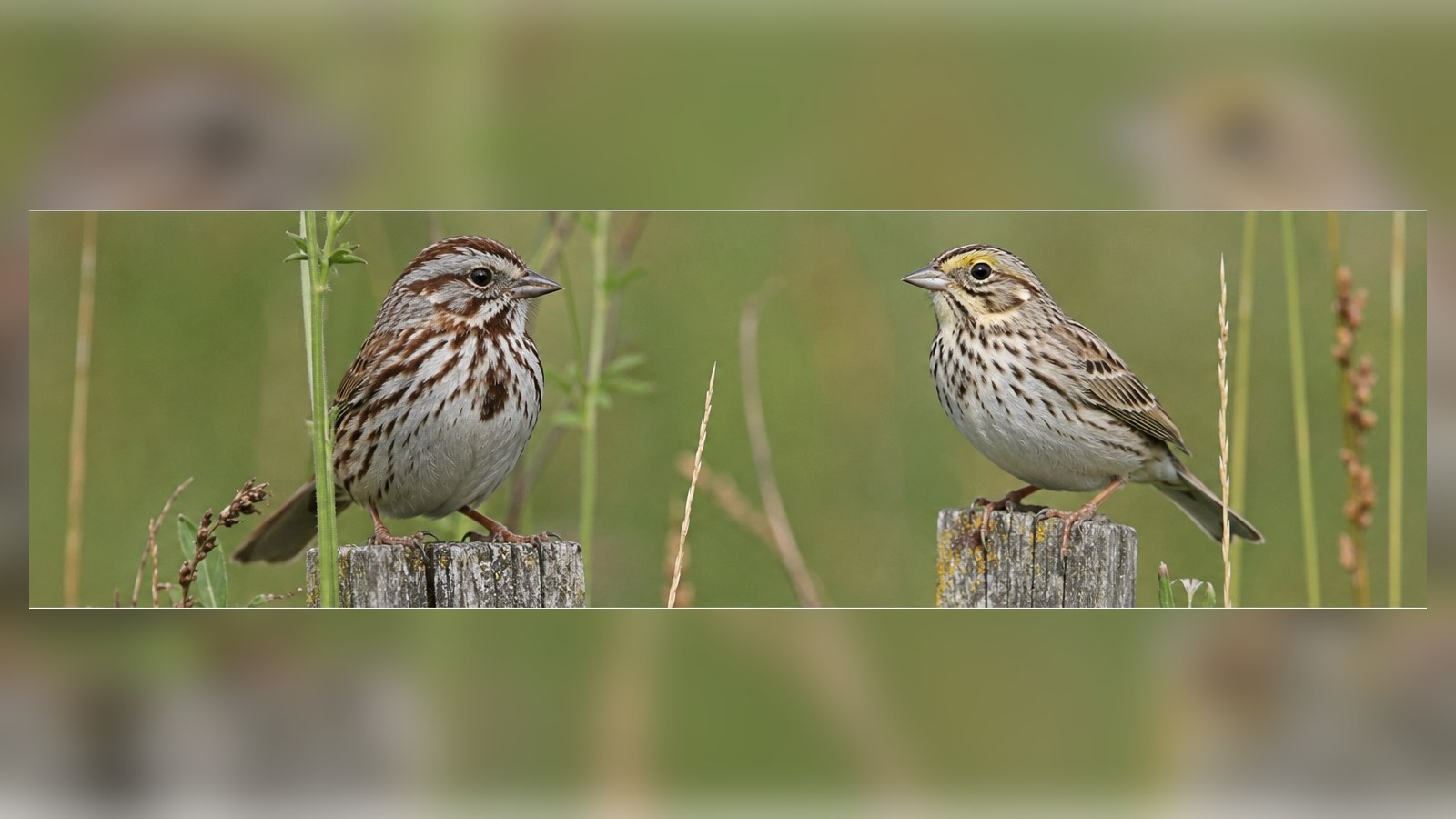
Why these two sparrows are confused
Song Sparrows and Savannah Sparrows are both medium-sized brown sparrows with streaked underparts, patterned backs, and pale areas on the face. At a distance, either bird may look like a small streaked shape on a fence, shrub, field edge, or patch of ground.
The mistake usually begins when the observer focuses only on breast streaking or a possible central spot. Those clues help, but tail length, bill size, face pattern, body proportions, habitat, movement, sound, date, and location make the comparison much stronger.
Side-by-side comparison
| Feature | Song Sparrow | Savannah Sparrow |
|---|---|---|
| Overall build | Medium-sized, fairly bulky, rounded-headed, and longer-bodied | Compact, plump-bodied, smaller-headed, and short-tailed |
| Tail | Long and rounded, usually without a visible notch | Short and usually notched |
| Bill | Short but relatively stout and substantial | Small for a sparrow, though thick at the base |
| Breast | Coarse, heavier streaks that often collect near the centre | Fine, crisp streaks across the breast and flanks |
| Face | Strong reddish-brown and grey stripes with a broad dark moustache mark | More delicate face pattern, often with yellow in front of or above the eye |
| Habitat | Shrubs, brush, gardens, marsh edges, overgrown fields, and woodland edges | Grassland, farmland, tundra, dunes, saltmarshes, and grassy roadsides |
| Movement | Hops through low cover and often pumps the long tail after short flights | Runs or hops low in grass, then makes a short circling flight when flushed |
| Song | Several loud phrases, often beginning with spaced notes and ending in a buzz or trill | Thin insect-like song with quick opening notes, a high buzz, and a short ending trill |
Tail length is often the best distant clue
A Song Sparrow usually looks long behind the wings. Its rounded tail contributes strongly to the bird’s proportions, and it may flick or pump the tail after moving between low perches.
A Savannah Sparrow has a noticeably shorter tail that’s often notched at the tip. The compact body and short tail can make the head look small and slightly peaked. When a distant bird turns sideways, this difference may be easier to judge than colour.
Compare the bill and head proportions
Song Sparrows have short, stout bills and rounded heads. The bill doesn’t look enormous, but it usually appears more substantial than the small bill of a typical Savannah Sparrow.
A Savannah Sparrow often looks compact with a small head and a small seed-eating bill. Some regional forms differ, so bill size should support the tail, streaking, habitat, and face pattern rather than stand alone.
Coarse streaks versus fine crisp streaks
Song Sparrow streaks are often broad, uneven, and somewhat messy. They may converge into a darker central concentration on the breast, and the flanks can also look heavily marked.
Savannah Sparrow streaks are usually thinner, sharper, and more evenly defined. The bird can still look strongly streaked, especially in dark regional forms, but the individual lines often appear finer than those of a Song Sparrow.
A central breast spot isn’t a final answer
Many Song Sparrows show a noticeable dark area where breast streaks meet. This is a good clue, but it’s not present with equal strength on every bird and may be hidden by posture or feathers.
Some Savannah Sparrows can also show a small central concentration of markings. Use a central spot as one piece of evidence, then check tail, bill, streaking style, face, habitat, and sound.
Yellow near the eye helps, but it can be faint
A small yellow patch in front of the eye, or along the eyebrow area, is a familiar Savannah Sparrow mark. In good light it can quickly point toward the correct species.
The yellow may be subtle, hidden by angle, dulled by wear, or difficult to see in a photograph. Some regional birds show less obvious yellow. Its absence shouldn’t automatically turn a Savannah Sparrow into a Song Sparrow.
Study the entire face pattern
Song Sparrows commonly show a strong reddish-brown line through the eye, a grey eyebrow area, crown stripes, and a broad dark moustache or malar stripe beside a pale throat.
Savannah Sparrows often have a cleaner, more delicate face pattern with a pale central crown stripe, dark moustache markings, and yellow near the eye. The exact colours vary, so compare pattern placement rather than searching for one precise shade.
Habitat can separate the choices quickly
Song Sparrows are strongly associated with dense low vegetation. They appear in gardens, shrub rows, marsh edges, stream borders, overgrown lots, woodland edges, and brushy areas near water.
Savannah Sparrows favour open country with low vegetation. Search grasslands, agricultural fields, tundra, coastal dunes, saltmarshes, pasture edges, and grassy roadsides. A streaked sparrow deep in a shrub is more likely to be a Song Sparrow, while one staying low in an open field deserves a close Savannah Sparrow check.
Watch how the bird uses cover
Song Sparrows move through shrubs, reeds, and low branches, then emerge onto open ground to feed. Singing males often choose a visible shrub, post, or small tree above nearby cover.
Savannah Sparrows spend much of their time on or near the ground in open vegetation. When disturbed, they may rise, show the short tail, circle, and land a short distance away rather than diving into a dense shrub.
Sound offers a strong confirmation
Song Sparrow songs vary widely, but they commonly begin with a few loud, separated notes and continue through several trills, buzzes, or changing phrases. The result often sounds bold and musical.
A Savannah Sparrow’s breeding song is thinner and more insect-like. It usually begins with quick notes, moves into a high buzzy section, and ends with a brief lower trill. The typical call is a thin hissing note.
Regional variation changes appearance
Song Sparrows are among the most regionally variable birds in North America. Northern and coastal birds may be dark and heavily streaked, while southern and dry-region birds may look smaller, paler, or rustier.
Savannah Sparrows also vary. The pale Ipswich form associated with maritime Canada and the Atlantic coast looks very different from dark saltmarsh forms on the Pacific coast. Across these forms, short tail, small head and bill, fine streaking, open habitat, and usually some yellow near the eye still help.
Season and location should narrow the shortlist
Both species occur widely in Canada and the United States, but their local timing differs. Song Sparrows may be permanent residents in some areas and seasonal visitors in others. Savannah Sparrows move between northern breeding areas and southern wintering grounds, with migration bringing them through many open landscapes.
Check a current regional range source for the exact date and location. Habitat can then make the expected species list even shorter.
Juveniles and worn birds need extra care
Young Song Sparrows can look buffier and less crisply patterned on the head than adults. Worn feathers can reduce contrast, and a wet bird may look darker and slimmer.
Young or worn Savannah Sparrows can also lose the neat appearance shown in a field-guide portrait. Structure, tail, habitat, movement, voice, and nearby adults become especially valuable when plumage is uncertain.
Photographs can preserve proportion better than colour
A side-view photograph may reveal the short versus long tail, relative bill size, head shape, and the direction of the breast streaks. Take several frames before changing position.
Don’t rely on strong editing to create yellow near the eye or change the apparent darkness of the breast. Compare the original image, multiple angles, and the field notes you made at the time.
What to check first
- Does the bird have a short notched tail or a long rounded tail?
- Are the breast streaks fine and crisp or broad and coarse?
- Does the bill look small or relatively stout?
- Is there yellow near the eye, even if faint?
- Is the bird staying in open grass or moving through dense low cover?
- Does the song sound thin and insect-like or bold and varied?
- Confirm with date, location, regional form, and several matching clues.
What to record during a brief view
- Short notched or long rounded tail
- Small or stout bill
- Fine or coarse breast streaks
- Yellow near the eye
- Strong or delicate face pattern
- Open grass or dense brush
- Tail pumping, circling flight, or low running
- Song structure, call, date, and location
Frequently asked questions
What should I look at first when comparing a Song Sparrow and a Savannah Sparrow?
Compare the tail and streaking. Song Sparrows usually have a longer rounded tail and coarser breast streaks. Savannah Sparrows have a shorter notched tail, smaller bill, and finer crisper streaks.
Do all Savannah Sparrows have yellow near the eye?
No. Yellow in front of or above the eye is common and can be a good clue, but it may be faint or difficult to see. Confirm the bird with tail length, bill size, crisp streaking, shape, habitat, sound, date, and location.
Can a Savannah Sparrow have a central breast spot?
Yes. Some Savannah Sparrows can show a small concentration of streaks near the centre of the breast. A central spot alone doesn’t prove Song Sparrow.
Where are Savannah Sparrows most likely to be found?
They favour open low vegetation such as grasslands, farmland, tundra, dunes, saltmarshes, and grassy roadsides. Song Sparrows more often use shrubs, brushy edges, gardens, marsh margins, and dense low cover.