
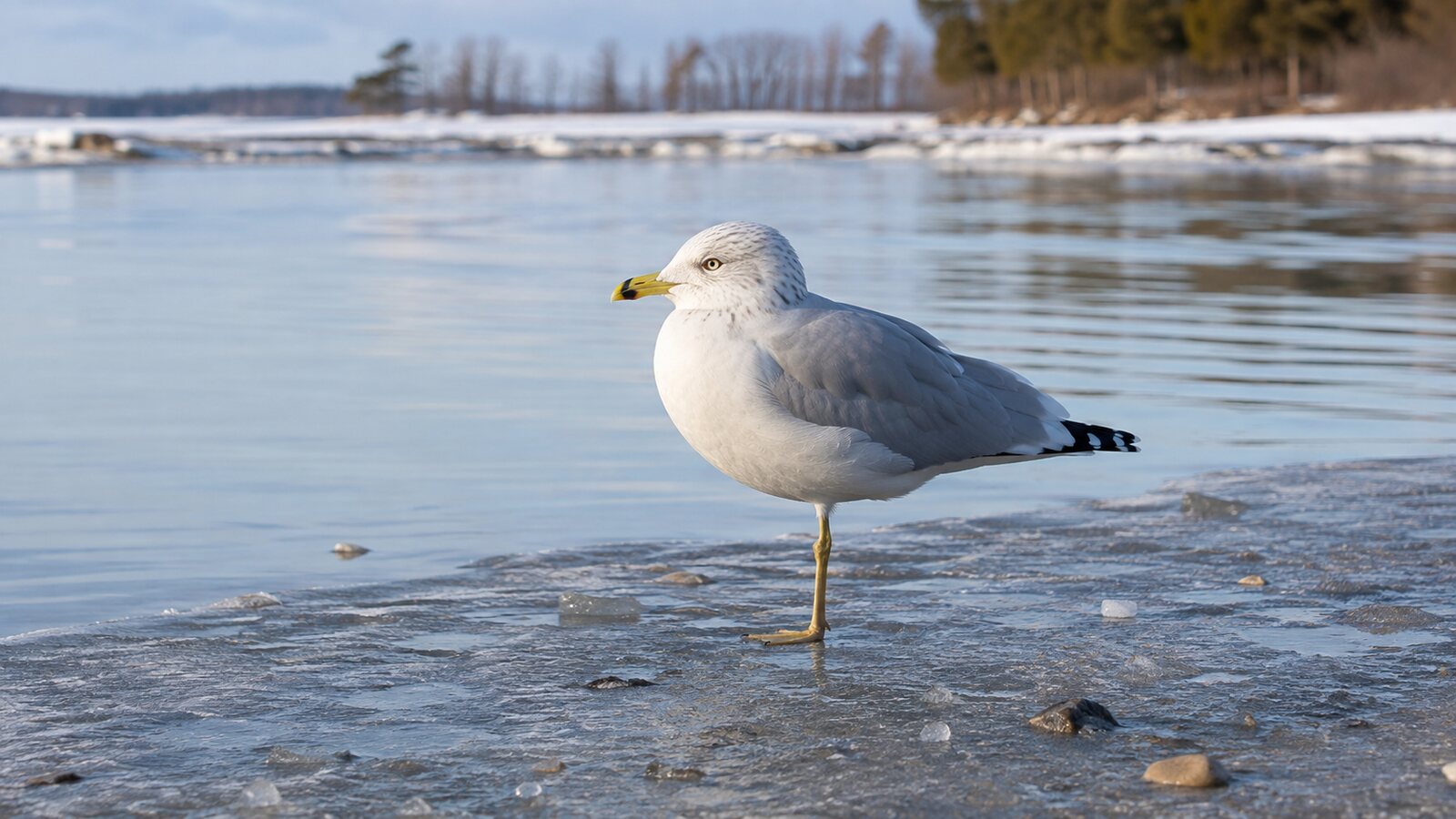
Why tucking one leg can save heat
Most of a bird’s body is wrapped in feathers, but the lower legs and feet are often exposed. That makes them important places for heat exchange with the environment.
When a duck, goose, gull, shorebird, or songbird pulls one foot up into its belly feathers, it reduces the amount of bare leg and foot exposed to cold air, ice, water, or a chilly perch. The tucked foot sits inside the bird’s warm feather insulation.
That is why one-legged resting is especially easy to understand on a cold day. It fits with the other heat-saving behaviours covered in how birds stay warm in winter.
But birds also stand on one leg when it is warm
The heat explanation is real, but it is incomplete.
Bird watchers see one-legged birds in mild and warm weather too. Research on wading birds and waterfowl has found that temperature does not affect every species in the same way. One study of several captive and wild species found one-legged standing actually increased with warmer temperatures in some birds.
That tells us not to turn a plausible explanation into a universal rule. Posture, rest, anatomy, activity, habitat, and species can all influence what a bird is doing.
Is standing on one leg tiring for a bird?
It looks tiring to us because human balance on one leg usually takes active muscular control. Birds are built differently.
Many birds have leg and foot anatomy that lets them maintain certain resting positions efficiently. The exact mechanics vary by bird group. A songbird gripping a branch, a duck resting on shore, and a flamingo standing in shallow water are not using identical systems.
The main point is that a posture that looks awkward to a person may be quite comfortable for the bird.
Why do flamingos stand on one leg?
Flamingos made this question famous. Their extremely long legs and habit of standing in water make the one-legged pose hard to miss.
Heat conservation has long been proposed because pulling one leg out of the water reduces heat loss. But biomechanics research found something else remarkable: a flamingo can support its body in a one-legged posture with very little active muscular force.
Researchers studying flamingo anatomy and live birds found that the one-legged stance can become mechanically stable when the body is positioned correctly. That means a resting flamingo may not be performing a difficult balancing act in the way it appears to us.
So the better answer is not “flamingos stand on one leg only to keep warm.” Their anatomy makes the posture efficient, and heat conservation may be an added benefit depending on conditions.
Why do ducks and geese stand on one leg?
With ducks and geese, the heat-saving explanation is especially easy to see in winter. Their feet may be standing on ice, snow, wet ground, or cold shoreline while most of the body is protected by dense feathers.
A resting bird can pull one foot into those feathers and alternate feet from time to time. You may also see the bird sit down and cover both feet with its body.
Waterfowl can limit heat loss through their legs. Their feet may stay much cooler than the body core without carrying away as much body heat as you might expect.
Why do gulls stand on one leg?
Gulls often use the same tucked-foot posture. It is common to see a gull standing on one leg on a cold beach, dock, parking lot, ice edge, or shoreline.
Again, there is no need to assume the bird has injured the missing-looking leg. Watch for a while. A healthy resting gull may lower the tucked leg, stretch, switch sides, walk normally, or fly away.
That switching behaviour is one clue that you are watching normal resting and heat conservation rather than a bird with only one functional leg.
Do songbirds stand on one leg too?
Yes. Small perching birds sometimes pull one foot into their belly feathers while resting on a branch, wire, feeder, or other perch.
The pose can be harder to notice because the tucked leg disappears into the feathers and the supporting foot may be hidden by the perch. A round, fluffed chickadee can look as if it has no legs at all.
For a perched songbird, the feet are also built to grip efficiently. Tendons help the toes maintain a grasp when the leg bends, which is part of how many perching birds can rest securely on a branch.
Can birds sleep on one leg?
Yes. Many birds rest or sleep in one-legged postures. A bird that feels secure may combine several resting behaviours at once: one leg tucked up, feathers loosened, head turned backward, and bill tucked into shoulder feathers.
Different species sleep in very different places and positions. Ducks may rest on water or shore, songbirds use branches and shelter, and cavity nesters can disappear into holes or boxes. See where birds sleep at night for more.
Does one leg mean the bird is injured?
Usually not if the bird is simply resting. Healthy birds regularly tuck one leg so completely that it looks missing.
Watch what happens when the bird moves. If it lowers the other foot, walks evenly, grips normally, or flies away without difficulty, the one-legged stance was probably just a resting posture.
A bird that consistently avoids using one leg while moving, holds the leg at an unusual angle, has a visible wound, or cannot perch or walk normally may be injured. Observing behaviour over several moments gives you more information than a single still pose.
Why don’t birds fall over?
Bird balance comes from the whole body, not just the supporting foot. The legs sit beneath the bird’s centre of mass, the body shifts slightly over the planted foot, and the nervous system continually responds to movement.
Some species have additional mechanical advantages. Flamingos are a striking example because their one-legged stance can become very stable with little muscle activity.
Wind, alertness, feeding, and disturbance can change the posture. A resting bird may look motionless on one leg, then instantly place both feet down when something catches its attention.
Frequently asked questions
Why do birds stand on one leg?
Heat conservation is one reason, but resting comfort, anatomy, and species-specific mechanics can also contribute.
Do birds stand on one leg to keep warm?
Often. Tucking one bare foot into belly feathers reduces exposed surface area, especially in cold weather. It doesn’t explain every one-legged bird, though.
Why do flamingos stand on one leg?
Flamingos can maintain the posture with very little active muscular force. Heat conservation may also be a benefit, but it isn’t the only explanation scientists consider.
Can birds sleep standing on one leg?
Yes. Many birds can rest or sleep upright while one leg is tucked into the feathers.
Keep following the question
That tucked foot is part of a bigger heat-saving picture, and the leg itself is easy to misread. Read do birds have knees?, how birds stay warm in winter, or return to the Bird Facts hub.