
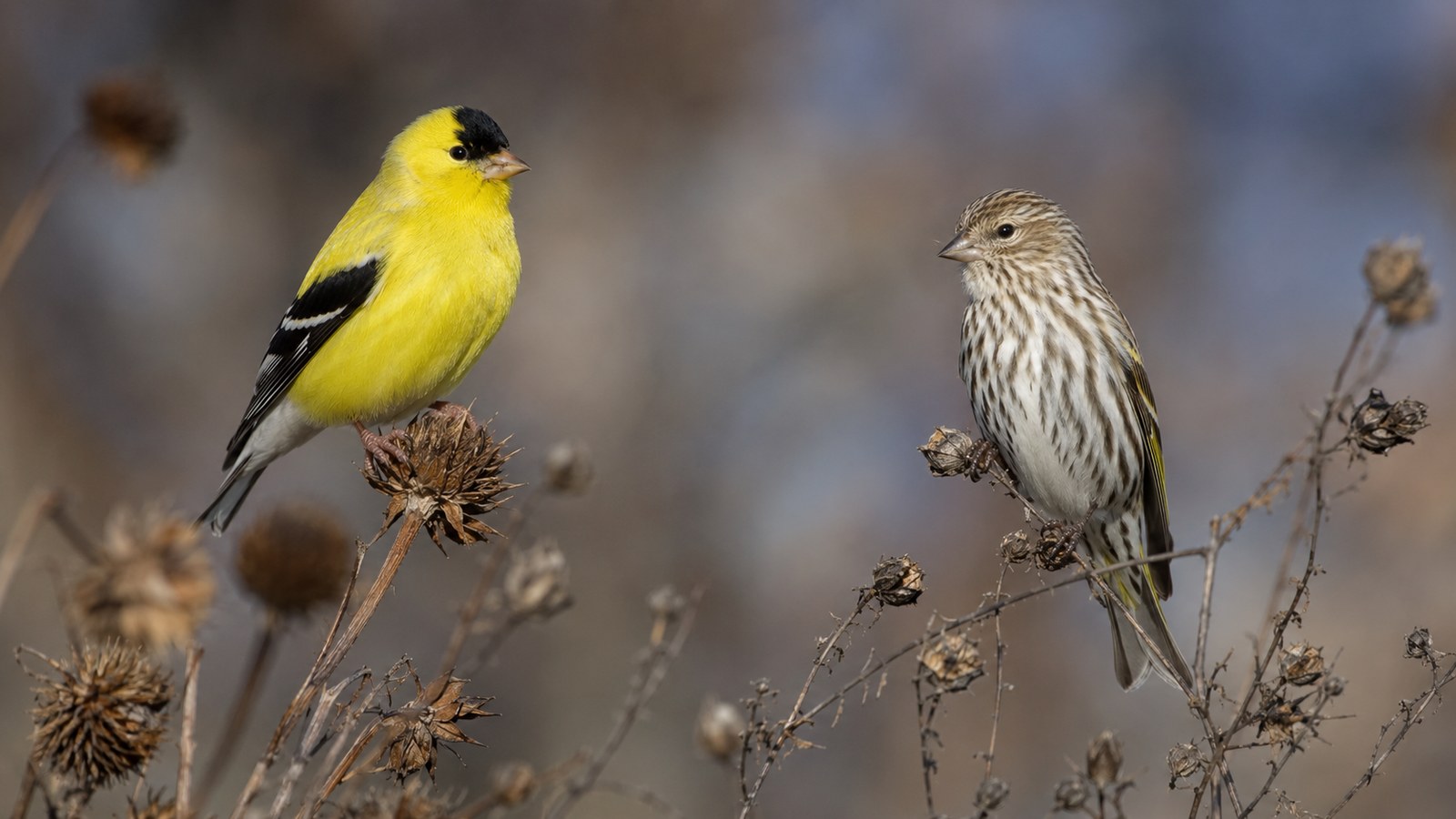
Why these two feeder finches are confused
American Goldfinches and Pine Siskins are small finches that eat similar seeds, gather in flocks, use tube and mesh feeders, and may appear together. Both have dark wings, pale wing markings, notched tails, and some yellow. A bright summer male goldfinch is easy, but a winter goldfinch can look buff, olive, grey-brown, or only faintly yellow.
The confusion increases when a Pine Siskin hides its yellow wing and tail edges. The dependable solution is to ignore brightness at first. Compare body streaking, bill shape, wing pattern, tail, movement, sound, and date.
Side-by-side comparison
| Feature | American Goldfinch | Pine Siskin |
|---|---|---|
| Overall pattern | Plain or softly coloured body without heavy streaking | Heavily streaked above and below |
| Bill | Short, broad, and conical | Thin, narrow, and sharply pointed |
| Breast and sides | Unstreaked or nearly unstreaked | Dense brown streaks |
| Wings | Dark wings with bold pale bars and patches | Dark streaked wings with subtle yellow edging |
| Tail | Short and notched with pale markings | Short, strongly notched, with yellow near the edges |
| Seasonal change | Dramatic change from bright breeding male to dull winter plumage | Streaked brown appearance remains broadly similar through the year |
| Flight | Deep bouncing or undulating flight | Fast, active, and often less deeply bouncing |
| Voice | Clear, musical calls often heard in flight | Rising buzzy call and rougher conversational notes |
| Flock behaviour | Social and often more orderly | Restless, active, and frequently assertive at feeders |
| Occurrence | Common and often predictable across much of North America | Highly variable, with irregular winter movements |
Streaking is the strongest starting clue
Pine Siskins are covered with narrow brown streaks. The marks run across the breast, sides, back, and head, creating a busy pattern. Even pale birds usually retain clear streaking below.
American Goldfinches are comparatively plain. Breeding males are bright yellow, females are softer yellow or olive, and winter birds become buff or brownish, but the breast and belly remain mostly unstreaked. The contrast between a plain body and dark wings is often visible even in poor light.
Don’t confuse shadow lines, wet feathers, or overlapping wing feathers with true streaking. Look for repeated narrow marks running through the breast and flanks. When these are absent, American Goldfinch becomes more likely.
Bill shape works when plumage is hidden
An American Goldfinch has a short conical bill designed for handling seeds. It looks broad at the base and tapers quickly to the tip. The small head and compact bill create a neat profile.
A Pine Siskin has a much narrower, more pointed bill. It can look surprisingly delicate compared with the heavily streaked body. In a side photograph, the difference between the goldfinch’s seed-cracking cone and the siskin’s fine sharp point is often decisive.
Bill colour changes with age, season, and light, so focus on shape rather than whether it appears pink, grey, or dark.
Winter American Goldfinches deserve special attention
A nonbreeding male American Goldfinch loses the bright yellow body and black forehead of summer. Females and immature birds are also much duller. A winter flock may look olive, buff, tan, or grey-brown, with only a little yellow on the face or shoulders.
The wings still help. Goldfinches show dark wings with bold pale bars and edging. The body stays relatively plain, and the bill remains short and conical. These clues are safer than expecting every goldfinch to be bright yellow.
During autumn and spring moult, individual feathers can create a patchy appearance. Record the whole pattern rather than matching the bird to one perfect seasonal photograph.
Pine Siskin yellow may be hidden
Pine Siskins often have yellow edging in the wings and at the base or sides of the tail. The colour can flash during flight, landing, bathing, or a disagreement at the feeder. On a calm perched bird, much of it may be covered.
Some individuals show very little obvious yellow. This is why “I didn’t see yellow” doesn’t rule out Pine Siskin. Heavy streaking and a pointed bill are more dependable. Yellow becomes supporting evidence when it appears in the expected wing and tail positions.
Compare wings and tail carefully
American Goldfinches have bold blackish or dark brown wings with clean pale bars, patches, or edging. The strong wing contrast can remain obvious when the body is dull. Their short tail is notched and carries pale markings.
Pine Siskin wings look more streaked and less cleanly blocked. Yellow edging may cut through the dark wing, and the tail is strongly notched with yellow near the sides. The bird often looks more angular and active.
A photograph taken during landing can reveal wing and tail colour that’s hidden when perched. Use burst mode only from a respectful distance and avoid crowding the feeder.
Flight and posture add good clues
American Goldfinches often fly in deep waves. Several rapid wingbeats lift the bird, followed by a closed-wing dip. Their clear calls frequently accompany this bouncing flight.
Pine Siskins can also undulate, but their flight often looks quicker and more restless, especially in tight flocks moving between treetops and feeders. At a feeder they may cling at varied angles and push into crowded feeding spots.
Behaviour varies with weather, flock size, and food pressure, so use it after plumage and bill shape rather than as a stand-alone answer.
Listen for clear versus buzzy calls
American Goldfinches give clear musical notes, including a flight call that many birders remember as a four-part phrase. The exact wording people attach to it differs, so describe the rhythm and tone rather than depending on one mnemonic.
Pine Siskins often give a rising buzzy call that sounds rougher and more drawn out. Feeding flocks also produce rapid twittering notes. A clean recording can help, but background feeder noise and overlapping birds may confuse sound applications.
Confirm any sound suggestion with the bird’s streaking, bill, wing pattern, location, and date.
Season and irregular movements change the odds
American Goldfinches are widespread across much of Canada and the United States. Local movements occur, but many areas receive them predictably during large parts of the year.
Pine Siskins are less predictable. Their numbers shift as conifer and seed crops change. A region may host large flocks one winter and almost none the next. Current local checklists are therefore better than assuming last year’s pattern will repeat.
In western North America, also consider Lesser Goldfinch in suitable range. It’s less streaked than a Pine Siskin and differs from American Goldfinch in back colour, wing pattern, and regional distribution. Keep the first decision focused on whether the mystery bird is heavily streaked and fine-billed.
Feeder observations that help
Both species readily eat nyjer and sunflower seed. Food choice alone doesn’t separate them. Instead, use the feeder as a scale. Compare bill length with the seed ports, body size with nearby chickadees or goldfinches, and wing pattern with other birds in the flock.
Take notes on flock size, arrival date, calls, aggression, and whether yellow flashes appeared during movement. Keep feeders clean and seed dry, especially when dense finch flocks gather.
A dependable identification routine
- Decide whether the breast and flanks are plain or heavily streaked.
- Compare the short conical bill with a narrow pointed bill.
- Study the wing pattern before relying on body brightness.
- Look for yellow in the wings and tail during movement.
- Watch flight style, posture, and flock behaviour.
- Listen for clear musical calls or a rising buzzy call.
- Check current local occurrence, especially for Pine Siskin.
- Record “small finch species” when the view remains incomplete.
Frequently asked questions
What is the easiest difference?
Pine Siskins are heavily streaked and have thin pointed bills. American Goldfinches are comparatively plain and have short conical bills.
Can a winter goldfinch look brown?
Yes. Winter birds may be buff, olive, or brownish. Look for plain underparts, bold dark wings with pale markings, and the short conical bill.
Do all Pine Siskins show yellow?
No. Yellow can be subtle or hidden while perched. Streaking and bill shape are safer starting clues.
Why do Pine Siskin numbers change so much?
They move irregularly as cone and seed crops change, so local numbers can differ greatly between years.