
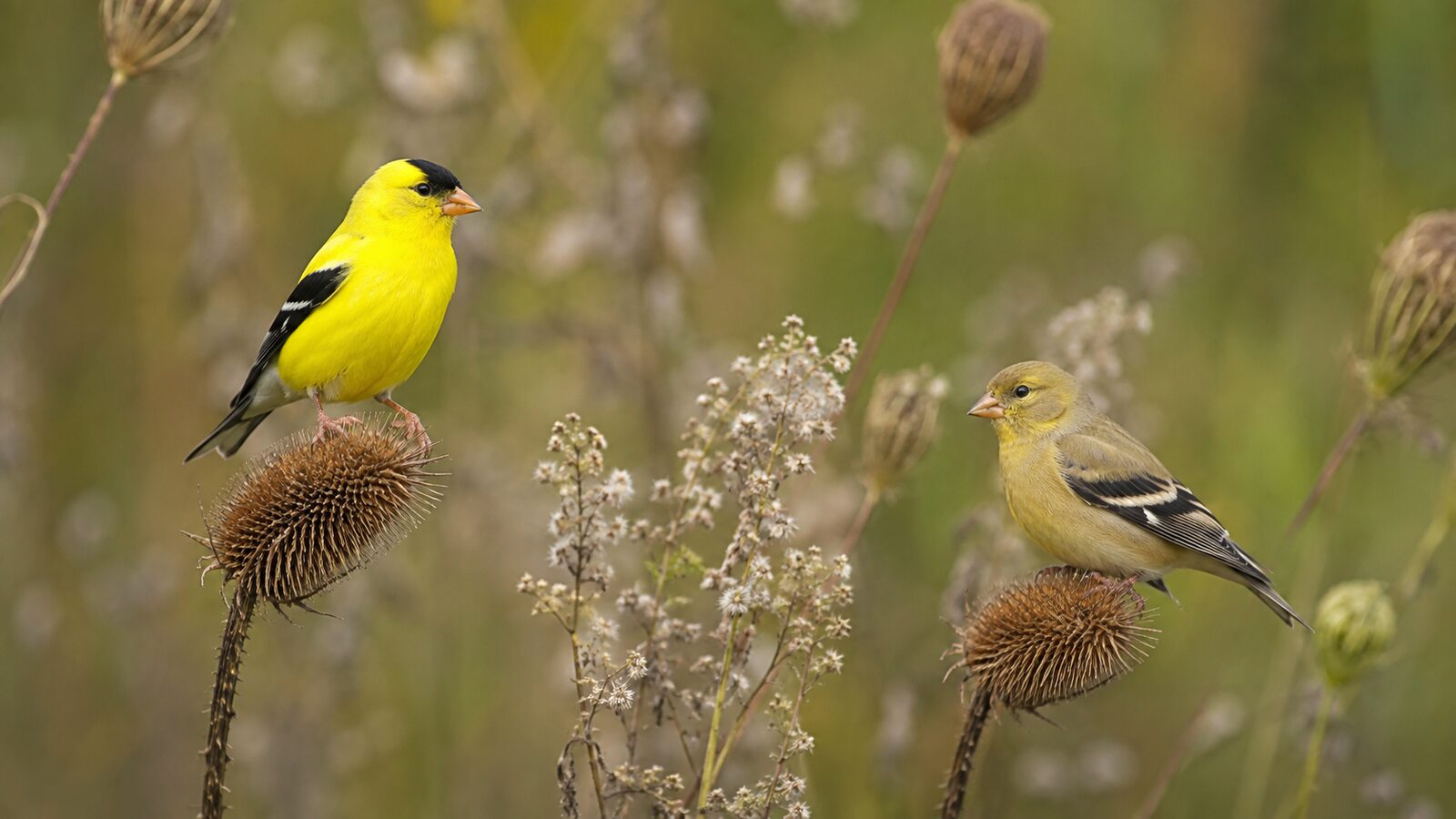
Variation is normal
Bird photographs often show a clean adult in good light, but real sightings are less tidy. A bird may be young, worn, moulting, backlit, wet, partly hidden, or in a different seasonal plumage.
Cornell and Audubon both emphasize that no guide can show every possible plumage. The goal is to understand which features can change and which clues remain dependable.
Male and female plumage may differ
In some species, adult males are brighter or more strongly patterned than adult females. In others, the sexes look nearly identical and can’t be separated reliably by a brief view.
Differences may involve head colour, wing pattern, body brightness, throat patches, bill colour, or overall contrast. Avoid assuming that every dull bird is female, because young males and non-breeding adults may also look subdued.
Sex differences aren’t always obvious
Some field guides use “female-type” for birds that share a general appearance but can’t be assigned confidently to sex or age. This can be more accurate than forcing a label.
When the species is clear but the sex isn’t, record the species and describe the plumage. Identification doesn’t need to include every possible detail.
Juvenile birds may seem unfamiliar
Young birds can have spots, streaks, pale feather edges, shorter tails, different bill colours, or softer-looking plumage. Some are similar to adults, while others look surprisingly different.
A juvenile American Robin, for example, has a spotted breast rather than the cleaner adult pattern. The body shape, behaviour, habitat, and nearby adults can provide context.
Young birds pass through several stages
“Juvenile” doesn’t describe every young-looking bird equally. Some species move through one or more immature plumages before reaching their definitive adult appearance.
Large gulls, eagles, and some other birds can take several years to acquire full adult plumage. A broad label such as “immature eagle” may be more honest than guessing an exact age.
Breeding and non-breeding plumage can differ
Many birds become brighter or more strongly patterned during the breeding season. Later they may appear duller, browner, greyer, or less contrasting.
Ducks, shorebirds, loons, grebes, gulls, and many songbirds can change noticeably. The date and location become important parts of the identification.
Moult replaces feathers
Feathers wear and must be replaced. Moult can produce uneven edges, gaps in the wings or tail, mixed old and new feathers, or a temporarily ragged appearance.
A bird in active moult may look unlike a polished field-guide image. Missing feathers can change the outline and make the tail or wings look shorter or uneven.
Fresh and worn feathers look different
New feathers often have crisp edges and stronger contrast. Sun, abrasion, weather, and normal use gradually fade colours and wear away pale feather tips.
A pattern may become sharper as pale edges wear off, or it may become less distinct as dark feathers fade. The bird hasn’t necessarily changed species or age category.
Regional variation can alter appearance
Some species vary gradually across their range, while others include recognized subspecies or regional populations with different shades, size, bill proportions, or markings.
This is one reason to use a guide or app set to the correct province, state, region, and date. A photograph from another part of North America may not match the local population perfectly.
Individual birds aren’t identical
Even birds of the same age and sex can vary in brightness, size, feather condition, and pattern. Some differences are subtle, while others are obvious.
Don’t reject an otherwise strong identification because one bird is slightly darker, paler, larger, or more heavily marked than a typical illustration.
Unusual pigment can create striking birds
Leucism, albinism, dilution, and other pigment variations can produce white patches, unusually pale feathers, or other abnormal colour patterns. Staining can also change feathers.
When plumage is unusual, focus on structure, bill, posture, behaviour, habitat, sound, and any normal pattern that remains visible. An unusual bird can still retain the species' familiar body plan.
Wet feathers look darker and thinner
Rain and bathing can darken plumage, flatten the feathers, and make a bird look smaller or more slender. Wet head feathers may hide a crest, and wet body feathers may reduce visible fluff.
After drying, the same bird can look rounder, paler, and more familiar.
Fluffed feathers change body shape
A cold or resting bird may trap air by fluffing its feathers, creating a round appearance. An alert bird may compress its plumage and look much slimmer.
Estimate the underlying body structure rather than using the outer feather outline alone. Bill, head proportions, leg position, and tail length can help.
Backlighting removes colour detail
A bird between you and a bright sky may become almost entirely dark. Iridescent feathers may look black until the light reaches them at the right angle.
Use silhouette, posture, bill, tail, flight, behaviour, and sound until a better viewing angle becomes available.
Warm and cool light shift colour
Morning and evening sunlight can add warm orange or golden tones. Deep shade and reflected sky can make neutral feathers appear blue or grey.
Record the pattern and light conditions. “Pale bird in warm sunset light” is better than an exact colour name chosen without context.
Iridescence changes with angle
Iridescent feathers reflect light differently as the bird or observer moves. A throat or head may flash green, purple, blue, bronze, or black within seconds.
This is common in hummingbirds, grackles, starlings, ducks, and several other groups. Watch for repeated flashes and combine them with stable features.
Cameras can alter the image
Automatic exposure, white balance, sharpening, noise reduction, and phone processing can change colour and detail. A shadow may be brightened, or a bright patch may lose texture.
Keep the original file when possible and compare it with written notes about the light. A photograph is evidence, but it’s not a perfectly neutral record.
Branches and leaves can hide key marks
A leaf may cover a wing bar, and a branch may create a false dark line across the breast. Partial views can make separate patches appear connected.
Wait for another position instead of building an identification around one obstructed frame.
Common reasons one species looks different
| Reason | What may change |
|---|---|
| Male versus female | Brightness, head pattern, wing pattern, bill colour, or body colour |
| Juvenile versus adult | Spots, streaks, feather edges, tail length, bill colour, or eye colour |
| Breeding season | Brighter colours or stronger contrasting patches |
| Non-breeding season | Duller, browner, greyer, or more blended plumage |
| Moult | Uneven, missing, mixed, or newly growing feathers |
| Feather wear | Fading, softer edges, or exposed underlying colours |
| Regional variation | Shade, size, bill proportions, or marking strength |
| Wet feathers | Darker colour and a slimmer-looking body |
| Fluffed feathers | Rounder shape and partly hidden markings |
| Lighting | Colours may appear dark, warm, cool, washed out, or iridescent |
What can you still trust when plumage changes?
Size and shape often remain more stable than colour. Bill structure, head proportions, leg length, wing shape, tail shape, and general posture can keep the bird in the correct group.
Behaviour also helps. A nuthatch still moves along bark in a characteristic way, and a flycatcher still launches from a perch to catch insects even when plumage is dull or worn.
Habitat, location, and season keep the shortlist realistic
A plumage that resembles several species becomes easier to interpret when only one or two are expected in that habitat, region, and month.
Use range information as a filter, not absolute proof. Birds can wander, but the common local possibility deserves careful comparison before a rare one.
Use broad labels when evidence is incomplete
It’s acceptable to record “female-type duck,” “immature hawk,” “gull species,” or “small streaked sparrow” when a precise identification isn’t supported.
An honest broad identification preserves the observation. A forced species name can make later comparison more difficult.
What can change a bird’s look
- Confirm the bird's size, shape, bill, posture, and tail.
- Record the date, location, habitat, weather, and light.
- Consider sex, age, and seasonal plumage.
- Look for moult, worn feathers, wet plumage, or fluffing.
- Compare behaviour, sound, and expected regional species.
- Accept a broader identification when the evidence remains incomplete.
Practise these clues with backyard woodpeckers
The common backyard woodpecker guide compares eight birds using size, bill, pattern, behaviour, sound, range, and season. If you have narrowed it to a similar pair, use the matching comparison: Downy vs Hairy, Yellow-shafted vs Red-shafted Flicker, the three sapsuckers, Red-bellied vs Red-headed, or Northern Flicker vs Pileated.
Frequently asked questions
Why can male and female birds look different?
In some species, males and females have different plumage, brightness, head patterns, bill colours, or body colours. In other species they look very similar.
Why do juvenile birds look different from adults?
Young birds may have spots, streaks, different feather edges, shorter tails, different bill colours, or duller patterns before they acquire adult plumage.
Do birds change colour with the seasons?
Many birds replace feathers through moult, producing different breeding and non-breeding appearances. Feather wear can also reveal or fade colours through the year. If you want the feather-replacement side of the story, read why do birds molt?
Can lighting make a bird look like a different colour?
Yes. Backlighting, shade, sunset light, reflected sky, camera exposure, and iridescence can change how colours appear. Use pattern, shape, behaviour, and several viewing angles.
Practise these clues with backyard finches
The common backyard finch guide applies size, bill, colour pattern, behaviour, range, and season to eight birds. Focused practice includes House Finch vs Purple Finch, Evening vs Pine Grosbeak, and Redpoll vs Pine Siskin.
Feathers can change a bird’s apparent size
A cold or resting bird can look much rounder simply because it has raised its feathers. Read why birds puff up their feathers for the behaviour behind that change.