
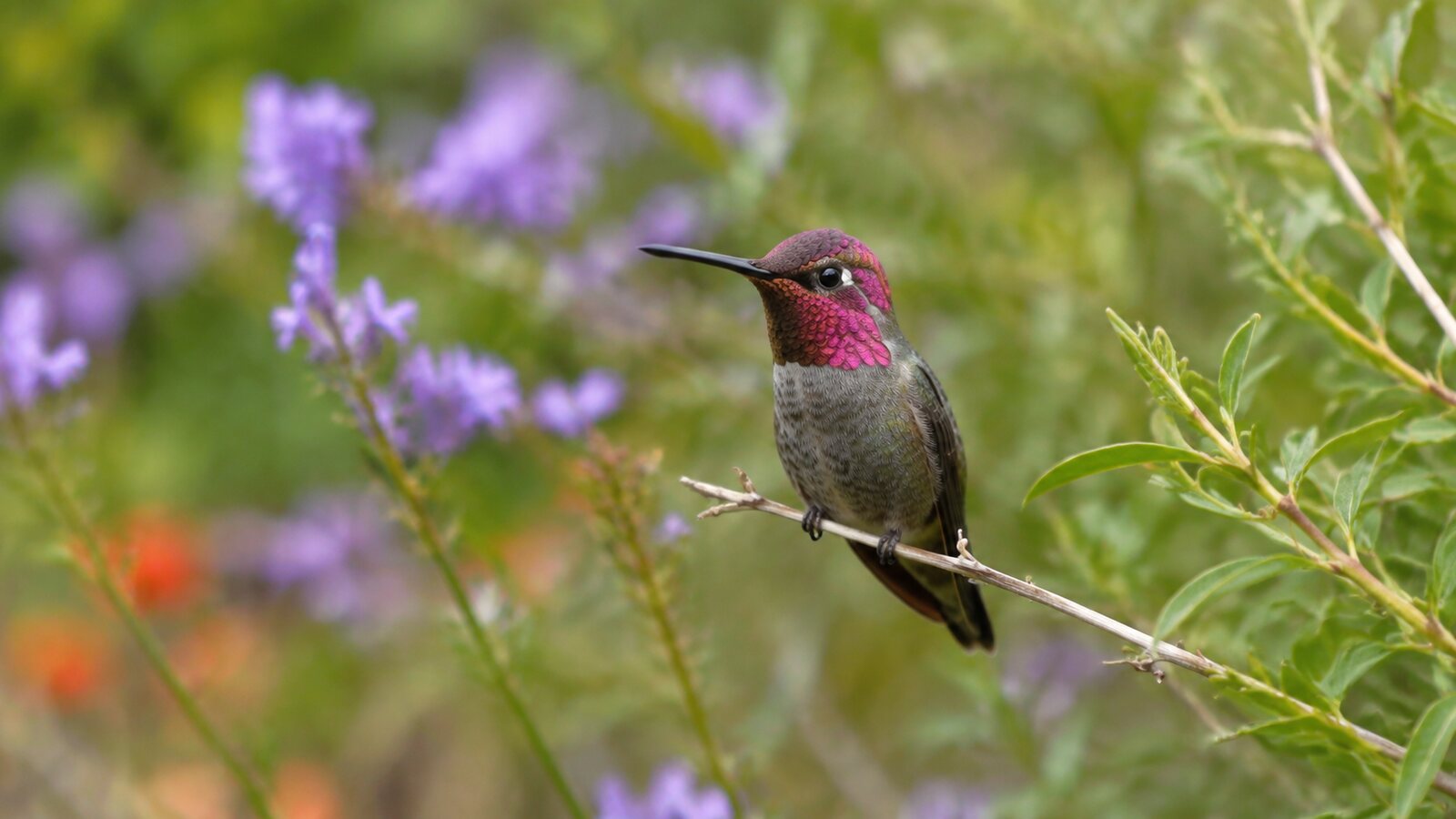
How to identify an Anna's Hummingbird
An adult male can be spectacular in good light. The crown and throat flash rose-pink to magenta, while the back is metallic green and the chest and belly are grayish.
Turn the bird away from the sun and that bright colour can almost disappear. Iridescent feathers change with the angle of light, so a male may look dark-headed one moment and brilliant pink the next.
Females and immature birds are less obvious. They are green above and pale gray below, often with a small reddish or pinkish patch in the centre of the throat. A pale spot behind the eye can also show.
Shape helps. Anna's Hummingbirds look fairly stocky for a hummingbird and have a straight, medium-length bill.
Where do Anna's Hummingbirds live?
Anna's Hummingbirds are strongly associated with the Pacific Coast and western North America.
They are common in gardens, suburbs, parks, coastal scrub, open woodland, oak habitat, and other places with flowers and insects.
The species has expanded its range dramatically during the past century. Cornell notes that it once bred mainly in California and northern Baja California but now occurs north to British Columbia in healthy numbers.
That makes Anna's Hummingbird especially familiar around Vancouver Island and the Pacific Northwest.
Do Anna's Hummingbirds migrate?
Not like Ruby-throated Hummingbirds do.
Many Anna's Hummingbirds remain in the same broad region all year. Some move shorter distances when flowers, weather, or food conditions change, but they do not normally make the long seasonal migration to Central America that defines many other North American hummingbirds.
That is why a hummingbird visiting a British Columbia feeder in winter can very reasonably be an Anna's.
What does an Anna's Hummingbird sound like?
The male sings a surprisingly long, rough song made from buzzes, whistles, and sharp chip notes. It does not sound sweet in the way people expect a tiny bird to sound.
Both sexes also use short sharp chips and quick twittering calls during chases and close encounters.
If you learn the male's scratchy song, you may notice Anna's Hummingbirds before you see them.
Why do male Anna's Hummingbirds dive?
Courtship.
A male can climb more than 100 feet into the air, then dive steeply past a female or another display target.
Near the bottom, a loud squeak appears. It is not a vocal note. Research showed that the sound comes from air passing over modified outer tail feathers.
The display can look extreme for such a tiny bird. It is one of the easiest behaviours to remember once you have seen it.
This aerial performance is one of many forms covered in why birds dance during courtship.
What do Anna's Hummingbirds eat?
Nectar is important, but hummingbirds do not live on sugar water alone.
Anna's Hummingbirds visit many native and garden flowers. They also take nectar from feeders when feeders are available.
Small insects and spiders provide protein and other nutrients. Cornell notes that Anna's Hummingbirds catch insects in the air, pick them from leaves and flowers, take them from spider webs, and sometimes feed at sap wells made by sapsuckers.
What should you put in an Anna's Hummingbird feeder?
Plain white table sugar and water.
Use one part sugar to four parts water. Do not add red dye, honey, artificial sweeteners, or other ingredients.
Our hummingbird nectar recipe covers the simple mix, while How Often to Change Hummingbird Nectar covers warmer weather and feeder cleaning.
How do Anna's Hummingbirds nest?
The female builds the nest and cares for the young by herself.
She makes a tiny cup from plant down and spider silk, often on a horizontal branch. Lichen, moss, and other bits can help camouflage the outside.
A clutch usually contains two white eggs. Cornell gives an incubation period of about 16 days and a nestling period of about 20 days.
Spider silk lets the nest stretch as the chicks grow. For a nest that begins barely wider than a large coin, that flexibility matters.
Anna's Hummingbird vs Ruby-throated Hummingbird
Range is a major clue.
Anna's Hummingbird is a western species, especially common along the Pacific Coast. Ruby-throated Hummingbird is the main breeding hummingbird across eastern North America.
Adult males look different too. Anna's has an iridescent rose-pink crown and throat. A male Ruby-throated Hummingbird has a red throat but a green crown.
Females take more care, so use location, shape, tail pattern, season, and sound rather than forcing the identification from one photograph.
How long do Anna's Hummingbirds live?
Many hummingbirds die young, but some survive for years.
Cornell reports an oldest recorded Anna's Hummingbird of at least 8 years and 2 months.
Frequently asked questions
Are Anna's Hummingbirds in Canada?
Yes. They occur in southwestern British Columbia and are now a familiar year-round hummingbird in parts of the region.
Do Anna's Hummingbirds stay all winter?
Many do in mild western areas. They can use torpor during cold nights, lowering body temperature and slowing metabolism to save energy. Read how small birds survive winter for the difference between hummingbird torpor and smaller temperature drops in some other birds.
Do Anna's Hummingbirds recognize feeders?
They can learn dependable food locations and return to them. That does not mean a feeder should be neglected. Clean nectar and clean feeder ports still matter.
Can you leave a hummingbird feeder up in winter?
Yes where hummingbirds remain, as long as you maintain it properly. Leaving a feeder up does not force a healthy migratory species to stay behind.
More familiar birds
Continue with Ruby-throated Hummingbird, Northern Flicker, or browse all Common Birds. For backyard care, see the full Backyard Birds section.