
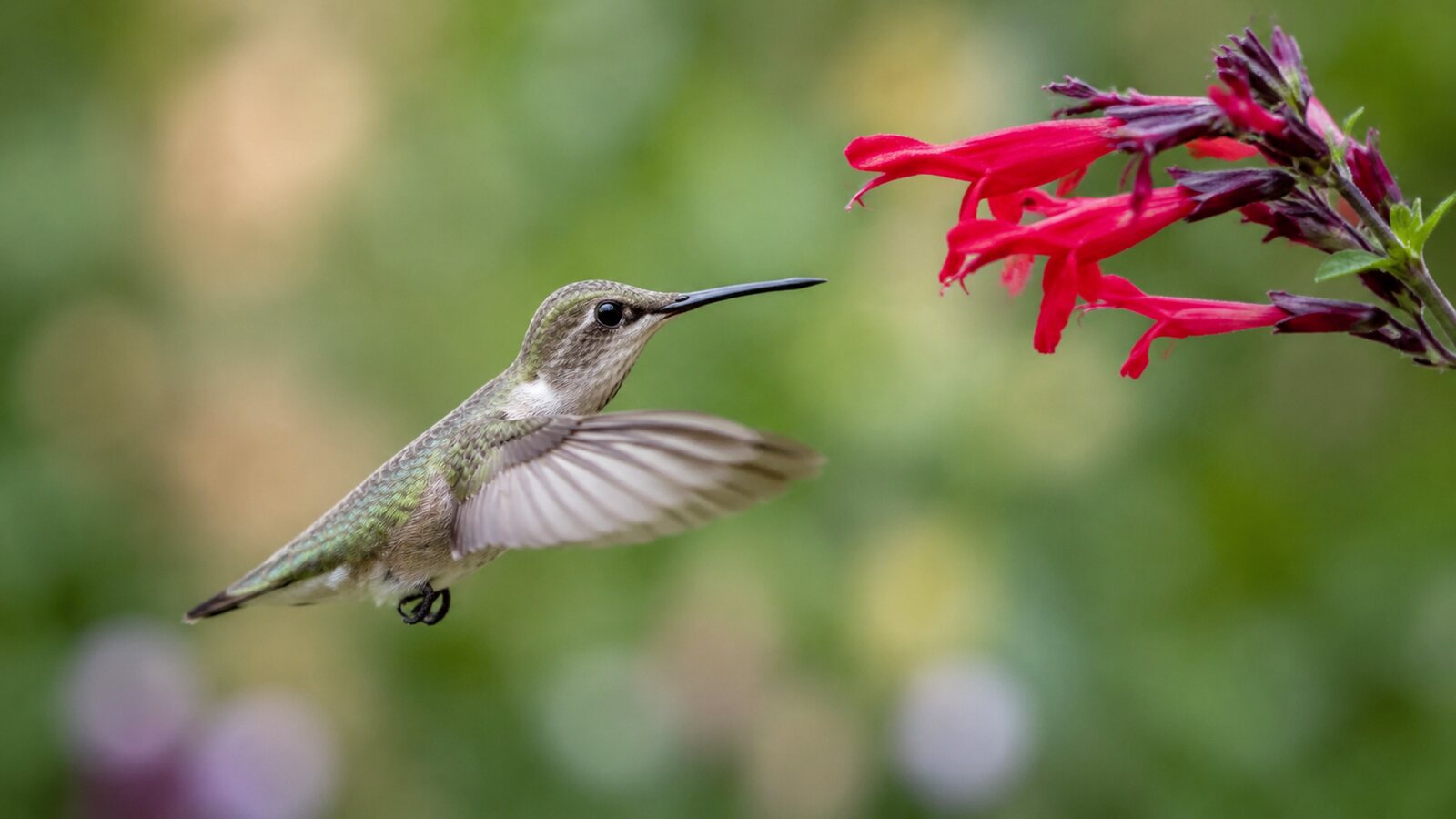
What birds can fly backwards?
Hummingbirds are the specialists.
They can fly forward, backward, sideways, up, down, and remain almost motionless in the air. Cornell describes hummingbirds as precision flyers that can stop instantly and adjust their position in every direction. Smithsonian likewise notes their unusual ability to hover and fly backward.
That is very different from a bird being pushed backward by a gust or making a brief awkward reverse movement. Hummingbirds can choose the direction and hold it.
Why can hummingbirds fly backwards?
The key is the shoulder.
Most birds get most of their lift from the downstroke. Hummingbirds rotate their wings through a much broader motion, often described as a flattened figure eight. Their wings can produce lift on both the forward and backward parts of the stroke.
Change the wing angle and the direction of that force changes too. The hummingbird can push itself forward, keep itself in place, or move backward.
It looks effortless. It isn't.
Why would a hummingbird need to fly backwards?
Flowers explain a lot.
A hummingbird may hover in front of a tubular flower, insert its bill, feed, then back straight out without turning its body around. The same control works at a hummingbird feeder.
It also helps during chases, courtship, and quick manoeuvres around branches and other birds. If you've watched hummingbirds defend a feeder, you've probably seen how abruptly they can change direction.
Can other birds fly backwards at all?
They can sometimes move backward briefly, but that is not the same thing.
A strong wind can push a bird backward relative to the ground. A bird landing on a perch may flap and shift backward for a moment. Some species can use short reverse movements while manoeuvring in tight spaces.
What most birds cannot do is hover in still air and deliberately sustain backward flight the way a hummingbird can.
Can hummingbirds hover without moving?
Yes, or very close to it.
A hummingbird can maintain its position relative to a flower while its wings beat rapidly around it. Smithsonian calls hummingbirds the only vertebrates capable of sustained hovering.
The bird is still moving constantly. Its body stays in one place because the forces created by the wings balance gravity and forward movement.
How fast do hummingbird wings beat?
Very fast.
Smithsonian reports around 70 wingbeats per second in direct flight for Ruby-throated Hummingbirds, with much higher rates possible during dives. The exact number varies by species and what the bird is doing.
You don't need to count them to appreciate it. At normal viewing distance, the wings often look like a blur.
Is backward flight harder than forward flight?
Hovering and manoeuvring are energetically expensive.
Hummingbirds have enormous metabolic demands for their size. They need frequent access to nectar and also eat small arthropods for protein and other nutrients.
Backward flight is usually a short manoeuvre, not a way to travel across the neighbourhood. For longer movement, forward flight makes much more sense.
Can hummingbirds fly upside down?
Briefly, they can get into some astonishing positions.
Hummingbirds may roll, pitch, dive, and twist during courtship or territorial chases. Smithsonian notes that they can fly upside-down as part of their exceptional manoeuvrability.
That doesn't mean a hummingbird cruises around upside down. These are short acrobatic movements.
Can hummingbirds fly straight up?
Yes.
Because they can direct lift in unusual ways, hummingbirds can rise almost vertically without needing a long forward takeoff run. That is handy around flowers, branches, and feeders where space is tight.
It is one reason a hummingbird can seem more like a tiny helicopter than an ordinary bird.
Why can't most birds hover like hummingbirds?
Their wings and shoulders are built for a different style of flight.
A robin, crow, goose, or eagle needs efficient forward flight. Their wing shapes vary enormously, but none has the same hummingbird combination of shoulder rotation, wing motion, small body size, and extremely high power output.
Some birds can hover briefly by flying into a headwind or flapping hard in place. Kestrels do this beautifully. It still isn't the same sustained hovering mechanism.
Do hummingbirds ever stop flying?
Of course.
They perch often. A hummingbird may sit quietly on a bare twig between feeding visits, preen, watch a territory, or rest.
At night, hummingbirds can enter torpor, a deep energy-saving state in which metabolism and body temperature drop substantially.
Can you see backward flight at a feeder?
Yes. A feeder is one of the easiest places to watch it.
Look at a hummingbird as it finishes drinking. Instead of turning its whole body around, it may back away from the feeding port, pause, then zip forward or sideways.
If you're feeding hummingbirds, keep the nectar simple and clean. Our hummingbird nectar recipe uses plain white sugar and water.
Frequently asked questions
Can birds fly backwards?
Hummingbirds can sustain controlled backward flight. Other birds may make brief reverse movements or be pushed backward by wind, but they don't normally fly backward the same way.
What bird is best at flying backwards?
Hummingbirds. Backward flight is a normal part of how they manoeuvre around flowers, feeders, and other birds.
Can hummingbirds hover?
Yes. Their wing motion lets them generate lift while keeping the body nearly stationary in the air.
Why don't hummingbirds just turn around?
Sometimes backing away is faster and requires less space, especially when the bird has its bill inside a flower or feeder port.
Hummingbirds bend the normal bird-flight rules
Backward flight is only one part of it. Hummingbirds hover, climb almost vertically, stop in an instant, and change direction quickly. Continue with how bird wings work, how birds control a turn, visit the hummingbird nectar guide, or return to Bird Facts.