
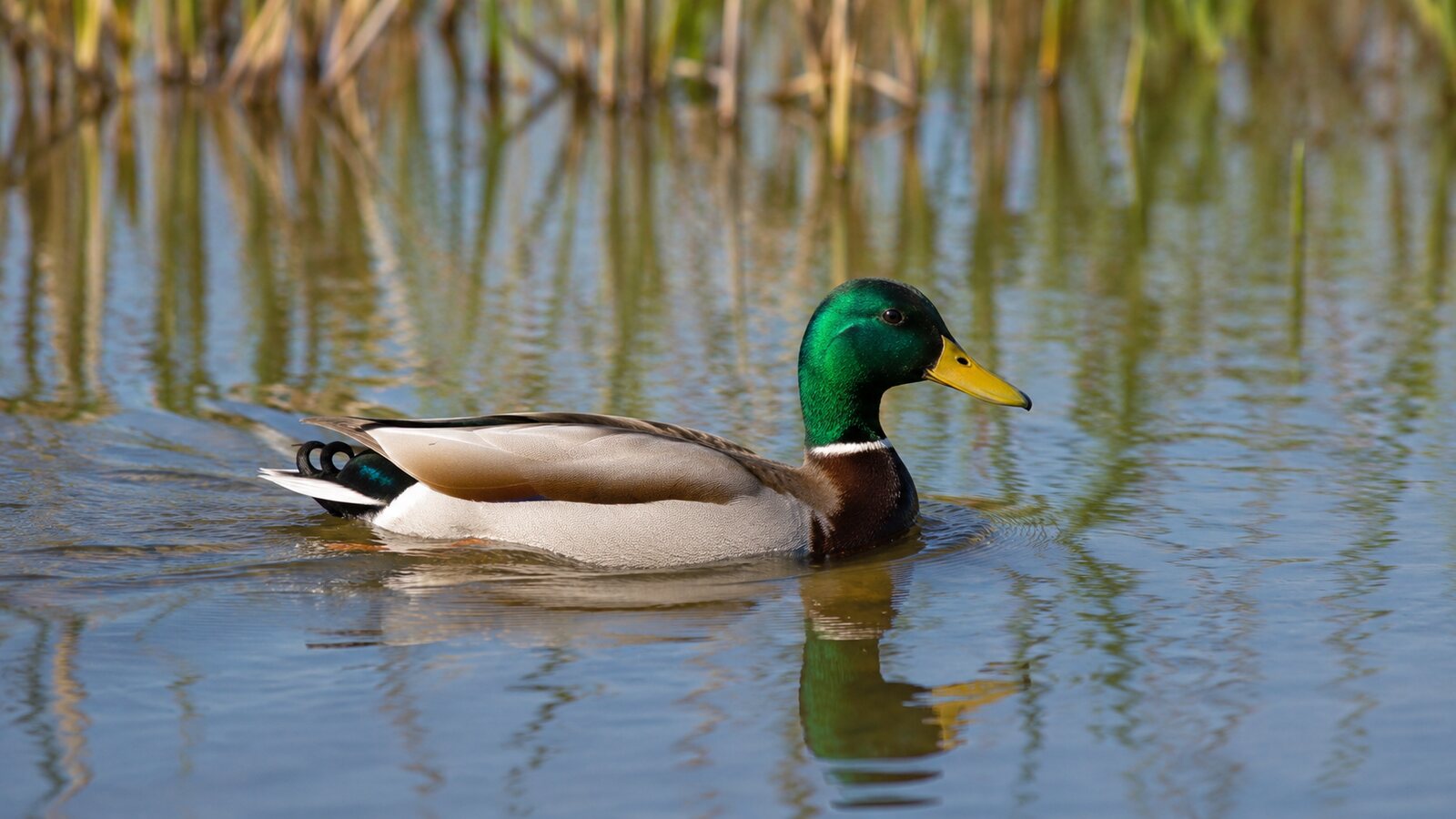
Which birds can swim?
Ducks, geese, swans, loons, grebes, coots, cormorants, puffins, murres, and penguins are obvious examples.
They do not all swim the same way.
A Mallard paddles mostly with its feet at the surface. A Common Loon dives and drives itself underwater with powerful feet placed far back on the body. A penguin uses stiff wings as flippers and moves through water with a motion that looks a lot like flight.
Water created several different solutions.
Can all birds swim?
No.
A robin can stand in a birdbath and splash. That is not the same as being able to cross a lake safely.
Many land birds are poorly equipped for sustained swimming. Their feet do not produce much thrust, their body position is wrong for efficient movement, and wet plumage can make escape harder.
A bird that accidentally lands in deep water may be able to flap or paddle for a while, but that does not make deep water harmless.
Why do ducks have webbed feet?
Webbing gives the foot a broader surface to push against water.
On the power stroke, the foot spreads and pushes water backward. On the recovery stroke, the bird can fold or angle the foot to reduce drag.
Not every swimming bird has classic duck-like webbing. Grebes and coots have lobed toes instead, and those expanded surfaces can work like paddles too.
The basic goal is the same: move water efficiently.
Can birds swim underwater?
Yes, and some are spectacular at it.
Common Loons are powerful underwater hunters. Cornell notes that they propel themselves with their feet while chasing fish.
Cormorants use their feet too. Diving ducks kick below the surface. Penguins and auks take another route, using their wings for underwater thrust.
Once you watch one of these birds underwater, "bird" stops feeling like a word that belongs only in the sky.
Do birds use their wings to swim?
Some do.
Penguins are the most obvious example. Their wings became short, stiff flippers specialized for moving through dense water rather than air.
Auks, including puffins and murres, can still fly in the air, but they also flap their wings underwater. Their wing design has to compromise between two very different fluids.
That compromise is one reason a puffin does not have the long soaring wings of an albatross.
Why are loons so good at diving?
Loons are built around underwater pursuit.
Their legs sit far back on the body, which makes them awkward walkers but powerful swimmers. Cornell also notes that loons have relatively solid bones compared with many birds, reducing buoyancy and making it easier to dive.
They can compress air in their feathers and adjust buoyancy before slipping below the surface.
Great in the water. Pretty clumsy on land.
Can penguins really be called flying underwater?
It is a good description, even though the physics of water and air are different.
Penguins produce thrust and lift-like forces with flipper-shaped wings. They bank, turn, accelerate, and glide through water with remarkable control.
Their bodies are streamlined, and their legs and feet sit toward the rear, where they help steer.
The trade-off is complete loss of powered flight in the air.
Are bird feathers waterproof?
Water birds have plumage that resists wetting, but "waterproof" can be too simple a word.
Feather structure traps air and helps keep water away from the skin. Preening maintains the feather surfaces, and oil from the uropygial gland contributes to feather condition in many species.
Birds still get wet. Feathers can become saturated under the right conditions.
For more on feather care, see why do birds preen?
Can birds drown?
Yes.
Any bird can be in trouble if it cannot reach a safe exit, becomes exhausted, is trapped, or gets its plumage badly soaked.
This matters around artificial water features. Deep smooth-sided containers can be hard for small birds and other wildlife to climb out of.
A backyard birdbath should stay shallow and give birds secure footing and an easy edge.
Can baby birds swim?
It depends on the species.
Ducklings, goslings, and many other waterfowl are precocial. They hatch covered in down, can move around quickly, and follow their parents onto water soon after hatching.
A baby robin is nothing like that. A nestling songbird is not ready for a swim and should not be treated as if every bird chick comes with a built-in paddling program.
Why do some birds float so high while others sit low?
Body shape, feather-trapped air, bone density, and how much air a bird holds in its respiratory system all affect buoyancy.
A duck often rides high and looks cork-like. A loon can sit very low, with much of its body nearly hidden beneath the surface.
That low profile helps a diving bird disappear with very little splash.
Is bathing the same as swimming?
Not really.
A chickadee can hop into shallow water, dip its body, flick water over its back, and fly away. It is bathing, not travelling through water.
The behaviour is about feather care rather than aquatic movement.
See why do birds bathe? for that side of the story.
Frequently asked questions
Can robins swim?
Robins are not adapted as swimming birds. They bathe in shallow water and could make emergency movements if they fell in, but deep water is not their normal habitat.
Can owls swim?
Owls are not aquatic birds, although individual owls have been observed using wing and body movements to cross short stretches of water in emergencies. It is not normal swimming behaviour.
Can birds swim and fly?
Many can. Ducks, geese, loons, puffins, cormorants, and numerous other water birds both fly and swim. Penguins are the famous exception that traded aerial flight for extreme underwater specialization.
What bird is best at swimming?
There is no single winner because surface swimming, deep diving, underwater speed, and endurance are different skills. Penguins, loons, grebes, cormorants, and auks are all highly specialized swimmers.
Keep following the question
Water changes how birds move, feed, and care for feathers. Read do birds drink water?, why do birds bathe?, or head back to the Bird Facts hub.