
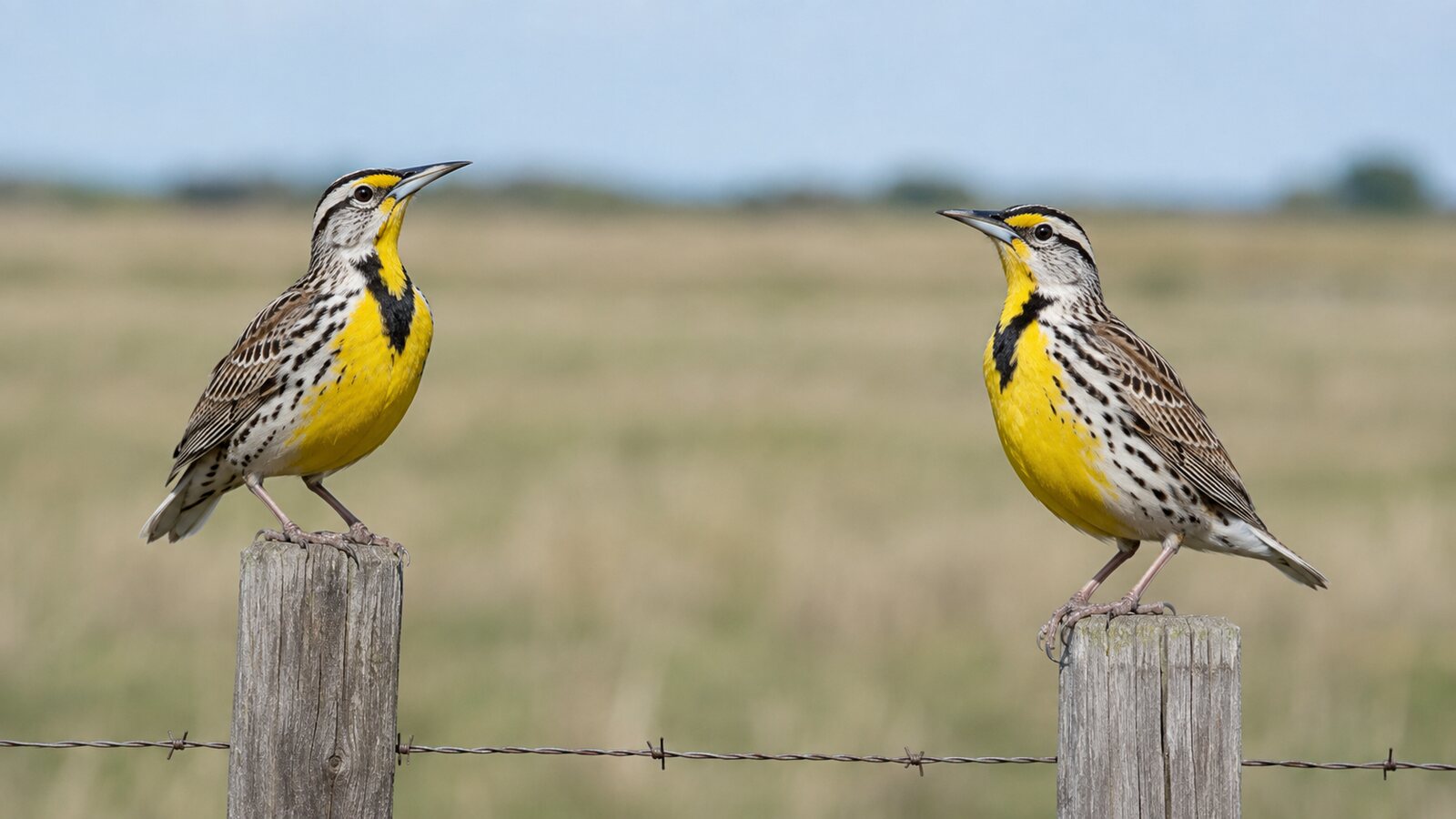
Eastern and Western Meadowlark comparison
| Clue | Eastern Meadowlark | Western Meadowlark |
|---|---|---|
| Main song | Short series of clear, slurred whistles | Longer rich whistles and bubbling warbles |
| Song impression | Simple, open, and sometimes plaintive | Complex, liquid, and flute-like |
| Lower cheek area | Often whitish beside the lower bill | Often more yellow beside the lower bill |
| Range | Mostly eastern and central North America | Mostly western and central North America |
| Habitat | Grasslands, pastures, hayfields, airports | Prairies, ranchland, meadows, open fields |
| Shared marks | Yellow breast, black V, patterned back, white tail edges | Yellow breast, black V, patterned back, white tail edges |
The easiest way to tell them apart
Listen for the shape of the song. An Eastern Meadowlark often gives three to five pure whistles that slur or step downward. A Western Meadowlark usually continues into a longer, more elaborate series of liquid whistles and bubbling notes.
Then check whether the location fits. In the central overlap zone, do not force the identification from geography alone. A clean recording and several views are far more useful than one distant photograph.
Why the birds look so similar
Both are stocky grassland songbirds with pointed bills, bright yellow underparts, a bold black V across the chest, striped faces, patterned brown backs, and white outer tail feathers. Both often sing from fence posts, shrubs, utility lines, or other low exposed perches.
Body size overlaps and posture changes quickly. Either species can look slim when stretched or round when feathers are fluffed, so overall shape rarely solves the comparison by itself.
Use face colour with caution
Eastern Meadowlarks often show whitish feathers along the lower cheek beside the base of the bill. Western Meadowlarks often show more yellow in the same area. This mark can help in a close, well-lit side view.
Shade, distance, camera exposure, feather wear, and head angle can change the apparent colour. Some birds also look intermediate. Treat the face as supporting evidence rather than a guaranteed answer.
Compare their songs
An Eastern Meadowlark song is usually brief and uncluttered. The notes are clear and whistled, with a simple slurred pattern that may sound slightly sad or questioning.
A Western Meadowlark song is richer and more varied. It often starts with clear whistles and flows into a rolling, gurgling, or bubbling finish. The exact phrases vary, but the longer musical shape is distinctive once familiar.
Both species also give short calls, flight notes, and chatter. A single call may be less decisive than a complete song. Use the guide to identifying birds by sound to compare pitch, pace, tone, and repetition.
Range narrows the possibilities
Eastern Meadowlarks occur mainly across eastern and central North America. Western Meadowlarks occupy much of western and central North America. The ranges overlap through parts of the Great Plains and nearby regions.
Bird ranges are not hard walls. Migration, local populations, habitat change, and occasional wandering birds can complicate the map. Use location to set probability, then confirm with song and visible clues.
Habitat and behaviour overlap
Both meadowlarks live in open country and spend much of their time on the ground. They walk through grass, probe soil and vegetation, and eat insects, seeds, and grain. Neither is a typical backyard feeder bird.
When disturbed, both may fly low with white outer tail feathers flashing. Their grass nests are hidden on the ground. Habitat confirms that the bird is probably a meadowlark, but it may not identify which one.
Male, female, and juvenile birds
Adult males and females look broadly similar, though males often appear brighter and carry a larger black chest patch. Juveniles are duller and more streaked, and the black V may be faint or incomplete.
A young meadowlark may lack the clean pattern expected from an adult illustration. Season, age, light, and worn feathers can all reduce the value of small colour differences.
Which meadowlark did you probably see?
An Eastern Meadowlark is more likely when the bird is in eastern grassland and sings a short series of clear, slurred whistles. A Western Meadowlark is more likely in western grassland when the song is long, liquid, and bubbling.
Where the species overlap, “Eastern/Western Meadowlark” is a responsible identification when the bird never sings and the visible details are weak.
Frequently asked questions
What is the best difference?
Song. Eastern Meadowlarks usually sing short slurred whistles, while Western Meadowlarks give longer, richer, bubbling phrases.
Can plumage alone identify the species?
Sometimes, but subtle plumage marks can be variable or hard to judge. Confirm them with voice and range.
Do their ranges overlap?
Yes. They overlap in parts of central North America, where sound becomes especially important.
Do meadowlarks visit feeders?
Usually no. They find food on the ground in fields and grasslands.
Full species guides
Continue with the Eastern Meadowlark guide or Western Meadowlark guide.