
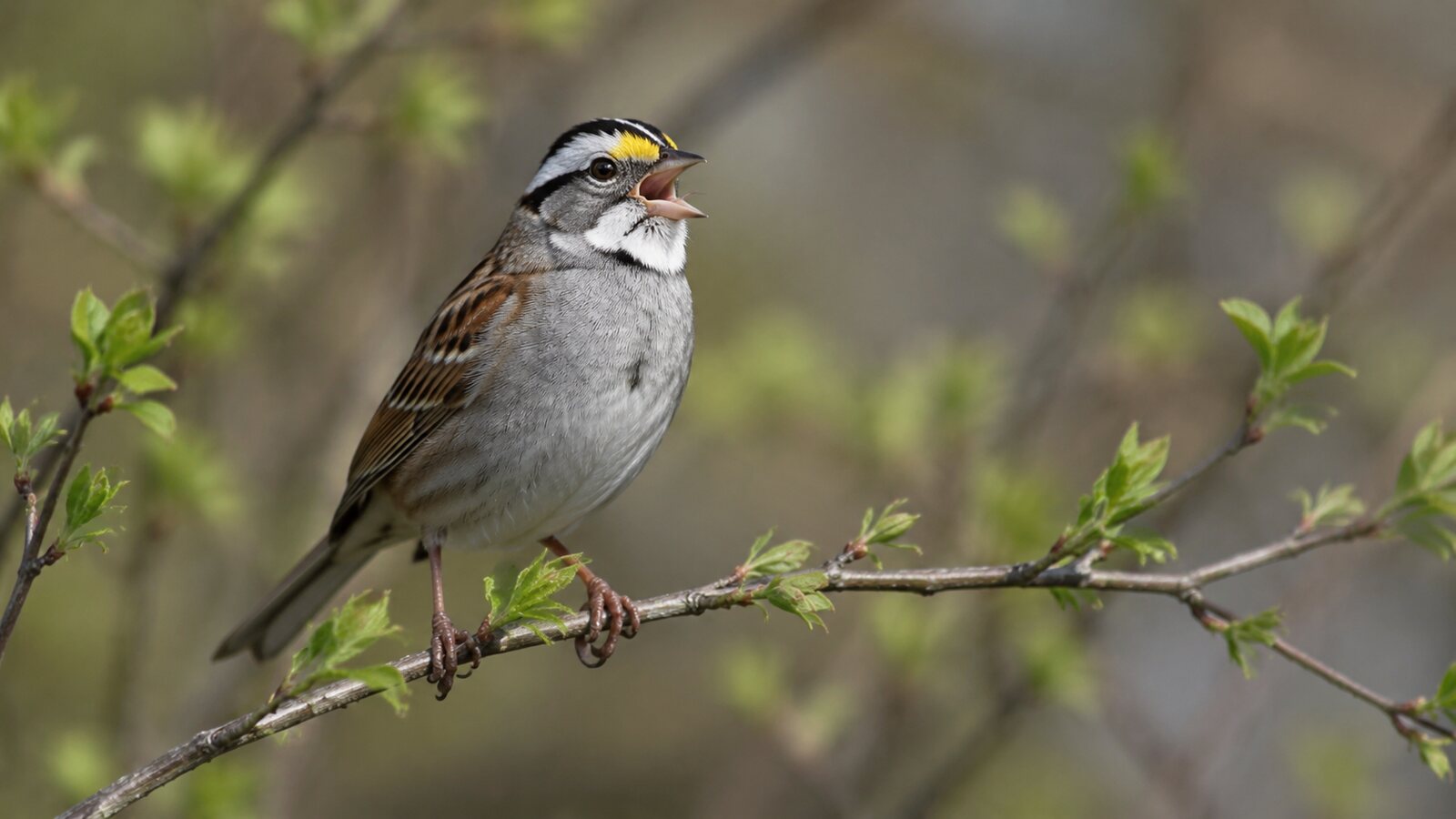
Birding by ear doesn’t require musical training
You don’t need to read music, name exact notes, or have perfect pitch. Bird identification by sound begins with ordinary comparisons. A call may sound sharp, soft, nasal, metallic, scratchy, liquid, buzzy, or flute-like.
Cornell teaches pitch, rhythm, and tone as good sound clues. Birds Canada also includes sound among the core ways to identify birds. The skill improves through repeated listening rather than technical vocabulary.
The bird on the other end of that call is listening with ear openings hidden beneath its feathers. Our Bird Facts page on whether birds have ears explains where those openings are and how birds hear without visible ear flaps.
Crows are a good example of why voice matters. Their familiar caws can separate them from the deeper croaks of ravens. See why do crows caw? and crow vs raven.
Separate songs from calls
A song is often longer, more patterned, and more closely connected with territory or courtship. A call is often shorter and may help birds stay in contact, warn of danger, beg for food, or coordinate flock movement.
The difference isn’t always obvious, and some species have several songs and many calls. Record what you hear without forcing it into a category when you’re unsure.
For the behaviour behind those sounds, read why birds sing and what short bird chirps can mean. The syrinx guide explains how birds produce their voices.
Notice the pitch
Pitch describes how high or low a sound seems. Some birds produce thin high notes that can be difficult for some listeners to hear, while others give lower whistles, hoots, croaks, or booming calls.
Also listen for movement in pitch. Does the phrase rise, fall, stay level, or move up and down? A descending whinny can be better than remembering only that the sound was fast.
Listen to pace and rhythm
Pace is how quickly the notes arrive. Rhythm is the pattern created by notes and pauses. A bird may give evenly spaced chips, a phrase that accelerates, a slow series of whistles, or several rapid notes followed by a long pause.
Tap the rhythm lightly with a finger or write it as short and long marks. Robin and I find that remembering the spaces between sounds can be just as handy as remembering the notes themselves.
Count repetitions and phrase length
Notice whether the bird gives one note, a pair, a three-part phrase, or a long repeated series. Count how many times the phrase repeats before the bird pauses or changes position.
A repeated pattern may remain consistent for several minutes. Another species may vary each phrase. That difference can narrow the choices even when the sound is partly hidden by traffic or wind.
Describe the tone quality
Tone quality is sometimes called timbre. It’s the character that makes a whistle sound different from a buzz even when both are at a similar pitch.
Everyday descriptions work just fine: whistle, trill, buzz, chip, rattle, squeak, chatter, croak, hiss, toot, hoot, or a harsh scold. Your words don’t need to match a field guide exactly. They only need to preserve what you noticed.
Listen for changes within the phrase
A phrase may begin slowly and speed up, grow louder, become rougher, or end with a separate note. Record the sequence in order rather than reducing it to one general description.
For example, “three clear whistles followed by a fast rattle” is better than “a musical bird.”
Birds also make non-vocal sounds
Bird identification by sound isn’t limited to songs and calls. Woodpeckers drum with their bills. Some birds clap wings, snap bills, rustle leaves, or make sounds with wings or tails during flight and display.
Watch for a matching movement. A repeated tapping from a tree, a wing whistle overhead, or vigorous scratching in dry leaves can provide both a sound and a behaviour clue.
Locate the bird without rushing closer
Turn slowly and listen from two or three positions. The apparent direction can change when sound reflects from buildings, water, cliffs, or dense vegetation.
Look first at likely singing perches, exposed branches, reed tops, fence posts, and the edges of shrubs. Avoid walking directly toward a nest, hidden young, or a bird that begins giving alarm calls.
Use habitat and height
Record whether the sound came from the ground, low shrubs, tree canopy, open sky, shoreline, marsh, grassland, or water. The same general whistle can point to different birds in different habitats.
Height is especially handy. A bird singing from the top of a tall conifer creates a different shortlist from a bird calling beneath wet leaves beside a stream.
Record the time, date, and location
Bird sounds change through the day and year. Dawn singing, migration calls, nesting alarms, winter flock notes, and nocturnal flight calls may occur in different seasons or situations.
Write down the exact date, local time, province or state, and habitat before comparing recordings. Those facts help remove species that are unlikely to be present.
Make a phone recording without disturbing the bird
Begin recording before moving. Hold the phone still, point the microphone toward the sound, and avoid rubbing the case, speaking, or walking during the best part of the recording.
A longer quiet recording is usually better than a close recording that changes the bird's behaviour. Don’t use repeated playback to draw a territorial bird closer, especially near nests or during breeding season.
Use Merlin Sound ID as a suggestion tool
Merlin Sound ID listens to nearby birds and offers real-time suggestions. Select a suggested species to compare your recording with reference songs and calls.
Merlin's official guidance encourages comparison and confirmation. A highlighted name can be wrong when several birds overlap, noise masks part of the sound, or a species has a similar call.
Confirm the suggestion with other clues
Ask whether the suggested bird fits the location, season, habitat, time of day, and height. Look for its expected size, shape, posture, movement, and colour pattern.
A strong identification uses several independent clues. A sound match becomes much more convincing when the bird is also behaving and appearing as expected.
Compare several recordings
One species can sound different across regions, individuals, ages, and situations. Compare several examples of songs and calls rather than choosing the first recording that sounds close.
Listen for the structure that stays consistent: pitch movement, rhythm, spacing, number of notes, and tone quality.
Learn one familiar sound at a time
Begin with birds you hear regularly near home. Learn one common song or call well enough that it becomes part of the background. Then add another sound that differs clearly.
Watching a visible bird while it sings creates the strongest connection. Over time, familiar sounds make unfamiliar ones easier to notice.
Use a sound-description worksheet
| Sound clue | What to record |
|---|---|
| Pitch | High, medium, low, rising, falling, or level |
| Pace | Slow, steady, rapid, accelerating, or irregular |
| Structure | One note, pairs, repeated notes, or a longer phrase |
| Tone | Whistle, trill, buzz, chip, rattle, hoot, croak, or harsh call |
| Repetition | How often the phrase repeats and how long the pauses are |
| Context | Habitat, height, date, time, weather, and visible behaviour |
Common sound-identification mistakes
- Choosing a species before describing the sound.
- Relying on a written phrase such as “cheer-up” without listening to rhythm and tone.
- Accepting one app suggestion without checking range and habitat.
- Assuming the loudest bird is the one shown by the app.
- Ignoring drumming, wing sounds, and other non-vocal noises.
- Moving too close and changing the bird's behaviour.
- Using playback repeatedly around territorial or nesting birds.
Practise with six memorable voices
Listen for an Eastern Phoebe’s short raspy phrase, the Gray Catbird’s cat-like mew, or a Northern Mockingbird repeating copied phrases. In lower cover, compare the Eastern Towhee’s opening notes and trill with the strongly repeated Common Yellowthroat song. A Red-winged Blackbird adds a rich buzzy ending over marshes.
Try six more distinctive singers
A Brown Thrasher usually repeats each phrase twice, while a House Wren pours out a bubbling jumble. In open country, compare the Eastern Meadowlark’s clear slurred whistles with the Western Meadowlark’s longer bubbling song. A Yellow Warbler speeds through bright whistles, and an American Redstart gives thin high notes, sometimes with a sharply accented ending.
Practise these clues with backyard woodpeckers
The common backyard woodpecker guide compares eight birds using size, bill, pattern, behaviour, sound, range, and season. If you have narrowed it to a similar pair, use the matching comparison: Downy vs Hairy, Yellow-shafted vs Red-shafted Flicker, the three sapsuckers, Red-bellied vs Red-headed, or Northern Flicker vs Pileated.
Frequently asked questions
What should I listen for when identifying a bird sound?
Listen for pitch, pace, rhythm, repetition, tone quality, phrase length, volume, and whether the sound rises, falls, buzzes, whistles, rattles, trills, or chips.
What is the difference between a bird song and a bird call?
Songs are often longer and more patterned, commonly linked with territory or courtship. Calls are often shorter and may signal alarm, contact, begging, movement, or flock coordination.
Can Merlin Sound ID identify a bird with certainty?
Merlin provides real-time suggestions, not automatic proof. Compare the recording with reference sounds and confirm the result using location, season, habitat, appearance, and behaviour.
How can I make a better phone recording of a bird?
Start recording before you move closer. Keep the phone still, point the microphone toward the sound, and avoid handling noise. Stay far enough away that the bird keeps behaving normally.
Practise these clues with backyard finches
The common backyard finch guide applies size, bill, colour pattern, behaviour, range, and season to eight birds. Focused practice includes House Finch vs Purple Finch, Evening vs Pine Grosbeak, and Redpoll vs Pine Siskin.