
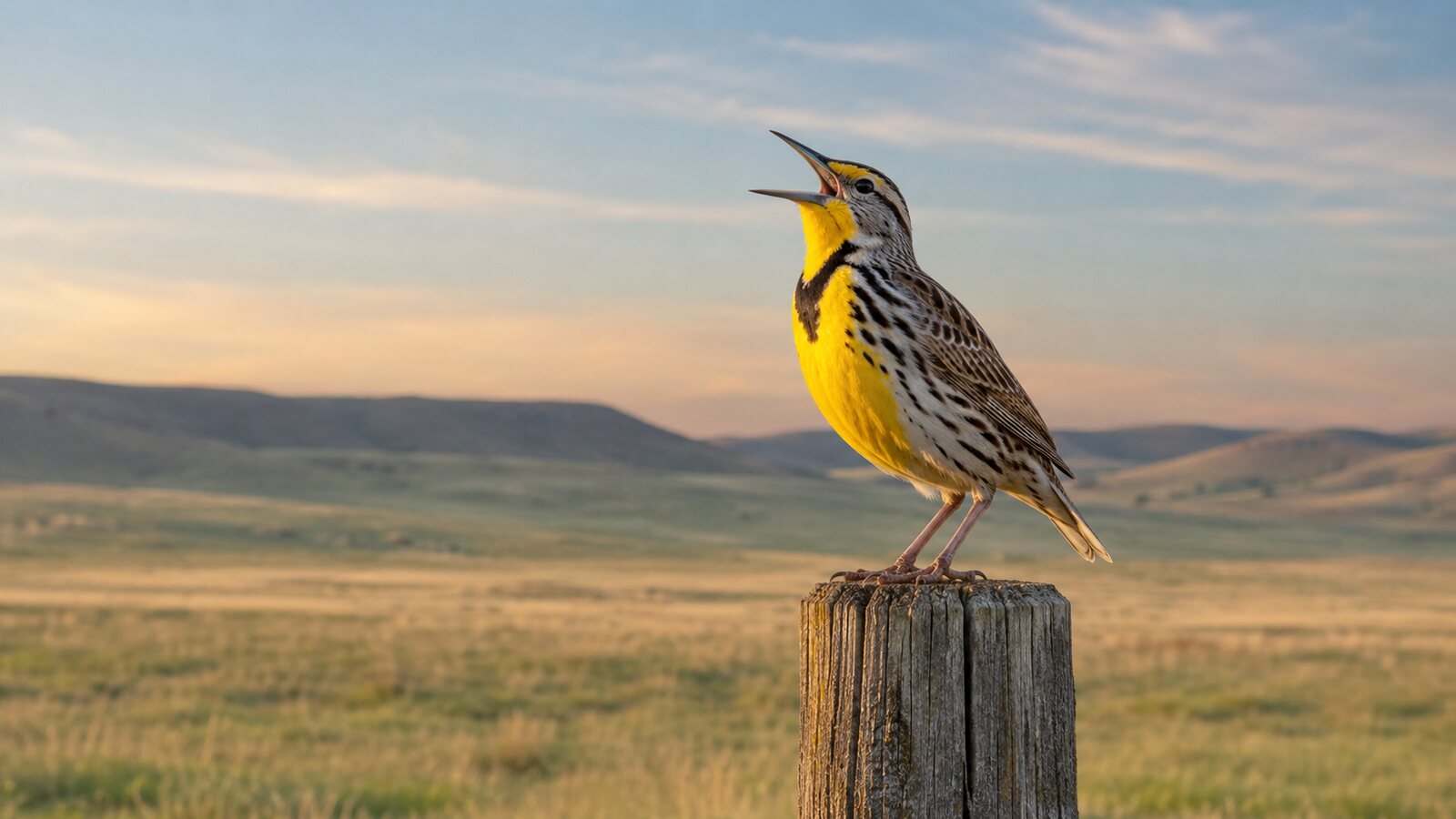
How to identify a Western Meadowlark
Western Meadowlarks have pointed bills, pale striped heads, brown-and-black patterned upperparts, yellow underparts, and a broad black V across the chest. The outer tail feathers show white in flight.
Males and females look much alike, though males are often brighter. Juveniles are dull and streaked, with little or no solid black on the chest.
Western Meadowlark size and wingspan
Adults are about 16 to 26 cm long, weigh roughly 89 to 115 g, and have a wingspan near 41 cm. Their shape is heavy-bodied, short-tailed, and upright when perched.
A meadowlark flying low over a field may show rapid wingbeats, short glides, and bright white tail edges.
What does a Western Meadowlark sound like?
The male song begins with one or more pure whistles, then rolls into rich, watery warbles. The notes often descend in pitch and can sound like a flute turning into a bubbling stream.
Calls include low bell-like notes, soft chupp sounds, and a thin flight note. In overlap areas, the longer, gurgling song is much more dependable than trying to separate the bird visually from an Eastern Meadowlark. The guide to identifying birds by sound can help you compare phrase shape and tone.
Habitat, range, and migration
Western Meadowlarks use prairies, ranchland, meadows, field edges, and other open country across western and central North America. They often sing from fence posts, utility lines, or low shrubs.
Many birds move south or to lower elevations after breeding, while some remain year-round in milder areas. Flocks can form in fall and winter.
What do Western Meadowlarks eat?
They eat grasshoppers, beetles, crickets, caterpillars, spiders, seeds, and grain. They walk on the ground, probing and parting vegetation with the bill.
Western Meadowlarks are not feeder birds. Healthy grassland with varied plants and low pesticide use provides their natural food.
Nesting, eggs, and young
The female builds a woven grass cup on the ground, hidden by surrounding plants. Some nests have an arching grass roof and a narrow path leading through the vegetation.
A clutch usually has three to seven white eggs marked with brown or purple. Incubation is about 13 to 16 days. Young leave the nest roughly 10 to 12 days after hatching, before they are strong fliers.
Similar birds and lifespan
Eastern and Western Meadowlarks can look almost the same. A Western often shows yellow beside the lower bill, but light and feather position can make that mark unreliable. Use song, range, and several field marks together.
The oldest recorded Western Meadowlark was at least 6 years and 6 months old. A record age is not the normal lifespan.
Why meadowlarks sing from posts
An open perch carries the male’s advertising song across grassland. The song announces a territory and can attract a mate, making this species a clear example of why birds sing and morning singing.
Frequently asked questions
Where do Western Meadowlarks live?
They use open grasslands, prairies, pastures, and fields across much of western and central North America.
Can you identify a meadowlark by song?
Yes. Voice is often the best clue. Western Meadowlarks give rich bubbling phrases, while Eastern Meadowlarks usually sing simpler slurred whistles.
Do Western Meadowlarks nest in trees?
No. The female builds a hidden grass nest on the ground.
More familiar birds
Use the Eastern vs Western Meadowlark comparison, meet the Red-winged Blackbird, or browse more common birds.