
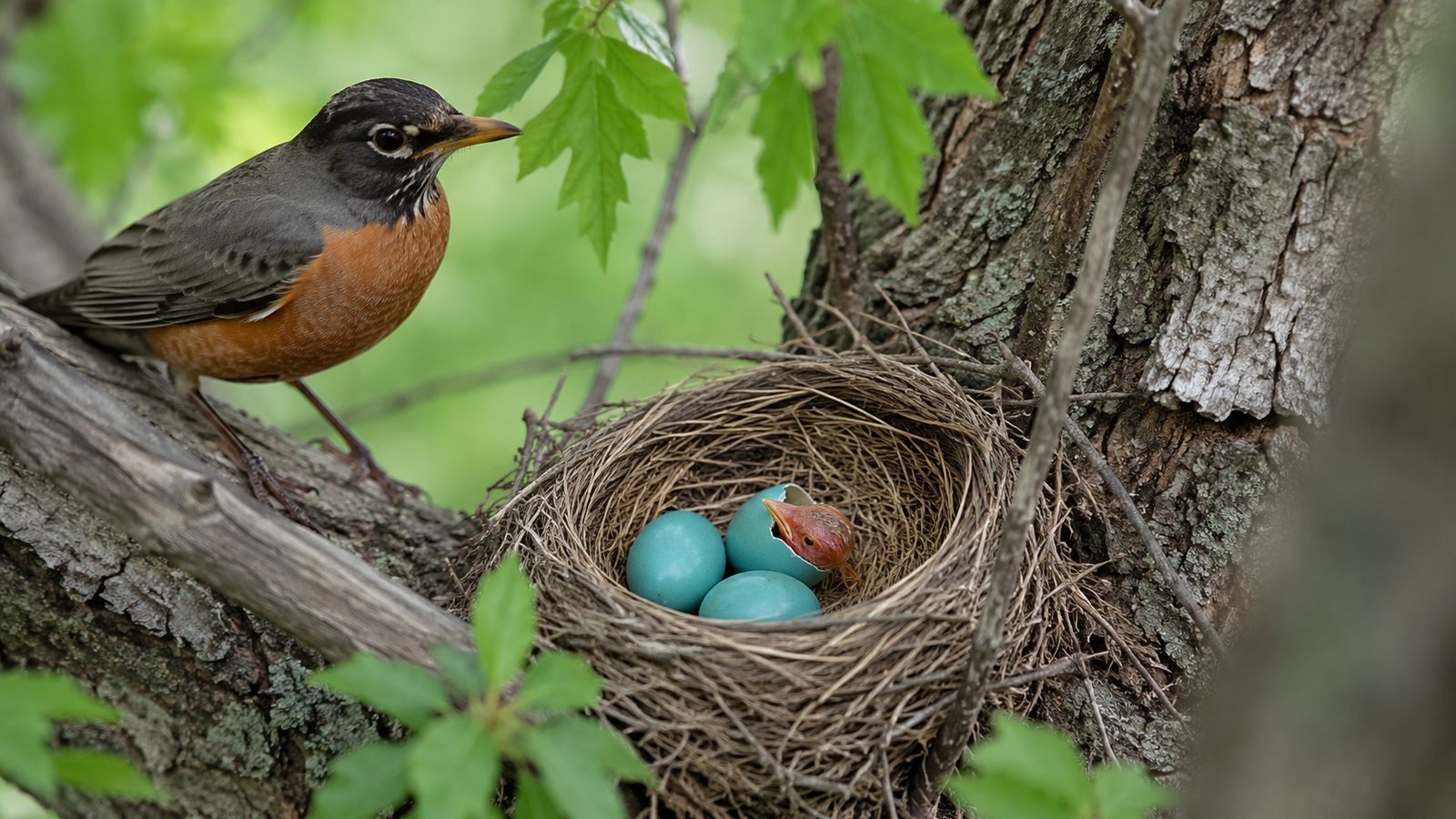
What does incubation mean?
Incubation is the period when a parent keeps eggs at the right conditions for the embryos to develop. In most birds, that means sitting over the eggs so body heat can warm them.
If you are wondering what happens before incubation starts, how do birds lay eggs? follows the egg from ovulation to the nest.
The parent does not simply sit motionless for days. It may turn the eggs, shift position, leave briefly to feed, trade places with a mate, or stand over the nest differently as the weather changes.
Eggs are remarkably well adapted to short normal breaks. A parent leaving for food does not automatically mean the nest has been abandoned.
How long do common bird eggs take to hatch?
Cornell NestWatch publishes average incubation periods for many familiar North American species. These figures show how quickly the schedule changes from one bird to another.
| Bird | Typical incubation |
|---|---|
| American Robin | About 13 days |
| Black-capped Chickadee | About 13 days |
| American Goldfinch | About 13 days |
| Baltimore Oriole | About 13 days |
| Blue Jay | About 17 days |
| American Crow | About 18 days |
| American Kestrel | About 30 days |
| Barn Owl | About 31 days |
| Bald Eagle | About 41 days |
Those are averages, not countdown timers. Individual nests can vary, and the start of full incubation is not always the same as the date the first egg appeared.
When does the incubation clock start?
That depends on the species. Many songbirds lay a clutch over several days and do not begin steady incubation until most or all of the eggs are laid. This helps the chicks hatch fairly close together.
Other birds begin serious incubation with the first egg. In those nests, the first chick may hatch before its younger siblings.
This is why counting days from the first egg can be misleading. If you did not see when regular incubation began, you may not be able to predict the hatch date exactly.
Why do some bird eggs hatch faster than others?
Species is the biggest part of the answer. Different birds have evolved different developmental schedules.
Small songbirds often develop quickly. Many hatch naked or sparsely feathered, with closed eyes and a great deal of growing still to do. These are called altricial young.
Ducks, geese, shorebirds, and other precocial birds hatch in a more advanced state. Their chicks may be covered in down, have open eyes, and be able to walk or follow a parent soon after hatching. Their eggs generally need more development before hatch day.
Large birds also tend to have longer incubation periods, although there are exceptions. An albatross can spend far longer in the egg than a backyard sparrow.
How long do robins sit on their eggs?
American Robin eggs are typically incubated for around 12 to 14 days. NestWatch lists an average of about 13 days.
That is one reason a robin nest near a porch can seem to change very quickly. A little over a month can cover much of the journey from eggs to fledglings: roughly two weeks of incubation followed by around two more weeks of nestling growth.
How long do hummingbird eggs take to hatch?
Hummingbird incubation varies by species, but many familiar North American hummingbirds are in the range of roughly two to three weeks.
The female handles incubation and chick care. Because the nest is tiny and well camouflaged, the best way to watch is from a generous distance with binoculars rather than approaching for repeated checks.
How long do duck eggs take to hatch?
Many duck species take around three to four weeks, depending on the species. Their chicks develop much further inside the egg than a typical robin or chickadee.
After hatching, ducklings can often leave the nest quickly and follow the female. That is very different from a songbird nest full of helpless chicks that need constant feeding.
How long do eagle eggs take to hatch?
Bald Eagle eggs are incubated for about five to six weeks. NestWatch gives an average incubation period of about 41 days.
Both adults may participate, although the female generally spends more time incubating. Once the chicks hatch, they remain dependent in the nest far longer than small backyard songbirds.
Do all eggs in a nest hatch at once?
No. In some nests, siblings hatch within a fairly tight window because regular incubation began after the clutch was complete.
In other species, incubation starts with the first egg, so the chicks hatch in sequence. The oldest chick can therefore be noticeably larger than the youngest.
Hatching itself can also take time. A chick uses a temporary hard point near the tip of its bill, called an egg tooth, to begin breaking the shell. If you are curious about the name, see do birds have teeth?
Do male birds sit on eggs?
Some do. Incubation roles vary just as much as nest styles.
In many songbirds, the female does most incubation. In species such as Black-headed Grosbeaks, both sexes incubate. Male and female Bald Eagles both spend time on the eggs. In a few birds, including some shorebirds, the male can take a major or even dominant role.
So seeing two adults near a nest does not tell you who is doing the incubating unless you know the species.
What happens if a parent leaves the eggs?
Short absences are normal for many birds. The adult may need to eat, drink, stretch, preen, or respond to another bird.
Cold or heat can affect how much time an adult spends covering eggs, but the pattern differs by species and weather. Do not use a brief absence as a reason to inspect or handle the nest.
If you stand too close, the adult may wait for you to leave before returning. Watching from farther away gives you a much better idea of normal behaviour.
Can I tell when eggs are about to hatch?
Usually not from a safe viewing distance. Parents may become more attentive, and after hatching you may notice a sudden change in behaviour as adults start carrying food to the nest and removing waste.
Trying to look into the nest every day adds disturbance at exactly the time the birds need space. If you are monitoring a nest for a citizen-science project such as NestWatch, follow that project’s observation guidelines.
What happens after the eggs hatch?
For altricial birds such as robins, chickadees, finches, and many other songbirds, hatching begins an intense feeding period. The chicks are still far from independent.
Precocial young such as ducklings may leave the nest soon after hatching, although they still depend on a parent for protection and guidance.
For the next stage, see how long baby birds stay in the nest.
Frequently asked questions
How long do bird eggs take to hatch?
Many small songbird eggs hatch after about two weeks of incubation, while larger birds and precocial species often take several weeks.
How long do robins sit on their eggs?
About 12 to 14 days is typical for American Robins.
Do all bird eggs hatch at the same time?
No. Some species hatch close together, while others hatch over several days because incubation began before the clutch was complete.
Does a bird have to sit on eggs all day?
No. Normal incubation often includes short breaks, and in some species parents trade incubation duties.
Keep following the nesting cycle
Start with how birds build nests, then continue to how long baby birds stay in the nest or learn why eggs or chicks sometimes disappear from a nest.