
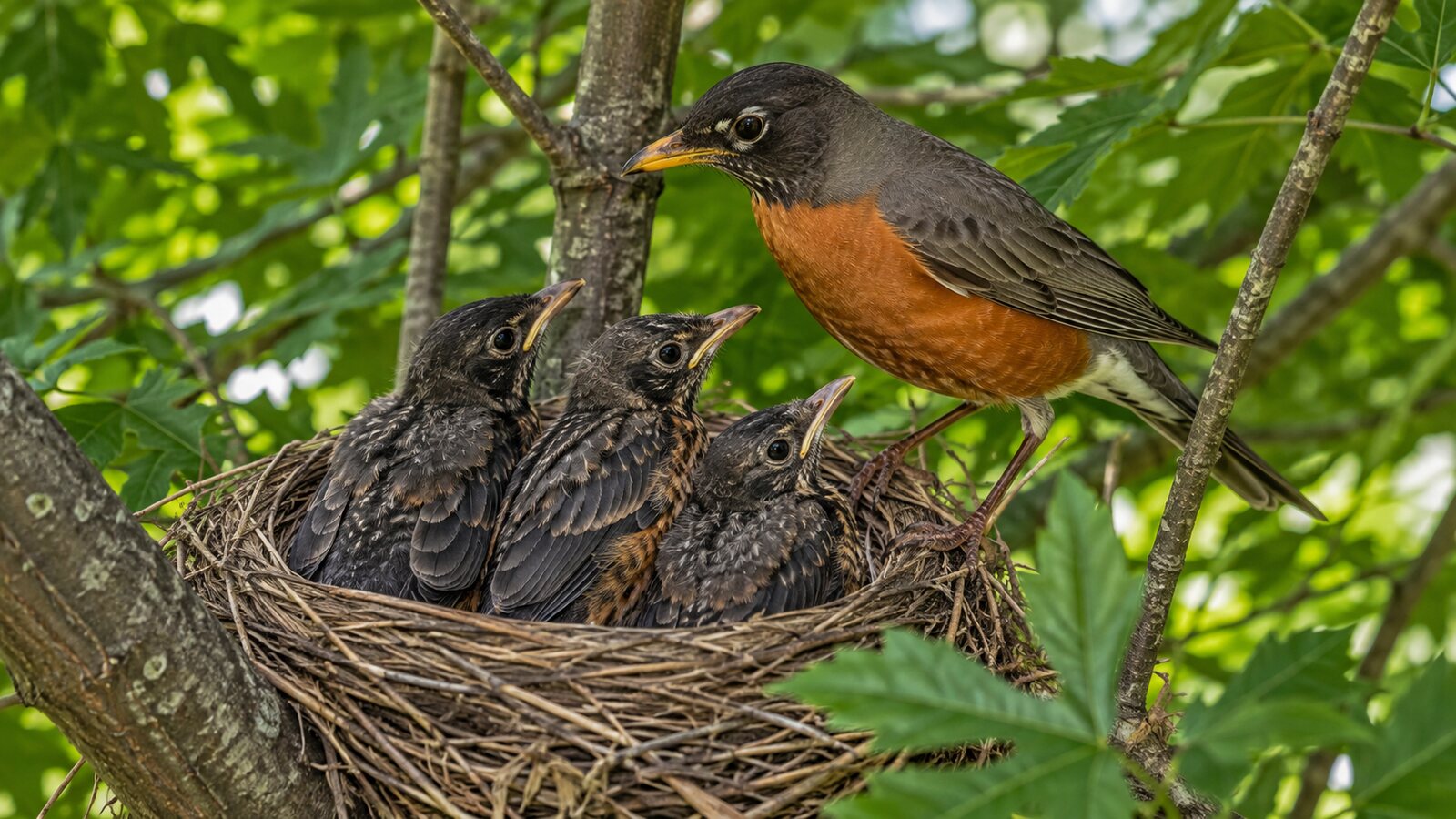
What happens between hatching and fledging?
For a typical backyard songbird, the change is incredibly fast. A chick may hatch nearly naked, with closed eyes and little control over its body. Within days, feather sheaths appear, eyes open, muscles strengthen, and the nest becomes crowded with growing siblings.
The parents make repeated feeding trips, bringing insects, fruit, seeds, or other food suited to the species. Many also remove fecal sacs to keep the nest cleaner.
By the end of the nestling period, the young bird may look almost adult-sized even though its tail is short, its feathers are fresh, and its flying skills are still rough.
How long do common baby birds stay in the nest?
Cornell NestWatch lists average nestling periods for many North American birds. A few examples show how much the timeline varies.
| Bird | Typical nestling period |
|---|---|
| American Tree Sparrow | About 10 days |
| Blue Grosbeak | About 11 days |
| American Goldfinch | About 14 days |
| Black-capped Chickadee | About 14 days |
| American Robin | About 15 days |
| Blue Jay | About 19 days |
| Barn Swallow | About 21 days |
| American Kestrel | About 30 days |
| Bald Eagle | About 75 days |
These are averages, not guarantees. Weather, food supply, brood size, nest safety, individual development, and the exact species can all shift the timing.
What does fledging mean?
Fledging means leaving the nest. It does not mean a young bird has suddenly become an independent adult.
A fledgling may flutter rather than fly strongly. It may sit low in a shrub, hop through grass, call loudly for food, and look vulnerable. The parents are often nearby and continue feeding it.
This awkward stage is normal. For many songbirds, getting out of a fixed nest reduces the risk that one predator will find and take the whole brood at once.
Why do baby birds leave before they can fly well?
Staying in the nest has benefits, but it also has a cost. A nest is one predictable location. If a snake, raccoon, squirrel, crow, jay, or other predator finds it, every chick can be at risk.
Research on songbirds has shown a tradeoff between leaving early with weaker flight and staying longer in a nest that predators can discover. Different species balance that risk differently.
That is why a young robin on the lawn may look as though it left too soon when it is actually following the normal schedule for its species.
How long do robin babies stay in the nest?
American Robin nestlings are typically in the nest for around two weeks after hatching. NestWatch gives an average of about 15 days.
After fledging, the young remain dependent on their parents. You may see a short-tailed, speckled robin crouched under shrubs while an adult arrives with food.
Young robins can be much more secretive after leaving the nest than they were when all the chicks were packed into one visible cup.
How long do chickadee babies stay in the nest?
Black-capped Chickadees average about 14 days as nestlings, while the exact range varies. Because they nest in cavities, you may notice the change mostly through sound and adult traffic rather than by seeing the chicks.
Near fledging time, adults may arrive constantly with food and the cavity can sound surprisingly busy. Once the young leave, the activity around the hole can stop quickly.
How long do eagle chicks stay in the nest?
Bald Eagles develop on a much slower schedule. NestWatch lists an average nestling period of about 75 days.
A young eagle needs time to grow a large body, develop full flight feathers, exercise its wings, and build enough strength to leave a high nest. Even after fledging, young eagles can remain around the territory while they develop hunting and flying skills.
Do ducklings stay in the nest?
Not for long. Ducks are a good example of precocial development. Their young hatch covered in down with eyes open and legs ready to work.
Once the clutch has hatched and the female is ready to move, ducklings can leave the nest and follow her to feeding habitat. They still need protection and guidance, but their strategy is very different from that of a helpless robin nestling.
Do baby birds come back to the nest?
Some species may return to a nest or nest box briefly, but many songbird fledglings do not go back to living in the nest once they leave.
The family often stays in the surrounding area. Parents continue bringing food, and siblings may remain loosely together while learning where to hide, perch, and forage.
A quiet empty nest does not mean the young disappeared. They may simply be spread through nearby vegetation where you cannot see them.
Should I put a fledgling back in the nest?
Usually no. If the bird is mostly feathered, can hop or perch, and is alert, it may be a normal fledgling. The best help is often to keep cats, dogs, and people away and let the parents continue caring for it.
If it is in immediate danger, you may be able to move it a very short distance to nearby cover where the parents can still find it. Do not carry it across the yard or take it inside simply because it cannot fly well.
An injured bird, a bird caught by a cat, or a young bird in clear distress is a different situation. Contact a licensed wildlife rehabilitator for local advice.
Use what to do if you find a baby bird for the full nestling, fledgling, danger, and injury checklist.
What if the baby bird has few or no feathers?
That sounds more like a nestling than a fledgling. Nestlings are too young to be out of the nest and generally need to be returned if it can be done safely.
If you can identify the original nest and safely reach it, wildlife organizations commonly advise placing an uninjured nestling back. Parent birds do not reject a chick simply because a person touched it.
If the nest cannot be found, the chick is injured, or the situation is unsafe, contact a wildlife rehabilitator rather than trying to raise the bird yourself.
How long do parents feed fledglings?
That varies by species. Some songbirds continue feeding young for days or weeks after fledging. In others, independence comes faster.
You may see a fledgling sitting still and calling while an adult searches for insects nearby. The young bird is learning to move through the habitat at the same time that it still depends on delivered food.
Fledglings also learn from experience. They improve at landing, balancing, recognizing danger, finding food, and following other birds.
Why did the nest suddenly become empty?
If the chicks were well feathered and close to normal fledging age, the entire brood may have left within a short period. Some young leave one after another over several hours.
If very young chicks vanish far too early, predation or nest failure is possible. It is often impossible to know exactly what happened from the empty nest alone.
Avoid repeatedly checking an active nest to find out. Observing the adults from a distance is less disruptive and often tells you more.
Leaving the nest also does not mean the parents stop caring for a youngster. Many fledglings still beg and receive food while they learn to forage. See why do birds feed each other?
Frequently asked questions
How long do baby birds stay in the nest?
Many small songbirds stay around 10 to 21 days after hatching. Larger birds often remain much longer, while ducklings and other precocial young leave quickly.
What does fledgling mean?
A fledgling is a young bird that has left the nest but is still developing and may continue to depend on its parents.
Do baby birds return to the nest after fledging?
Some may, but many songbird fledglings remain outside the nest once they leave.
Should I rescue a baby bird on the ground?
A healthy feathered fledgling usually should be left with its parents. A bare or nearly bare nestling, an injured bird, or a bird in immediate danger may need help.
Keep following the nesting cycle
Continue with baby-bird stages, what baby birds eat, whether you can touch a baby bird, or how long bird eggs take to hatch.