
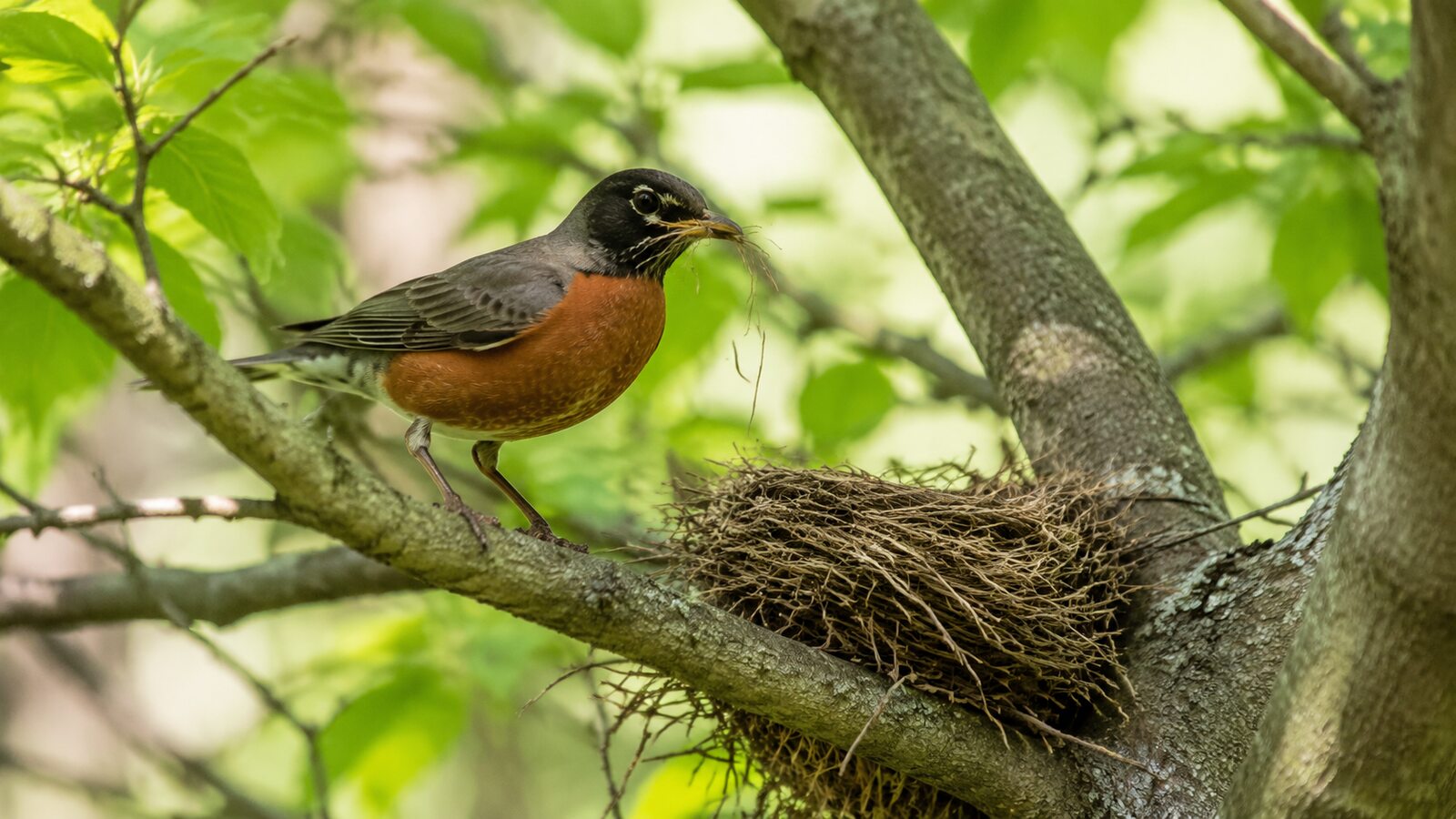
Where does nest building start?
Before a bird carries the first twig, it needs a place to breed. The right site depends on the species. A robin may use a tree fork, ledge, or sheltered structure. A chickadee looks for a cavity. A Killdeer may settle on open gravel. A Bald Eagle needs a large, sturdy support for a nest that can become enormous over many seasons.
The site has to work for the bird’s whole nesting strategy. It may need concealment from predators, shelter from wind and rain, room for adults to come and go, and access to food once chicks hatch.
That is one reason nests show up in places that seem odd to us. A hanging planter, porch beam, light fixture, fence post, cliff shelf, marsh reed, or dead tree can all provide the combination a particular bird is looking for.
What do birds use to build nests?
Birds use whatever materials fit their normal nest design and are available nearby. Common natural materials include grass, twigs, roots, bark strips, leaves, moss, lichens, mud, plant down, feathers, fur, and spider silk.
Different materials do different jobs. Sticks can make a strong frame. Fine grasses and rootlets can form a tighter cup. Mud can bind a nest together. Soft plant fibres, hair, or feathers may line the inside. Spider silk is light and flexible, and hummingbirds can use it to help a tiny nest stretch as the chicks grow.
Birds sometimes carry paper, plastic, fishing line, string, dryer lint, and other human-made material. That does not mean those items are good nest supplies. Long fibres and plastic can tangle around feet or legs, and some household material holds water or breaks down poorly.
How do birds carry nesting material?
The bill does most of the work for many birds. A bird may pull up a strand of grass, snap a small twig, gather mud, strip bark, or pick up moss and fly it back to the nest site.
Some species also use their feet. Raptors can carry branches in their talons. Other birds may brace or manipulate material while working it into place.
The building process often means dozens or hundreds of short trips. From a window, you may notice a bird repeatedly disappearing in the same direction with grass or fibres in its bill. That can be one of the clearest clues that nesting has started nearby.
How does a bird shape a cup nest?
A classic songbird cup is built from the outside in. The bird first creates a loose structure, then adds finer material and presses the interior into shape.
A female robin, for example, uses grasses and other fibres with mud to form a sturdy cup. Other songbirds weave flexible stems or rootlets together. A bird may sit low in the unfinished nest and turn its body while pushing with the breast and feet. Repeating that movement helps create the rounded interior.
The finished cup needs to be deep enough to hold eggs and young but open enough for the adults to feed chicks and keep the nest clean.
Do all birds build cup-shaped nests?
Not even close. North American birds use an impressive range of nest types.
- Scrapes: Killdeer and many shorebirds lay eggs in a shallow depression with little construction.
- Cavities: Woodpeckers excavate holes, while chickadees, bluebirds, nuthatches, and others may use existing cavities or nest boxes.
- Platform nests: Eagles, Ospreys, herons, and some other large birds build broad structures from sticks.
- Mud nests: Barn Swallows and Cliff Swallows use mud as an important building material.
- Hanging nests: Baltimore Orioles weave a pouch that hangs from slender branches.
- Floating or marsh nests: Some waterbirds anchor nests among aquatic vegetation.
A nest is not really a bird’s house in the human sense. For most species, it is a temporary place for eggs and young, not somewhere the adults live year-round.
How do birds know how to build nests?
Birds are not handed instructions by their parents, yet members of the same species tend to build recognizably similar nests. That tells us inherited behaviour is a major part of nest construction.
But experience matters too. Nest building is a physical skill involving material choice, placement, tension, balance, and site selection. Research on several species has found that birds can change techniques and become more efficient with experience.
So the best way to think about it is not “instinct or learning.” It is usually both. A young bird starts with species-typical behaviour and can refine the details through practice.
How long does it take birds to build a nest?
There is no single building time. A simple scrape may take very little work. A small cup nest may be finished over several days. A larger or more elaborate structure can take much longer.
Environment changes the schedule too. Rain can interrupt mud gathering. Dry weather can make mud harder to find. A bird may abandon an early attempt after disturbance or poor site choice and start again somewhere nearby.
Environment and Climate Change Canada says nest building in migratory birds can take a few days to about two weeks. Some species are faster or slower than that broad range.
Which parent builds the nest?
It depends on the bird. In many songbirds, the female does most or all of the construction. In other species, both members of the pair contribute. In still others, the male builds or starts nests as part of courtship.
Hummingbirds are a familiar example in which the female handles the nesting work and later raises the chicks. Large raptors often have both members of a pair involved in adding material to a nest.
Watching who carries material can sometimes reveal the roles within a pair, but you need to know the species before assuming which bird is male or female.
Do birds build a new nest every year?
Many do, especially small songbirds whose nests are built for one breeding attempt or one season. Others return to a durable structure and repair or enlarge it.
A bird may also return to the same general nesting area without using the exact same nest. A familiar porch, shrub, nest box, or tree can remain attractive even when a fresh nest is built.
There are enough exceptions that this deserves its own answer. See do birds reuse nests?
Should I leave nesting material out for birds?
You usually do not need to supply it. A bird-friendly yard already offers grasses, leaves, plant fibres, mud, moss, twigs, and other natural material.
Avoid offering yarn, thread, fishing line, plastic strips, or long pieces of hair that can wrap around a bird. Dryer lint is also a poor choice because it can hold moisture and may contain residues from detergents or fabric products.
Leaving some natural areas a little less tidy can be better than putting out a basket of artificial nesting material. Native plants, shrubs, and leaf litter support both nest building and the insects many birds need once chicks hatch.
What should I do if a bird is building near my house?
Give it space and watch from a distance. Repeated close approaches can keep an adult away from the site or draw attention to the nest.
Once eggs or young are present, disturbing an active nest can also raise legal issues. In Canada and the United States, many native migratory birds, eggs, and active nests have federal protection. The exact rules differ, so if a nest creates a real safety or property problem, check the appropriate wildlife authority before moving or removing anything.
If the location is simply inconvenient, the least disruptive option is often to let the nesting attempt finish. For many backyard songbirds, the active period is measured in weeks, not months.
Frequently asked questions
How do birds build nests?
They gather material and arrange it using the bill, body, and sometimes feet. Depending on the species, they may weave, stack, press, line, excavate, or use mud to make the nest.
How do birds know how to build nests?
They begin with strong inherited behaviour, but practice and experience can improve how they choose materials and construct the nest.
How long does it take a bird to build a nest?
Simple nests may take a day or two, while many more involved nests take several days or longer. Species, materials, weather, and disturbance all affect the timing.
Do birds live in nests?
Usually not. Most birds use nests mainly for eggs and young. Outside the breeding period, adults generally sleep or rest elsewhere. See where birds sleep at night.
Keep following the nesting cycle
Once a nest is finished, the next questions are often about eggs and chicks. Continue with how birds lay eggs, how long bird eggs take to hatch, how long baby birds stay in the nest, or return to the Bird Facts hub.