
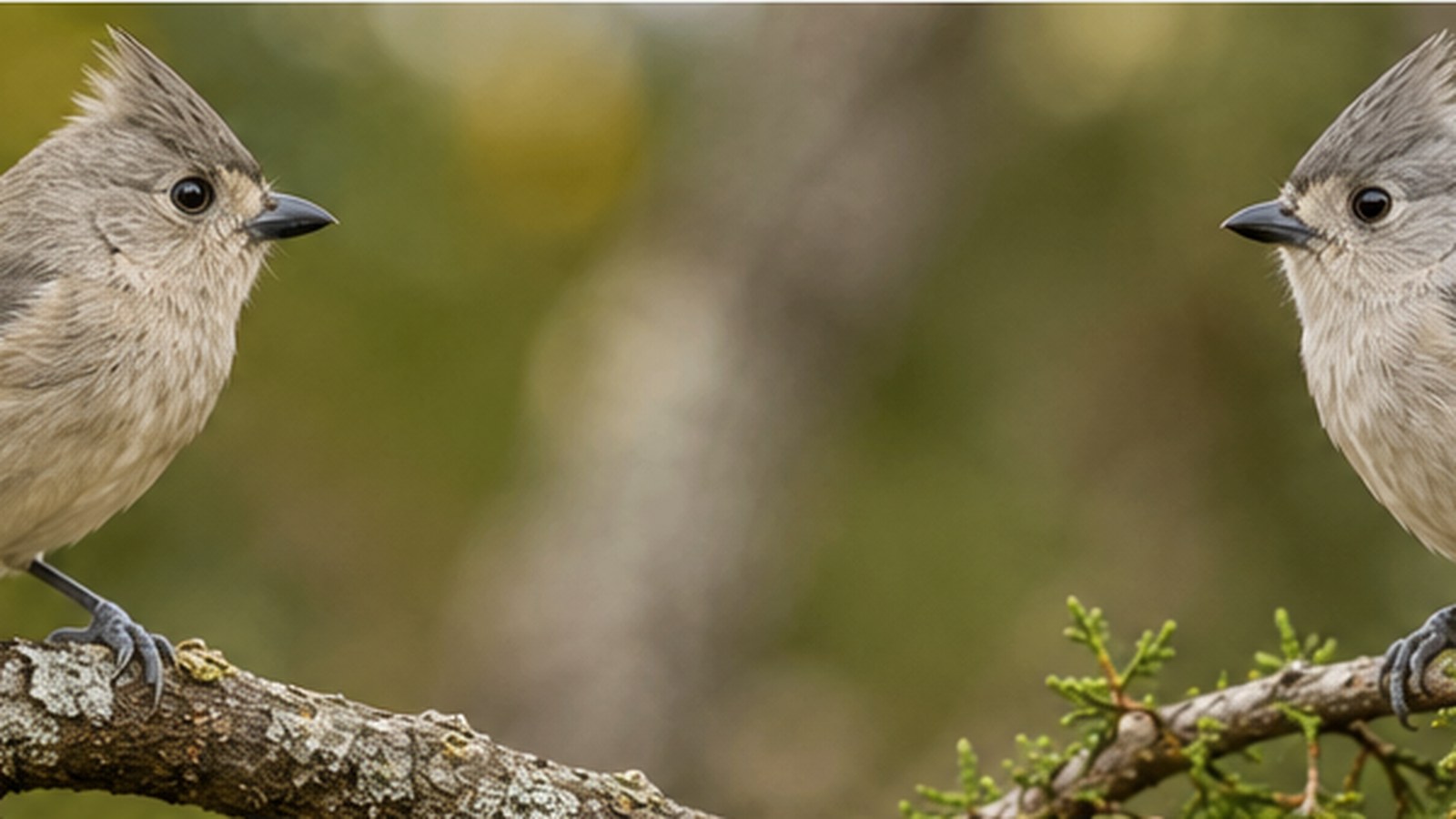
Oak and Juniper Titmice side by side
| Clue | Oak Titmouse | Juniper Titmouse |
|---|---|---|
| Overall colour | Plain gray-brown, often a little warmer | Plain gray, often a little cooler or paler |
| Habitat | Warm, dry oak and oak-pine woodland | Dry, open pinyon-juniper woodland |
| Region | Pacific slope from southern Oregon through much of California into Baja California | Interior West in pinyon-juniper country |
| Voice | Sharp notes in repeated, steady sequences; varied chatter | Rapid rolling song and harsh scratchy contact calls |
| Best field strategy | Use place and oak habitat first | Use place and pinyon-juniper habitat first |
Why this comparison is harder than it looks
Both birds are small crested songbirds with stout little bills, dark eyes, longish tails, and nearly unmarked gray-brown plumage. A photograph with the background cropped away can remove the very clue that would have solved the identification: the woodland itself.
Cornell treats Oak and Juniper Titmice as extremely similar. Their ranges are mostly separate, which means the strongest question is often not “Which one looks grayer?” but “Where was I, and what trees were around me?”
Start with the map before the feathers
Oak Titmouse is mainly a Pacific-slope species. It is closely tied to oak country across much of California and extends north into southwestern Oregon and south into Baja California. Juniper Titmouse belongs to the interior West, where pinyon pine and juniper dominate large stretches of dry open woodland.
If the bird was in a California oak woodland, Oak Titmouse should be high on the list. If it was in Utah, Colorado, Nevada, New Mexico, or another interior-western area of mature pinyon-juniper, Juniper Titmouse is usually the more realistic starting point.
There is one important overlap area
The ranges are not perfectly separated. Cornell notes that Oak and Juniper Titmice overlap mainly in extreme northern California. In that area, Oak Titmice can occur in western juniper woodland, so habitat alone becomes less decisive.
If you’re near that contact area, save the exact location instead of only the county or state. A map pin, trail name, road, or coordinates can make the record much easier to review later. That’s also where voice and several photographs deserve extra weight.
Oak Titmouse is usually a little warmer
Oak Titmice tend to average a little browner or warmer on the back than Juniper Titmice. Juniper Titmice tend to look a little grayer. That difference can show in a clean side-by-side comparison, but it’s not a field mark I’d trust by itself.
Shade can make an Oak Titmouse look cool gray. Late-day sun can warm a Juniper Titmouse. Cameras can shift white balance, and image editing can change both birds again. Use colour only after range and habitat have already pointed you in a direction.
Body shape will usually tell you “titmouse,” not species
Both species have the same basic titmouse outline: a pointed crest that can be raised or flattened, a compact body, a rounded stout bill, and a medium-long tail. Their proportions overlap too much to make size or shape the main separator.
Shape is still handy when you’re deciding whether the bird is a titmouse at all. A Bushtit is smaller, thinner, round-headed, and lacks the obvious crest. A Gray Vireo has a heavier-looking bill and pale spectacles rather than a plain dark-eyed face.
Watch the crest change with posture
An alert bird may raise the crest into a sharp point. A relaxed or feeding bird may flatten it until the head looks much smoother. Don’t use crest height as an Oak-versus-Juniper clue because both species can change it from moment to moment.
A short burst of photos helps. One frame may show the head flattened while the next shows the crest raised. Together they give a better impression of the bird’s real shape than a single still image.
Habitat is more specific than “woods”
Write down the dominant trees. “Forest” or “woodland” is too broad for this pair. Oak Titmice are strongly associated with warm, open, dry oak or oak-pine woodland. Juniper Titmice are specialists of dry, open pinyon-juniper woodland.
A photograph of the surrounding trees can be surprisingly valuable. If the bird disappears before you finish taking notes, one wide habitat photo can preserve information you may not remember later.
Listen for a different style of voice
Oak Titmouse males use several songs built from sharp, strong notes repeated in steady sequences. Their calls can be high, low, shrill, scratchy, lisping, or chattering. Juniper Titmice often sing a rapid rolling series and give harsh, scratchy contact calls.
Those descriptions are easier to use after you’ve heard local examples. The titmouse sound guide compares all five North American titmice covered on Armchair Birder and explains what to record besides the sound itself.
Juniper Titmouse often advertises from an exposed perch
Juniper Titmice can sing and call from elevated perches, especially in spring. Once you’re in the right pinyon-juniper habitat, listening for a scratchy voice and then scanning exposed branches can be more productive than searching every gray bird by sight.
Oak Titmice are also vocal and active. They may call from higher perches and then move quickly through oak branches while searching leaves, bark, and twigs for food.
Both birds can forage acrobatically
These are active foliage-gleaning birds. They hop through branches, cling to twigs, reach around leaves, and probe bark or crevices for insects and other food. That behaviour can remind you of chickadees because they belong to the same family.
Behaviour confirms the general bird group better than it separates Oak from Juniper. Let the dominant trees, region, and voice carry more of the species-level decision.
What if the photograph has no habitat?
Keep the original image and check its date and location metadata before cropping or exporting it again. Even a phone photograph may preserve enough location information to solve a bird that looks impossible on plumage alone.
Then look for broad colour rather than tiny marks. Is the back consistently warmer brown-gray or cleaner gray across several frames? If the answer changes from photo to photo, the lighting is probably stronger than the plumage difference.
What to photograph near northern California
In the small part of the continent where both species can occur, take more than one bird portrait. Photograph the side of the bird, the back, the crest raised if possible, and the surrounding trees. Record the voice if the bird calls.
That combination is much better than an extreme crop of the face. These birds don’t have one dramatic head stripe or breast patch that settles the question.
Feeder visits can happen, but they don’t solve the ID
Juniper Titmice can visit sunflower and suet feeders where they occur, and Oak Titmice can use bird-friendly yards and nest boxes in suitable habitat. A feeder gives you time to study the bird, but the food choice isn’t a species-level field mark.
Use that extra viewing time to note the surrounding trees, take several photographs, and listen. If the feeder sits in mature oak woodland, that context means more than the seed the bird selected.
Don’t force a colour difference you can’t see
One of the easiest ways to make this comparison harder is to convince yourself that every Oak Titmouse must look obviously brown and every Juniper must look obviously gray. Many individuals won’t show that difference cleanly in the field.
If geography and habitat strongly support one species and the plumage looks neutral, that can still be a sensible identification. If you’re in the overlap area and the bird is silent with poor photos, leaving it as Oak/Juniper Titmouse is better than inventing certainty.
A field routine for Oak and Juniper Titmice
- Confirm a small plain crested titmouse shape.
- Save the exact location before relying on colour.
- Identify the dominant trees, especially oak, pinyon, and juniper.
- Check whether the back looks warmer brown-gray or cooler gray across several views.
- Listen for the pace, tone, and structure of the song or call.
- Take at least one wider photograph that keeps the habitat.
- Near extreme northern California, keep the identification cautious when clues conflict.
Frequently asked questions
Can I separate Oak and Juniper Titmice by colour alone?
Sometimes a clean comparison shows Oak as a little browner and Juniper as a little grayer, but the difference is subtle. Location, habitat, and voice are safer starting clues.
Which bird lives in California oak woodland?
Oak Titmouse is the expected species through much of California oak country. Juniper Titmouse is mainly an interior-western bird of pinyon-juniper woodland.
Which bird lives in pinyon-juniper?
Juniper Titmouse is a pinyon-juniper specialist across the interior West. Oak Titmouse can use other habitats locally, including some juniper woodland near the northern edge of its range, so exact location still matters.
Should I trust an app from one photograph?
Use an app suggestion as a shortlist. For this pair, check the map, habitat, voice, and original photo context before settling on the species.