
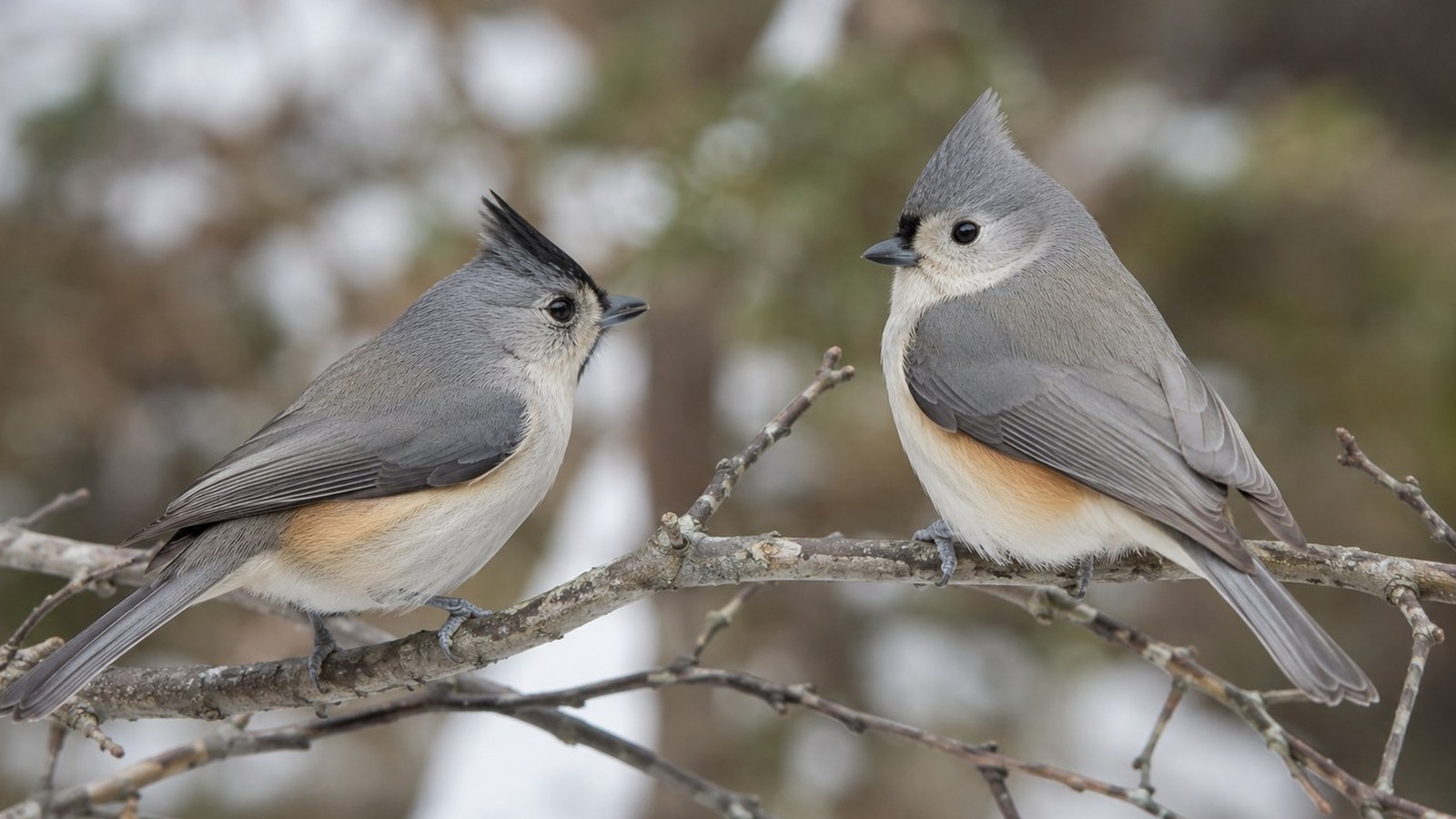
Five North American titmice by sound
| Bird | Starting sound | What confirms it |
|---|---|---|
| Tufted Titmouse | Clear repeated peter-peter-peter whistle; nasal mechanical calls | Eastern range, gray crest, black forehead, white face, warm sides |
| Black-crested Titmouse | Sweet repeated peer notes; chick-a-dee contact calls | Texas and Mexico, black crest, pale forehead, hybrid-zone caution |
| Bridled Titmouse | Fast harsh peeta-like song; low rapid nasal scold | Bold black-and-white face, southwestern mountain woodland |
| Oak Titmouse | Sharp strong notes repeated at a steady tempo; varied chatter | Pacific-slope oak or oak-pine woodland, warmer gray-brown plumage |
| Juniper Titmouse | Rapid rolling multi-syllable song; harsh scratchy calls | Interior-western pinyon-juniper woodland, plain gray plumage |
Start by describing the sound instead of naming the bird
When a titmouse calls from inside leaves, your first job is to preserve the pattern. Was it a clear whistle or a scratchy call? Were there two syllables or one? Did the bird repeat the phrase at a steady pace? Was a flock chattering, or was one bird singing from an exposed perch?
Those notes are better than writing “titmouse?” and trying to remember the sound later. A short phone recording can help, but a written description still matters when wind, traffic, or other birds make the recording messy.
Tufted Titmouse: the familiar clear whistle
Tufted Titmouse is famous for a clear repeated whistle often written as peter-peter-peter. A bird may repeat the phrase again and again, especially as breeding season approaches. Females can also sing, though the familiar loud song is most often associated with males.
The species also gives nasal, mechanical calls, including scratchy chickadee-like notes and fussier scolds. If you hear the classic whistle in eastern deciduous or mixed woods, Tufted Titmouse belongs high on the shortlist.
Black-crested Titmouse can sound surprisingly similar
Black-crested Titmouse sings sweet whistled phrases that can sound much like Tufted Titmouse. Cornell notes that the two songs are sometimes not distinguishable. Black-crested often gives a single-syllabled peer repeated in a series, while Tufted more often gives a two-syllabled peter, but that’s a tendency rather than a perfect rule.
That means sound alone shouldn’t decide a central Texas bird. Check the crest, forehead, exact location, and whether the bird sits inside the contact zone where Tufted and Black-crested Titmice hybridize.
Listen for pitch and pace, but don’t turn them into hard rules
Black-crested songs are often described as a little higher and faster, and some of its calls are more nasal. Those differences can help when you already know both local voices well.
Distance, wind, age, individual variation, and habitat can change what reaches your ears. One distant whistle is weak evidence. Several phrases plus a photograph and location are much stronger.
Bridled Titmouse: harsher and faster
Bridled Titmouse has a very different face, and its voice can help you find that face. Cornell describes the male song as a harsh series of four or five peeta-like phrases, delivered more rapidly and less musically than the songs of the larger titmice.
The common call is a low, rapid, nasal chickadee-like scold. In mountain oak, pine-oak, or riparian woodland of the Southwest, a fast harsh titmouse sound is worth tracing through the middle levels of the trees.
Oak Titmouse: repeated sharp notes and busy chatter
Oak Titmouse males use several songs built from sharp, strong notes, high or low, repeated in sequences with a steady tempo. Males sing more as spring approaches, while both sexes are vocal through the year.
Calls can include shrill or scratchy notes, chattering, lisping sounds while foraging, and other short vocalizations. Because the bird looks so much like Juniper Titmouse, learning the local Oak voice can save a lot of second-guessing.
Juniper Titmouse: rapid rolling phrases
Juniper Titmouse often sings a rapid rolling series of several syllables. Cornell describes a sequence of roughly five to fifteen syllables that lasts only a few seconds. The sound can have a quick, almost electronic rhythm.
Its common calls are harsh and scratchy and may be used when an intruder appears or when a pair stays in contact while feeding. In mature pinyon-juniper woodland, that scratchy voice is a strong clue before the plain gray bird comes into view.
Oak versus Juniper is where sound earns its keep
Oak and Juniper Titmice can look almost identical. Their normal ranges are mostly separate, and their voices add another clue. Oak tends toward repeated sharp notes in steady sequences, while Juniper often gives rapid rolling songs and harsh scratchy calls.
Use the Oak vs Juniper Titmouse guide with the sound. If you’re in the small northern California overlap area, the recording and habitat become especially valuable.
Habitat changes which sounds are realistic
A clear whistled titmouse in an eastern wooded suburb, a harsh patterned bird in Arizona oak woodland, and a scratchy plain titmouse in Utah pinyon-juniper are three different identification problems. Save the habitat before opening a sound library.
Try to be specific about trees. Oak, pine-oak, mesquite, pinyon, juniper, and mixed deciduous woodland are better notes than simply “woods.” Elevation can add another clue for Bridled Titmouse.
Record the whole sequence
One note can be clipped by wind or hidden behind another bird. Record long enough to capture several complete phrases and the pauses between them. Those pauses help you judge pace and repetition.
Keep your phone still, don’t cover the microphone, and avoid moving closer just to get a louder recording. A bird calling naturally from its normal perch gives you better evidence than a bird reacting to disturbance.
Watch which bird actually makes the sound
Titmice often share woodland with chickadees, nuthatches, kinglets, vireos, woodpeckers, and other noisy birds. It’s easy to watch one bird while another calls just outside the frame.
If you can, watch for the bill opening or the throat moving with the sound. A short video can be especially handy because it links the voice to the bird and may also capture crest posture and head pattern.
Automatic sound suggestions are a shortlist
Sound-recognition apps can point you toward likely birds, but they don’t remove the need to check the field evidence. Similar whistles, overlapping species, background birds, and poor recordings can all create a confident-looking wrong suggestion.
Compare the suggestion with region, habitat, season, head pattern, and the full phrase you heard. The general bird sound identification guide explains pitch, pace, rhythm, repetition, and recording context in more detail.
Build a local sound library in your head
You don’t need to memorize every titmouse from every part of the continent. First narrow the list to species that can reasonably occur where you live or travel. Learn one common song and one common call from each.
Eastern birders may focus on Tufted. Texas birders may need both Tufted and Black-crested. California birders may focus on Oak, while interior-western birders learn Juniper. Southwestern mountain birders can add Bridled.
Save the date because birds change what they say
Singing becomes more noticeable around the breeding season, while contact and scolding calls may dominate at other times. A bird that is easy to identify by song in spring may be found mostly by short calls later in the year.
Date also helps when you compare your recording with reference material. Try to compare similar seasons and local populations rather than expecting every individual to sound identical.
A seven-question listening worksheet
- Was the sound clear and whistled, harsh, scratchy, nasal, or rolling?
- How many syllables were in one phrase?
- How quickly did the bird repeat the phrase?
- Was one bird singing or were several birds calling?
- What trees and habitat surrounded the bird?
- What exact location, date, and elevation did you record?
- Did you see the crest, forehead, face, or body colour well enough to confirm the sound?
Common titmouse sound mistakes
- Calling every clear peter-like whistle a Tufted Titmouse.
- Assuming Tufted and Black-crested can always be separated by song.
- Ignoring the Oak versus Juniper habitat split.
- Forgetting that Bridled Titmouse can sound chickadee-like when scolding.
- Identifying a recording without saving the exact location.
- Attaching the loudest call to the bird you happen to be watching.
- Using one automated suggestion without checking the visual field marks.
Frequently asked questions
Which titmouse says peter-peter-peter?
Tufted Titmouse is famous for that clear repeated phrase. Black-crested Titmouse can give similar whistles, so use the map and head pattern as well.
Which titmouse has the fastest rolling song?
Juniper Titmouse commonly gives a rapid rolling series of several syllables. In the right pinyon-juniper habitat, that sound is a good clue.
Can Oak and Juniper Titmice be separated by sound?
Their voices provide supporting evidence and can tell you more than their subtle plumage differences. Exact location and habitat still matter because the birds are mostly separated geographically.
What if I hear a titmouse but never see it?
Keep the recording and write down the habitat and location. You may reach a strong shortlist by voice, but a cautious broader identification is better when two local species sound too similar.