
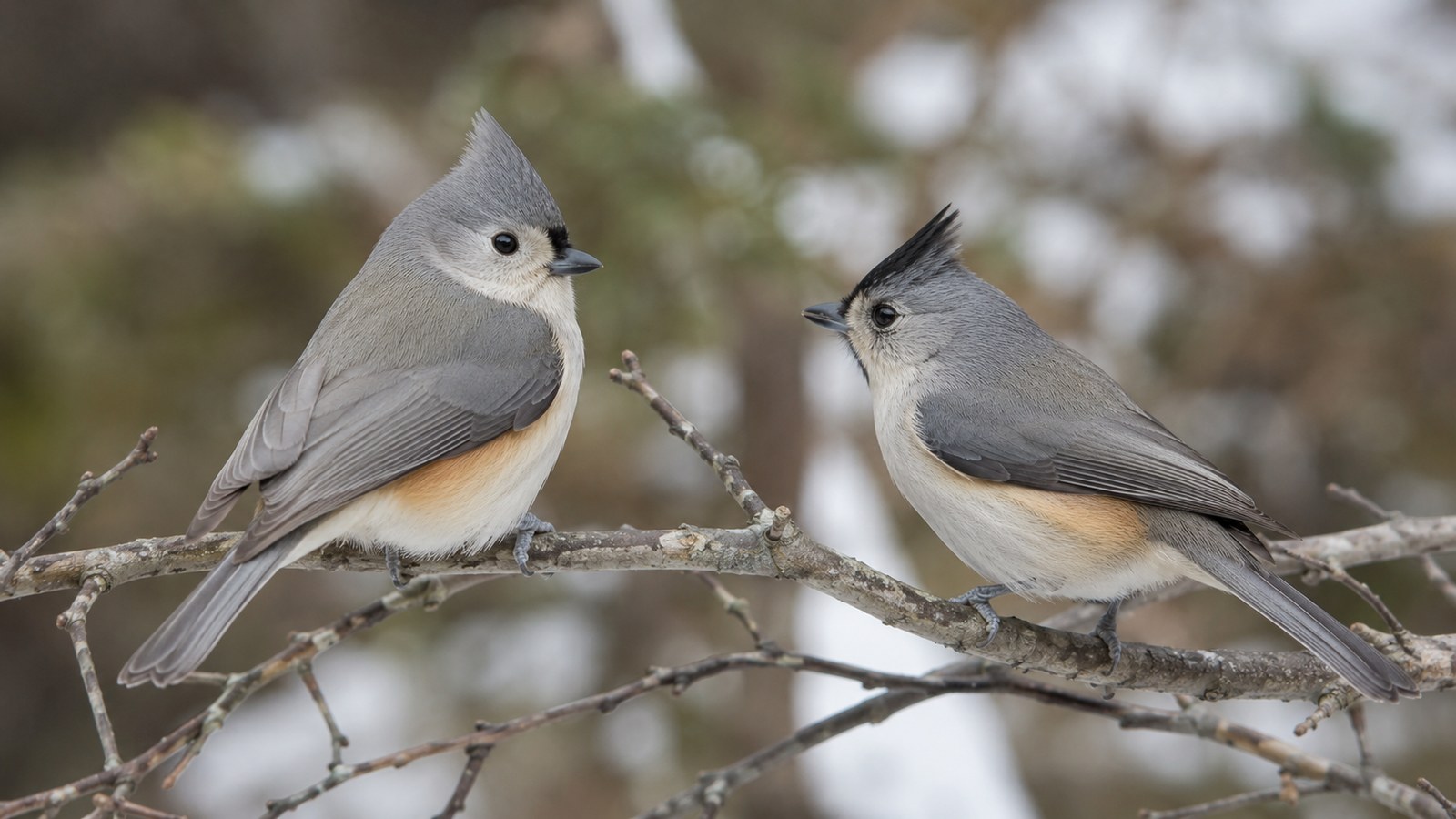
Side-by-side comparison
| Clue | Tufted Titmouse | Black-crested Titmouse |
|---|---|---|
| Crest | Gray | Black |
| Forehead | Black patch | Usually pale or white |
| Face | Plain pale face with dark eye | Plain pale face with dark eye |
| Upperparts | Gray | Gray |
| Sides | Often peachy or rusty wash | Pale to grayish or warm, varying regionally |
| Main range | Eastern North America | Texas and Mexico |
| Voice | Clear repeated whistles are common | Often more nasal, faster, and higher |
| Contact zone | Central Texas, where hybrids and intermediate birds occur | |
Look at the crest first
On a clean adult Tufted Titmouse, the crest is gray like the back. The small black area is concentrated on the forehead just above the bill. On Black-crested Titmouse, the crest itself is black from front to back and stands out sharply against the gray body.
That difference can be visible even at moderate distance. It stands out when the bird is perched sideways and the peachy sides are hidden by the wing.
Then check the forehead
The forehead flips the pattern. Tufted Titmouse has a black forehead patch. Black-crested Titmouse usually has a pale or white forehead in front of the black crest. Looking at both areas together is much safer than asking only whether the bird has “black on the head.”
Direct sunlight can wash out pale feathers, while shade can make gray feathers look nearly black. If you can, take a photograph and compare crest and forehead in the same frame.
The rest of the body tells you less
Both species have gray backs, pale underparts, dark eyes, short stout bills, long tails, and warm colour along the sides. That shared body pattern is exactly why the head deserves so much attention.
Don’t try to force an identification from a slightly warmer flank or a tiny difference in gray. Those colours vary with wear, light, camera settings, posture, and regional variation.
Range narrows the problem before plumage
Tufted Titmouse is widespread across the eastern United States and reaches into parts of far southern Canada. Black-crested Titmouse is centred much farther southwest, especially Texas and Mexico. Away from their contact zone, location can make one species much more likely before you see the head clearly.
Save the exact location rather than only the state. Central Texas is where the comparison becomes genuinely difficult, so county, town, park, or map coordinates can matter later.
Central Texas is the exception to the tidy rule
Tufted and Black-crested Titmice meet and hybridize in central Texas. Cornell notes that hybrids are fairly common there. Some birds show a gray rather than black crest, but a forehead that looks brownish or gray instead of the clean black of Tufted or white of Black-crested.
That means a bird in the contact zone can honestly remain “Tufted/Black-crested Titmouse” or “titmouse sp.” when the evidence is weak. A careful uncertain identification is better than forcing a pure species from one blurry photograph.
Voice can support the head pattern
Tufted Titmouse is famous for clear, repeated whistled phrases. Black-crested Titmouse has related vocalizations, but they’re often described as more nasal, higher, and faster. In the hybrid zone, songs can also be mixed or intermediate.
Record a short clip when you can do so without disturbing the bird. Note the pace, number of syllables, pitch, and whether the phrase repeats. The sound-identification guide explains how to turn a vague memory into usable notes.
Behaviour won’t usually separate them
Both species move actively through branches, hang from twigs, search for insects and seeds, join other woodland birds, and visit backyard feeders. They can grab food and carry it away rather than sit in one place for long.
Behaviour can still confirm that you’re looking at a titmouse, but it usually won’t solve Tufted versus Black-crested by itself.
Feeder sightings are a good chance to photograph the forehead
At a feeder, let the bird come to you instead of moving closer. A burst of photographs can capture the crest raised and lowered, different head angles, and the forehead at the base of the bill.
Sunflower seed, peanuts, and suet may bring titmice into view where they occur, but the food choice doesn’t identify the species. Use the feeder only as a convenient viewing station.
Don’t confuse either bird with a chickadee
Chickadees have a more obvious black-and-white head pattern and no pointed titmouse crest. They’re also usually smaller and shorter-bodied. The common backyard chickadee guide covers the regular North American species.
If the head looks plain except for the crest and forehead, Tufted or Black-crested is a better fit than Black-capped or Carolina Chickadee.
Bridled Titmouse is much more strongly patterned
In the Southwest, Bridled Titmouse can enter the comparison. It has bold black-and-white facial striping and a dark throat, unlike the plain pale faces of Tufted and Black-crested Titmice. Once you see that face clearly, it should leave this two-species comparison.
When the crest is flattened
A titmouse can lower its crest until the head looks surprisingly smooth. If the best field mark disappears, wait for the bird to change posture. Meanwhile, record the forehead, face, bill, tail, body colour, location, and voice.
A short video can be better than one still photograph because it may catch the crest rising as the bird looks around.
What to do with a poor photograph
First, keep the original file. Cropping too aggressively can remove context, and heavy editing can create false colour edges around the crest. Check whether the image still shows the forehead at the bill, the crest above the eye, the side colour, and the surrounding habitat.
Then compare the photograph with the exact location and any sound notes. A weak picture plus strong location and voice evidence can be better than a sharp picture with no context.
Hybrid clues aren’t a paint-by-number checklist
It’s tempting to call every gray-crested bird with an odd forehead a hybrid, but one strange-looking feature isn’t enough. Feather wear, moult, shadow, motion blur, and camera processing can all soften the head pattern.
A possible hybrid becomes more convincing when several things line up: the bird is in the central Texas contact zone, the crest and forehead both look intermediate across several photographs, and the voice also seems unusual for a clean example of either species. Even then, a cautious label may be the best field conclusion.
Listen to more than one phrase
One short whistle can be misleading, especially with wind, traffic, other birds, or a distant singer. Try to hear a repeated series. Note whether the song sounds one-syllabled or two-syllabled, how fast it repeats, and whether the tone is clear or nasal.
In the contact zone, sound deserves the same caution as plumage. A bird that doesn’t fit the textbook pattern may be giving you real biological information rather than a bad observation.
Use several photographs from different angles
A head turned toward you can hide the crest, while a bird facing away can hide the forehead. Side views are usually best, but front and rear views can confirm how the dark and pale areas connect.
Keep the sequence rather than choosing only the sharpest frame. A slightly blurry image may show the forehead better, while the next frame shows the crest. Together they can answer a question neither photo solves alone.
Record the exact place in central Texas
“Texas” is too broad for this identification problem. Black-crested Titmouse is expected across much of the central and southern part of the state, while Tufted Titmouse is an eastern species. The contact zone between them is where intermediate birds become most important.
Save a map pin, park name, road, town, or coordinates with the sighting. That location can be as informative as the bird’s flank colour when you review the record later.
What if the bird is silent?
You can still make a strong identification from a clean head pattern and location. Sound is supporting evidence, not a requirement. If the bird shows a gray crest and black forehead well away from the contact zone, Tufted may be straightforward. A black crest with pale forehead in Black-crested range can be equally strong.
When the bird is both silent and poorly seen inside the contact zone, leaving it as Tufted/Black-crested Titmouse is a sensible field note.
A field routine for this pair
- Confirm a crested titmouse shape with a short stout bill and long tail.
- Decide whether the crest is gray or black.
- Check whether the forehead is black or pale.
- Record the exact location, especially anywhere in central Texas.
- Listen for the pace and tone of the song or call.
- Take several side-view photographs rather than one.
- Leave intermediate birds uncertain when the clues don’t agree.
Frequently asked questions
Can a Tufted Titmouse have a very dark-looking crest?
Yes. Lighting can make gray feathers look darker than they are. Check the black forehead patch, location, and several photographs before treating a dark-looking crest as Black-crested.
Can a Black-crested Titmouse have a gray-looking crest?
Some birds can look softer in poor light, and hybrid-zone birds may genuinely show intermediate crest colour. A clean white forehead plus black crest supports Black-crested, but central Texas birds deserve extra caution.
Which species reaches Canada?
Tufted Titmouse reaches parts of far southern Canada. Black-crested Titmouse is a Texas and Mexican species.
Should I identify a hybrid from one photograph?
Usually not. A possible hybrid is best supported by location plus several plumage views and, when available, sound. It’s fine to keep the identification broader when the evidence is incomplete.