
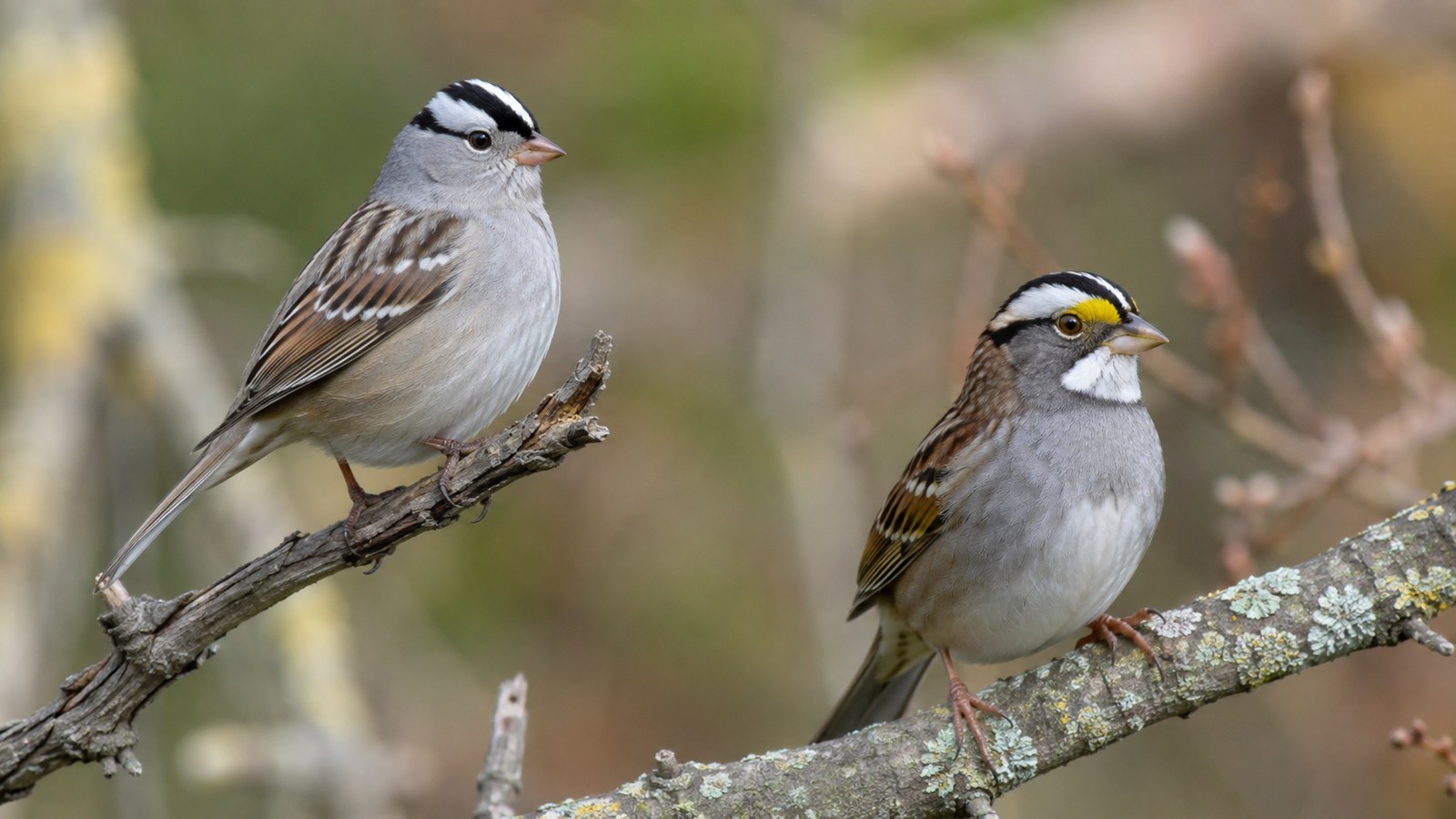
How to identify a White-throated Sparrow
This is a full-bodied sparrow with a rounded head, prominent bill, long legs, and fairly long tail. The white throat stands out against a gray face and breast.
White-striped adults have crisp black-and-white crown stripes. Tan-striped adults have brown and tan stripes instead. Both forms have yellow in front of the eye. Juveniles are browner, with streaking across the breast and less yellow on the face.
Size and similar sparrows
Adults are 16 to 18 cm long, weigh about 22 to 32 g, and have a wingspan of 20 to 23 cm. They are slightly larger than Song Sparrows.
White-crowned Sparrows lack the clean white throat and yellow lores. A Song Sparrow is more heavily streaked below and lacks the bold throat patch. See White-crowned vs White-throated Sparrow for a direct comparison.
What does a White-throated Sparrow sound like?
The song is a clear, thin whistle followed by repeated notes. Many people remember it as Oh-sweet-Canada-Canada-Canada or Old-Sam-Peabody-Peabody-Peabody.
Birds may sing during migration and even in winter. The call is a sharp, metallic pink or tink.
What do White-throated Sparrows eat?
They scratch through leaf litter for seeds, fruit, insects, and other small invertebrates. Spring diets can include fresh buds.
At feeders they eat millet and sunflower seed, often from the ground beneath a platform or hopper. Compare sunflower-seed visitors and the best seed choices for backyard birds.
Range, habitat, and migration
White-throated Sparrows breed across the boreal forest of Canada, the northeastern United States, and nearby northern areas. They use forest edges, bog borders, regenerating clearings, and dense shrubby cover.
Most migrate south or into lower latitudes for winter, when they appear in thickets, parks, overgrown fields, and wooded suburbs across much of the eastern and southern United States. Migration happens mainly at night.
Nesting and behaviour
The female usually builds a cup on or close to the ground, hidden under low plants, roots, or brush. A clutch can contain one to six pale blue or greenish eggs marked with darker spots.
Outside the breeding season these sparrows form flocks and feed close to the ground. They often scratch backward with both feet, then inspect the uncovered leaf litter.
Frequently asked questions
Do White-throated Sparrows visit feeders?
Yes. They eat millet and sunflower seed, often on the ground beneath the feeder.
Why do White-throated Sparrows look different?
Adults occur in white-striped and tan-striped forms. Both are normal forms of the same species.
Do White-throated Sparrows migrate?
Most do. They breed mainly in northern forests and winter farther south, though some areas hold them for much of the year.
More familiar birds
Continue with Song Sparrow, Dark-eyed Junco, or browse Common Birds.