
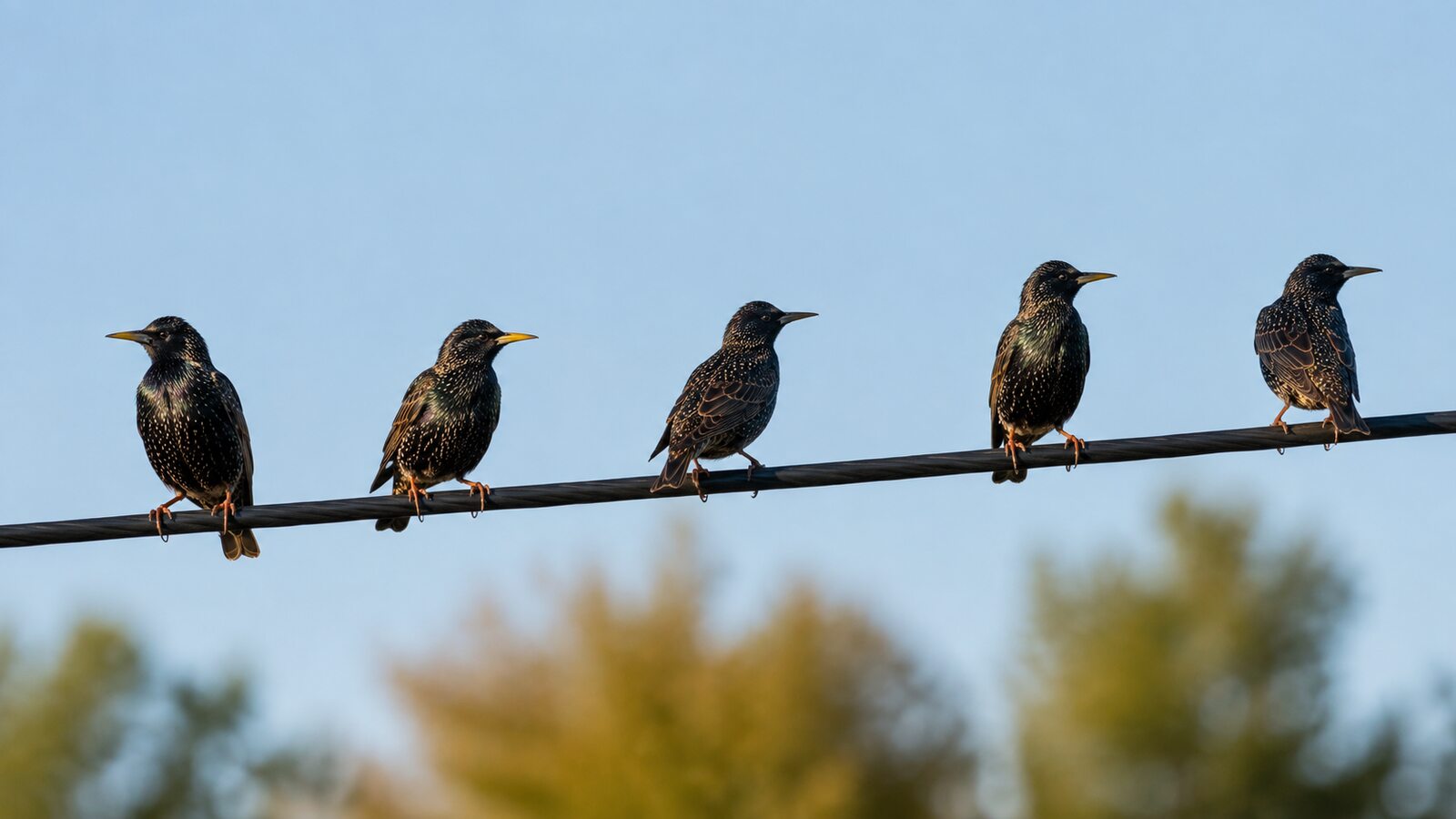
Power lines act a lot like bare branches
Bird feet are very good at gripping narrow perches. A wire is not so different from a twig in that respect.
What makes the wire especially attractive is the view. There are no leaves in the way. A bird can look across a yard, road, field, parking lot, or shoreline and spot food, competitors, predators, or flock mates.
In places with few tall trees, utility lines may be some of the best perches around.
Some birds are waiting for food
Watch an American Kestrel on a wire and this becomes obvious.
Kestrels, shrikes, kingbirds, bluebirds, swallows, and other species may use exposed perches while watching for prey. The bird can scan from above, drop or fly out to grab food, then return to a perch.
Not every bird on a wire is hunting, of course. A House Finch is much more likely to be resting or socializing than waiting to pounce on a mouse.
Wires are good gathering places
Flocking birds often need somewhere to assemble.
Starlings, blackbirds, swallows, pigeons, finches, and other social birds may line up before moving to a feeding area or evening roost. During migration, a wire can become a temporary waiting room.
Cornell notes that House Finch flocks commonly perch on power lines. If you see dozens of birds packed onto a wire in late summer or fall, the group may be feeding, resting, or organizing before its next move.
Why do birds sit so close together?
Sometimes the flock simply wants the same good perch.
Being in a group also means more eyes watching for danger. One bird reacts, and suddenly the whole line empties.
In cold weather, birds may cluster more closely, although a row on a wire does not automatically mean they are huddling for warmth. The spacing depends on species, weather, social behaviour, and how crowded the perch is.
Why do birds face the same direction on a wire?
Wind is often the reason.
Birds generally prefer to face into the wind because it makes balance and takeoff easier. Their feathers also lie more naturally when wind comes from the front rather than pushing up from behind.
If nearly every bird on a wire is pointing the same way, check which direction the breeze is coming from.
Do birds use wires for singing?
Yes. An exposed perch can be a good stage.
A singing bird wants its sound to carry, and many species choose open, elevated perches during the breeding season. A wire, fence post, antenna, or treetop can all do the job.
This is especially noticeable with meadowlarks, kingbirds, blackbirds, and some finches in open country.
Are telephone wires different from power lines to a bird?
From a perching point of view, not much. Both can provide a narrow elevated surface.
From a safety point of view, the infrastructure matters a great deal. Some lines carry electrical current and some do not. Spacing, insulation, pole hardware, and the size of the bird all affect risk.
That is why it is better not to assume that every wire with birds on it is harmless.
Why don't the birds fall off?
Perching birds have feet and tendons that make gripping branches and wires easy.
They still adjust constantly. Watch through binoculars and you may see toes shift, tails flick, wings open briefly, or the body lean into gusts. It looks effortless because birds are very good at it.
Do birds sleep on power lines?
Some birds may rest or even roost on wires, but exposed power lines are not the usual nighttime choice for many backyard songbirds.
Dense vegetation, tree cavities, sheltered branches, buildings, and communal roosts can offer more protection from weather and predators. Our page on where birds sleep at night covers those options.
Are wires dangerous to birds?
They can be.
Small birds perched on a single conductor often avoid electrocution because both feet are at nearly the same electrical potential. Larger birds can be at greater risk if a wing, foot, or other body part touches two energized components, or an energized part and grounded equipment, at the same time.
Collisions are a separate problem. Large birds and birds flying in poor visibility can strike wires they do not see in time.
See why birds usually do not get electrocuted on a single power line for the electricity part.
Why are there suddenly hundreds of birds on the wires?
Season is a good clue.
Late summer and fall bring family groups, post-breeding flocks, and migration. Some species gather in very large numbers before travelling to a roost. Food can also concentrate birds in one area for a few days.
Then the flock moves on and the wires look empty again.
Frequently asked questions
Why do swallows sit on power lines?
Swallows may rest and gather on wires between feeding flights, especially before migration. A wire gives a whole flock an open place to land.
Why do pigeons sit on wires?
Pigeons and doves use elevated structures for resting, watching the surroundings, and gathering. In cities, utility wires are part of the available perch network.
Why do hawks sit on power poles?
A tall pole gives a hawk a broad view of open ground where prey may be moving. Unfortunately, some pole designs also create electrocution risks for large raptors.
Why do birds all fly off a wire at once?
One bird may spot danger first. Flocking birds react quickly to one another, so a single alarm or sudden movement can launch the whole group.
Watch what the bird does next
A bird's next move often tells you why it chose the wire.
Does it drop into a field after prey? Join a flock? Start singing? Preen for five minutes? Fly toward a roost?
The wire is only the perch. The behaviour around it tells the story.
Continue with why birds don't get electrocuted on power lines, why birds flock together, or return to Bird Facts.
Sources and further reading
- Cornell Lab: House Finch flocks commonly perch on power lines
- Audubon: power poles as bird perches and the risks they can create
- Audubon Bird Migration Explorer: power lines and birds
Mourning Doves are one of the classic wire-perching birds. Our Mourning Dove guide covers their shape, cooing song, food, flight, and nesting.