
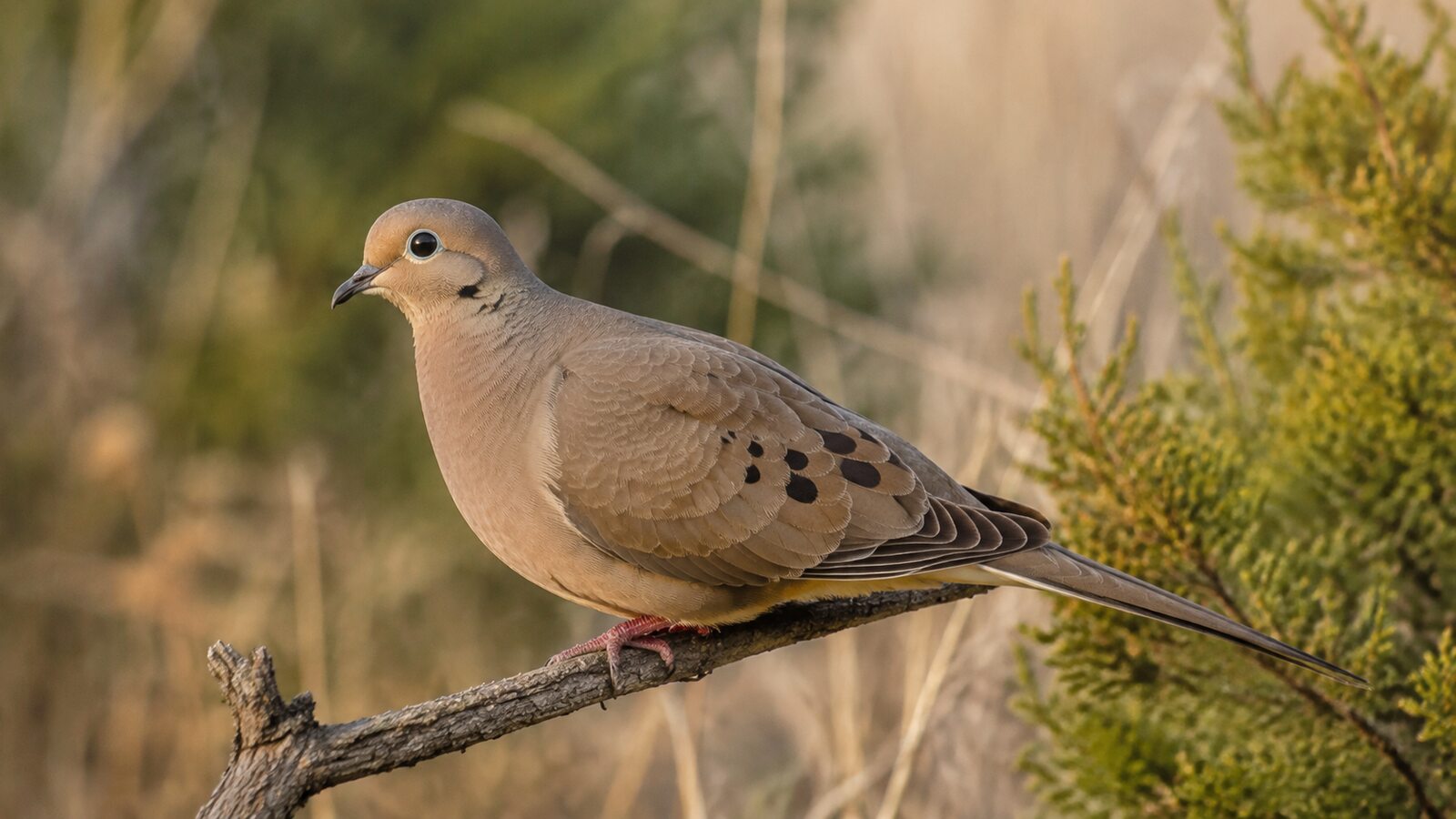
How to identify a Mourning Dove
Mourning Doves have a smooth, streamlined shape. The head is small, the body is plump but not heavy-looking, and the tail is long and pointed.
The plumage is mostly soft tan, brown, and gray. Black spots mark the wings, and the breast can show a warm pink or buff wash. The eye is dark with a pale blue skin ring around it.
In flight, watch the tail. The long pointed shape and white outer tail edges are good clues.
Their flight is quick and direct. Cornell describes it as fast and bullet-straight, which fits the way they can shoot across an open yard.
What does a Mourning Dove sound like?
The song is a soft series of low coos. It can sound sad or distant, which is where the word mourning comes from.
People sometimes mistake the sound for an owl, especially early in the morning or when the dove is hidden.
There is another sound too. When a Mourning Dove takes off, the wings can make a sharp whistle. That sound is mechanical. It comes from the wings rather than the throat.
What do Mourning Doves eat?
Seeds. Mostly seeds.
Cornell reports that seeds make up about 99 percent of the diet. Mourning Doves eat wild grass and weed seeds, grains, and other small seeds they can pick from the ground.
That feeding style explains why you often see them walking under a feeder instead of clinging to it. Fallen seed is easy to reach.
A clean platform feeder or ground-feeding area can attract them, but regular cleanup matters because food and droppings build up quickly on the ground.
Where Mourning Doves live
Mourning Doves are found across most of North America.
They favour open country, woodland edges, farms, grasslands, roadsides, parks, and suburban yards. Telephone wires and exposed branches make convenient resting places.
Some populations stay year-round. Northern birds can migrate long distances south, while birds farther south may move only a short distance or not at all.
Where do Mourning Doves nest?
The nest often looks surprisingly flimsy.
Mourning Doves build loose platforms of twigs in trees, shrubs, and sometimes on buildings or other structures. The male commonly brings material while the female arranges it.
A typical clutch contains two white eggs.
Both parents help incubate and feed the young. Like other pigeons and doves, they produce crop milk, a nutrient-rich secretion used to feed nestlings early in life.
Why do Mourning Doves sit on power lines?
Power lines give them a clear, elevated place to rest, watch the area, gather with other doves, and move between feeding spots.
The species is so strongly associated with wires that a row of doves can be one of the easiest roadside identification clues.
For the broader question, see Why Do Birds Sit on Power Lines?.
Why do Mourning Doves bob their heads?
When doves walk, the head appears to bob forward and back. The movement helps stabilize their view while the body is moving.
There is more going on than a simple bounce. The head stays briefly stable relative to the surroundings, then quickly moves forward to a new position.
We cover that behaviour more broadly in Why Do Birds Bob Their Heads?.
Mourning Dove look-alikes
Eurasian Collared-Dove is larger, paler, and squarer-tailed, with a black collar on the back of the neck.
White-winged Dove has broad white wing patches that are easy to see in flight and a shorter, squarer tail.
Rock Pigeons are heavier and more variable in colour. Their broad bodies and shorter tails look very different beside a slim Mourning Dove.
In western areas, Band-tailed Pigeon is much larger and chunkier.
How long do Mourning Doves live?
Mourning Doves face many risks, and a large number die young.
Some individuals survive for many years, though. As with other birds, maximum banding records are interesting, but they should not be mistaken for the normal lifespan of every dove.
Frequently asked questions
Do Mourning Doves mate for life?
Pairs may remain together for a breeding season and can form strong pair bonds, but it is too simple to say that every pair stays together for life.
Why do Mourning Doves make a sad sound?
The low cooing song sounds mournful to many people. The bird is not necessarily sad. It is normal communication, especially during courtship and territory-related behaviour.
Do Mourning Doves use bird feeders?
Yes, especially platform feeders and the ground below feeders. Millet, cracked corn, and other small seeds are commonly taken.
Are Mourning Doves pigeons?
They belong to the same bird family, Columbidae, which includes pigeons and doves.
More familiar birds
Continue with Northern Cardinal, Blue Jay, Black-capped Chickadee, or browse all Common Birds.