
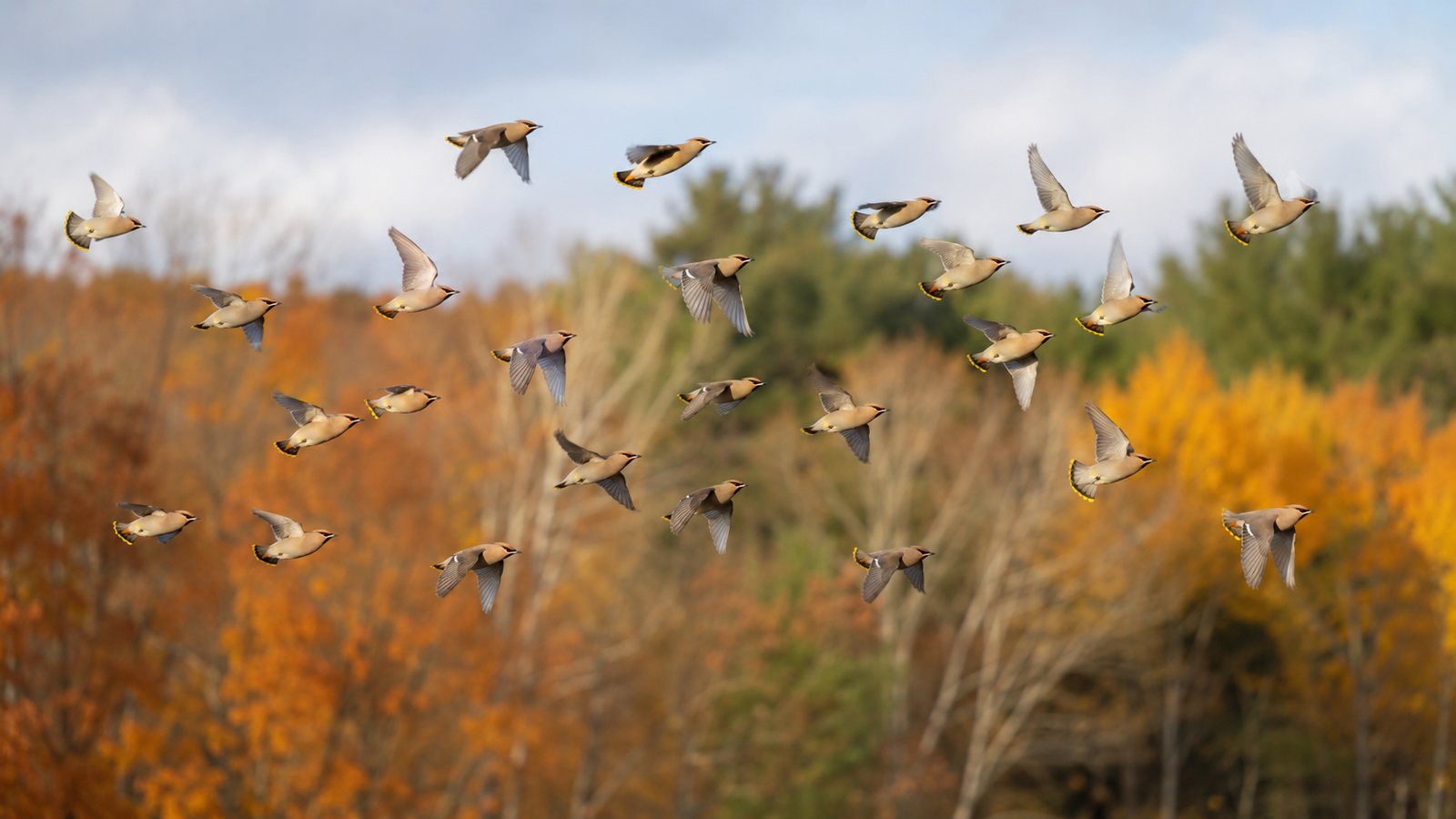
Safety is one of the biggest benefits
Imagine eating lunch while also checking every few seconds for a hawk. That is basically a normal day for a small bird.
In a flock, several birds can scan the surroundings. One individual can spend more time feeding while neighbours are also watching. If somebody spots danger and gives an alarm call, the whole group may react.
There is another advantage. A predator facing dozens or hundreds of moving birds may have a harder time locking onto one target. The flock does not make each bird invincible. It changes the odds.
Why do birds flock around food?
Food can be patchy. One tree is full of seeds. The next ten are nearly empty.
A group gives birds more chances to discover a good feeding spot. If one bird suddenly drops into a berry bush or seed-rich patch, others notice. Social birds can use the behaviour of flockmates as information.
Of course, finding food together also creates competition. A flock can cooperate in one sense and squabble in the next. Anyone with a busy feeder has seen that.
For the other side of the story, read why birds chase each other.
Why do birds flock in winter?
Winter changes both food and social behaviour.
Many birds that defended breeding territories in spring no longer need the same private space. Chickadees, nuthatches, kinglets, woodpeckers, and other woodland birds may move through the same area in loose mixed-species flocks.
Different species search in different places. A nuthatch works trunks and branches. A chickadee checks twigs and leaf clusters. A woodpecker probes bark. Travelling together can increase the number of eyes watching for predators without forcing every bird to hunt in exactly the same way.
The flock can feel almost like a moving neighbourhood.
Why do some birds form huge evening flocks?
They may be heading to a communal roost.
Starlings, crows, blackbirds, vultures, robins, and other birds can gather in large numbers before nightfall. The flock may build gradually as smaller groups join from different directions.
Roosting together can provide safety and access to a sheltered site. In some species, communal roosts may also help birds exchange information about feeding areas.
If the birds seem to appear out of nowhere near sunset, the destination may matter more than the patch of sky you’re watching. See where birds sleep at night for more.
Why do starlings make murmurations?
A starling murmuration is flocking turned up to eleven.
Thousands of birds can twist through the sky in waves that look almost liquid. There is no little starling air-traffic controller shouting instructions from the front.
Research on collective movement shows that coordinated patterns can emerge when individuals respond rapidly to the movement of nearby flockmates. A change in direction spreads across the group.
Predator pressure is part of the picture. Dense, shifting groups can make it difficult for a falcon to isolate one bird. The spectacle we enjoy from the ground is a serious survival situation for the flock.
Do bird flocks have leaders?
Sometimes. But not in the way people often imagine.
A family group may follow experienced adults. Geese in a travelling formation can change positions, and birds at the front have a different aerodynamic job from birds behind them. Other flocks coordinate through local reactions rather than one permanent leader.
So the answer depends on the flock. A line of goslings behind a parent is not organized like a murmuration.
Why do geese fly in a V?
Formation flight can save energy.
A bird flying behind and slightly to the side of another can take advantage of moving air created by the wingbeats ahead. The exact spacing matters. Birds also take turns in demanding positions rather than leaving one individual to do all the hard work.
Geese aren’t flocking only for aerodynamics, though. They are also migrating as social groups, maintaining contact and moving toward shared stopover and wintering areas.
Read why birds fly in a V for the airflow and leader changes. Our migration page covers the bigger seasonal reason for those journeys.
Why don’t birds crash into each other in a flock?
Most of the time, they are paying very close attention.
Birds have fast visual systems and excellent control of speed and direction. In a tight flock, each bird responds to the positions and movements of birds around it. Small adjustments ripple through the group quickly.
Collisions can happen, especially around panic, obstacles, bad visibility, or human-made structures. But normal flocking is not random chaos. It only looks that way from far away.
Why do birds suddenly all take off at once?
One bird may have seen something you didn’t.
A hawk, cat, person, loud noise, or sudden movement can trigger the first few birds. Their takeoff becomes a signal in itself. Within a fraction of a second the entire group is airborne.
Sometimes the flock lands again almost immediately. False alarms are cheaper than ignoring a real predator.
Why do mixed species flock together?
Because different birds can bring different strengths.
Mixed flocks are especially noticeable in winter woodlands. Chickadees are often vocal and alert. Nuthatches search bark and trunks. Kinglets work fine foliage. Woodpeckers bring size and a different feeding style.
The birds are not planning the flock in a human way. Staying with the group can still pay off. More eyes may spot predators, and other birds can lead the flock toward food.
For a birder, mixed flocks are worth following. One chickadee can lead you to five other species in a minute.
Why do some birds stop flocking in spring?
Breeding changes the social rules.
A winter flock may split as birds establish territories and pairs. The same species that tolerated neighbours at close range in January may start singing, displaying, and driving rivals away in April.
Food has changed too. Insects return, plants leaf out, and nesting birds spread across habitat that offers suitable nest sites.
Bird social life is seasonal. That is easy to miss if you only watch one month of the year.
Are all flocks made of the same species?
No. Some are, some aren’t.
Geese, blackbirds, shorebirds, waxwings, finches, and starlings often form flocks dominated by one species or a few closely associated species. Woodland winter flocks can be much more mixed.
At a feeder you may have a temporary flock created by the food itself. Chickadees, finches, juncos, sparrows, nuthatches, woodpeckers, and jays can all be using the same small area without moving together once they leave.
That distinction matters. A crowd is not always a travelling flock.
A swirling group of hawks or vultures can have another explanation too: they may be circling together in a thermal.
Frequently asked questions
Why do birds flock together?
Common benefits include predator detection, reduced individual risk, food finding, information sharing, travel, and roosting.
Why do birds flock in winter?
Many birds are no longer defending breeding territories, and flocking can help them locate food and watch for predators during a difficult season.
Do flocks always have a leader?
No. Some groups follow experienced birds, while many coordinated flocks move through rapid reactions among nearby neighbours.
Why do some flocks form a V?
For species such as geese, the formation can reduce the energy needed for flight when birds use air movement produced by those ahead of them.
A flock is a moving set of trade-offs
More eyes. More competition. Better information. Less privacy. Birds gain different things from flocking at different times of year. Continue with why birds migrate, why birds chase each other, or return to Bird Facts.
If the flock is lined up above a road or yard, continue with why birds sit on power lines.