
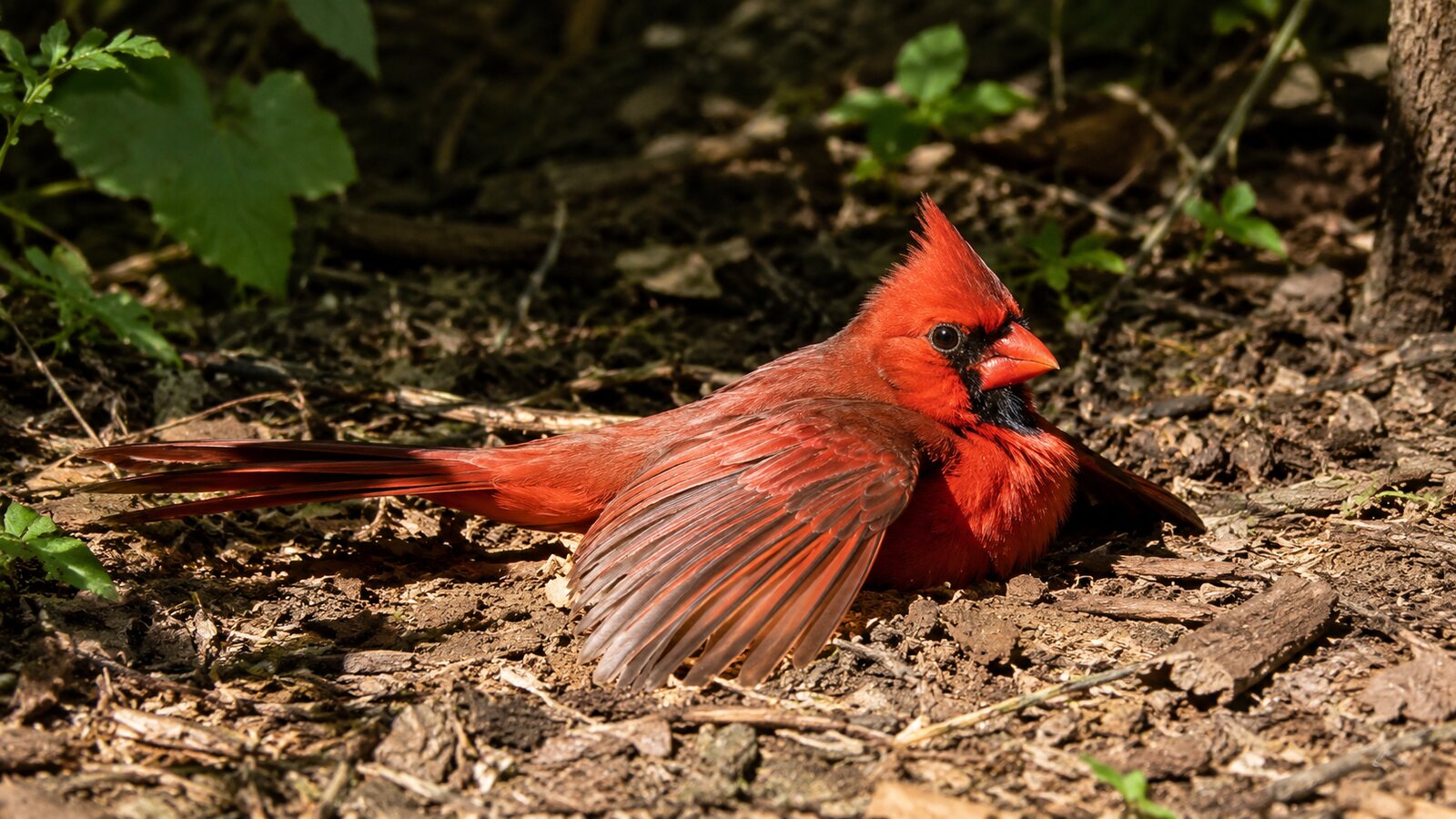
Bird sunbathing is called sunning
Ornithologists usually call the behaviour sunning.
The posture varies by species. A bird may spread both wings, drop one wing toward the sun, fan its tail, raise the feathers on its back, turn its head, or lie surprisingly flat.
It can look dramatic. That is part of what makes people worry.
Birds can use the sun to warm up
This is the easiest reason to understand.
A bird that spent a cold night outside can absorb solar heat instead of producing every bit of warmth through metabolism. Dark feathers can become especially warm in direct sun.
Turkey Vultures are famous for sitting with their wings spread in the morning. Warmth is one likely benefit, particularly after cool nights.
Sun can help dry wet feathers
A bath, rainstorm, heavy dew, or time on the water can leave plumage damp.
Direct sun and moving air speed drying. Birds often combine sunning with preening, shaking, and rearranging feathers.
Dry, well-aligned feathers matter. They are part of insulation, waterproofing, and flight.
Does sunbathing kill parasites?
There is good evidence that it can help.
Feather lice hide among the plumage where a bird's bill cannot always reach them easily. Experiments and field observations described by Audubon found that intense sunning can heat feathers enough to kill lice, and heat may also make surviving parasites move where preening can reach them.
That does not mean parasite control is the only purpose of sunning. Birds probably get several benefits from the same behaviour.
Why do birds fluff their feathers while sunning?
Opening the plumage lets sunlight reach deeper between the feathers.
A bird may lift feathers, twist its body, and angle one side toward the sun. The strange pose exposes areas that normally sit in shade.
Afterward, the bird often preens. That sequence makes sense if sunning is part of feather maintenance rather than simply relaxing in the warmth.
Do birds sunbathe when it is already hot?
Yes, which is one reason warming cannot be the whole explanation.
Some birds sun in temperatures where they are also panting. That looks contradictory until you consider parasite control and feather maintenance.
Researchers studying vultures have recorded very high temperatures in sun-exposed feathers. For lice, that can be deadly.
Which birds sunbathe?
A lot of them.
Audubon notes that sunning has been observed in birds from more than 50 families. Vultures, cormorants, doves, thrushes, finches, swallows, and many others may do it.
The exact posture differs. A robin on a lawn may flatten itself and spread a wing. A vulture may sit upright with both wings extended. A cormorant's wing-spreading can involve drying and other functions too.
Is sunning the same as spreading wings?
Sunning is one reason birds spread their wings. It is not the only one.
Birds also spread wings to dry, cool, stretch, balance, display, threaten, shade young, or regulate body temperature. Context is important.
If you want the broader list, see why birds spread their wings.
How can I tell sunbathing from an injured bird?
Watch before approaching.
A sunning bird is usually alert. It may shift position, look around, preen, close its wings, and fly normally when it is ready. The behaviour often happens in a patch of direct sunlight.
An injured or sick bird usually shows other signs too. It may be unable to stand or fly, keep one wing drooped, bleed, close its eyes, look very weak, or barely react to danger.
If a bird may be injured, use a licensed wildlife rehabilitator rather than assuming every odd posture is sunning.
Do birds sunbathe in winter?
They can.
On a cold clear morning, solar warmth is worth taking advantage of. Birds already use feathers, food, shelter, and behaviour to conserve energy in winter. Sunning can fit into that bigger picture.
See how birds stay warm in winter for the rest of the toolkit.
Do birds enjoy sunbathing?
We cannot ask them.
A bird may look wonderfully relaxed, but appearance is not proof of a human-like feeling. What we can say is that many species deliberately seek sunny spots and adopt repeatable sunning postures.
That is already interesting enough.
Frequently asked questions
Why is a robin lying in the sun?
If the robin is alert, has feathers spread, and later gets up normally, it may simply be sunning. Robins and other thrushes can adopt very flat, odd-looking sunning postures.
Why do vultures spread their wings in the sun?
Warming, drying, and feather maintenance can all be involved. Research also supports parasite control as a benefit of sunning in vultures.
How long do birds sunbathe?
There is no fixed time. A bird may sun for a few minutes, change sides, preen, and move on. Weather, species, feather condition, and temperature all affect the behaviour.
Should I disturb a bird that is sunning?
No. If the bird appears alert and safe, give it space. You may get a much better look at the full behaviour by simply watching.
Odd-looking can still be normal
Bird watching gets more interesting when a strange posture stops looking like a problem and starts looking like behaviour.
Sunning is a good example. Wings out. Feathers messy. Maybe even a little panting. Then, a few minutes later, the bird is gone.
Continue with why birds spread their wings, why birds preen, or return to Bird Facts.