
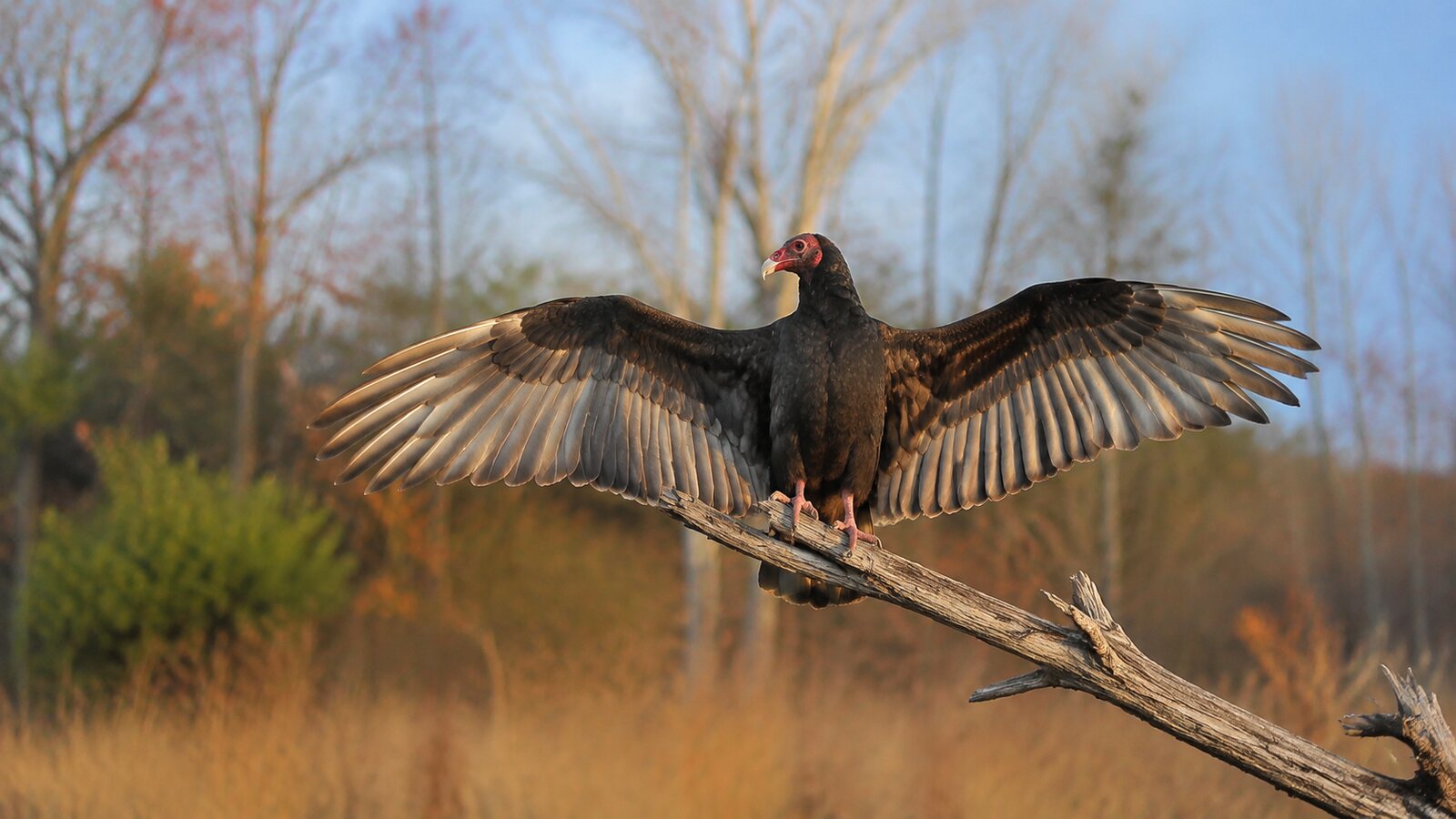
Why do birds spread their wings in the sun?
Birds sunbathe. Really.
Ornithologists usually call the behaviour sunning. A bird may turn toward or away from the sun, fluff its feathers, spread the tail, droop one or both wings, or flatten itself in a sunny patch. The pose can look so odd that people sometimes think the bird is hurt.
Sunning has been reported in birds from many different families. It probably serves more than one purpose, which is why the exact posture and timing vary so much. The dedicated why birds sunbathe page looks more closely at warming, drying, feather care, and parasite control.
Sunshine can provide free warmth
A cold bird has to burn food energy to stay warm. Sunlight changes the equation.
Large dark birds such as Turkey Vultures are well known for opening their wings on cool mornings. By exposing more feather surface to the sun, they can gain heat without producing all of it internally.
Small birds sun too. The benefit may be modest on a warm afternoon, but after a chilly night even a little solar heat can help.
If cold-weather survival has you curious, see how birds stay warm in winter.
Does sunning help birds get rid of parasites?
There is good evidence that it can play a part.
Feather lice and other tiny hitchhikers live where a bird can’t always reach them easily. Research has found that feather temperatures during sunning can become harsh enough to kill some lice. Sunlight may also cause parasites to move, potentially making them easier to catch during preening.
That doesn’t mean every bird lying in the sun is running a parasite-removal program. Warming, drying, comfort, and feather care can overlap. Biology is often messier than one tidy explanation.
Why do birds spread their wings after a bath?
Wet feathers need attention.
After bathing, many birds shake hard, fluff up, preen, and adjust their wings. Opening the wings lets air move around the feathers and gives the bird access to places that are harder to reach when everything is folded tightly against the body.
You may see this at a backyard bird bath on a sunny day. One bird splashes for ten seconds. Another sits nearby and spends several minutes putting itself back together.
Our bird bath guide covers how to make that behaviour easier to watch at home.
Why do cormorants stand with their wings open?
Cormorants are probably the birds most people associate with this pose. They come out of the water, perch on a rock, piling, dock, or tree, then hold both wings wide.
Drying is part of the story. Their plumage allows more wetting than the plumage of many other waterbirds, which can help reduce buoyancy while diving. Once back above water, wing spreading can speed evaporation from the outer feathers.
Temperature matters too. Studies of cormorant wing-spreading suggest the behaviour can serve thermoregulation as well as drying, so the old one-line answer is probably too narrow.
Do birds spread their wings to cool down?
They can.
Moving the wings away from the body exposes areas that are normally covered and can increase airflow. A hot bird may also pant, hold feathers closer to the body, seek shade, or reduce activity.
Here is the confusing part: open wings can help a bird gain heat in one setting and lose heat in another. Sun angle, air temperature, wind, body posture, and feather condition all change what the posture does.
So don’t judge from the wings alone.
Sometimes a wing spread is just a stretch
You probably stretch after sitting too long. Birds do too.
A common bird stretch involves extending one wing and the leg on the same side. The feathers fan neatly, the toes reach back, and then everything folds up again. It lasts only a moment.
Another stretch may raise both wings above the back. That can look dramatic if you catch the exact second in a photo, but it is ordinary maintenance behaviour. The new why do birds stretch? page looks at the one-wing, one-leg stretch and other versions more closely.
Why do birds spread their wings at other birds?
To be seen.
Wide wings make a bird look larger. They can also reveal patterns or colours that disappear when the wing is folded. During courtship, that may help attract attention. During a dispute, it can make the owner of a feeder, territory, nest site, or patch of shoreline look harder to push around.
Geese, swans, raptors, nuthatches, and many other birds use wing position as part of social displays. Watch the rest of the body. Raised feathers, lunging, calling, chasing, or an open bill tells you this isn’t a lazy stretch.
You can follow that behaviour into why birds chase each other.
Can birds use their wings to shade something?
Yes. Wings can work like movable umbrellas.
Some birds shade chicks or eggs from strong sun. Others use wings while hunting. Herons, for example, may create shade over shallow water, which can reduce glare and change how prey responds.
That is a good reminder that a bird wing is not just a flight surface. It is also insulation, shade, a display board, a balance aid, and sometimes a very effective threat.
How can I tell sunning from an injured bird?
This is the part worth watching carefully.
A sunning bird often chooses direct sunshine, adopts an exaggerated but controlled posture, shifts position, preens, then gets up and carries on normally. It may look ridiculous. That’s okay.
An injured bird may lose balance, droop one wing, struggle to stand or fly, bleed, or barely react to danger. If a wild bird clearly cannot function normally, contact a licensed wildlife rehabilitator.
Don’t walk up to a healthy sunning bird just to test whether it can fly. Give it room and watch from a distance.
Why does a bird spread only one wing?
One-sided wing spreading is common during stretching and some sunning postures. A bird may lean onto one side and expose the other wing to sunlight, then switch sides later.
It can also happen during feather care. The key is whether the movement looks controlled and temporary.
A wing that hangs abnormally all the time is different. Context again.
Frequently asked questions
Why do birds spread their wings on the ground?
Many are sunning. The posture can help with warming and feather care, and research supports a role in controlling some feather parasites.
Why do birds spread their wings after rain?
Opening the wings can help air circulate around damp feathers. Birds often combine it with shaking and preening.
Why do birds spread their wings when fighting?
Wide wings increase apparent size and can be part of a threat or territorial display.
Is a bird lying in the sun with its wings open sick?
Not necessarily. Sunning can look alarming. A bird that soon gets up, preens, flies, and behaves normally was probably fine.
One posture, several possible stories
That’s what makes bird behaviour fun to watch. Continue with why birds preen, why birds puff up, or head back to Bird Facts.