
What counts as a bird problem?
In the wild, birds solve practical problems every day. They locate food, open hard shells, approach unfamiliar feeders, avoid competitors, choose safe routes, and respond when a normal food source changes.
Researchers often simplify one challenge into a controlled task. Food might be attached to a string, placed behind a barrier, covered by a lid, or reached only after an object is moved. The setup lets researchers record what each bird tries and how performance changes.
Birds can learn by trying
Trial and error is real learning. A bird attempts an action, notices the result, and is more likely to repeat an action that works.
That is not the same as planning every step before moving. Some famous string-pulling experiments show why researchers stay cautious: a bird can reach the food by responding to the result of each pull without understanding the whole task as a person might.
Crows are flexible, but results still vary
American Crows are curious, social, and adaptable. A study of wild-caught crows using a string-pulling task found clear differences among individuals. Experience, persistence, social surroundings, and the exact setup all affected performance.
That is more informative than saying every crow is a genius. It shows that a familiar North American species can learn and master a new task, while reminding us that individuals do not behave like copies of one another.
Tool use is one answer, not the whole answer
New Caledonian Crows can make and use tools to reach food. Other birds use objects as probes, hammers, anvils, hooks, or bait in particular settings.
Tool use is impressive, but a bird does not need a tool to show flexible thinking. Choosing a new route, opening a container, learning a sequence, or adjusting to a changed feeder can all involve problem-solving.
Birds can learn by watching
Social learning saves time and risk. A bird may follow another bird to food, copy a successful action, or join an alarm response after watching flockmates.
This is especially important in social species. Information about food or danger can spread through a group even when not every bird had the original experience.
Our visiting crows keep testing the puzzle
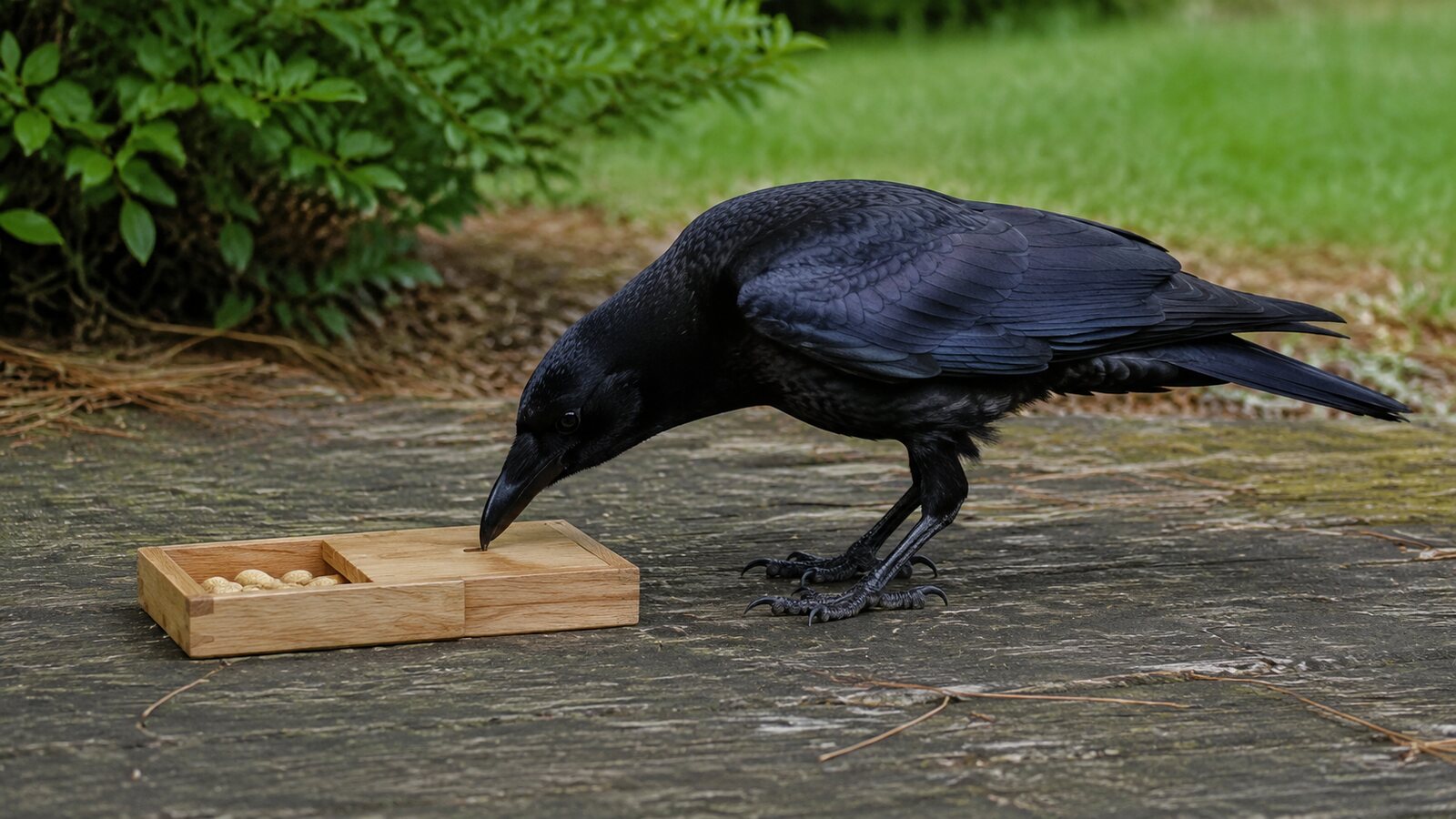
Several generations of crows visit our home. Robin has been teaching them to find food in simple dog puzzle toys, and it is fascinating to watch them inspect a compartment, try an approach, and return to it later.
That backyard observation is not a controlled experiment or proof of what a crow understands. It does show why ordinary bird watching can lead to good questions about learning, persistence, and memory.
Motivation changes performance
A bird may ignore a task because it is cautious, full, stressed, distracted, or unfamiliar with the materials. Failure does not automatically mean the bird lacks the ability. Success does not mean it understood the task in every possible way.
Scientists repeat trials, compare birds, and change parts of the setup to separate learning from chance. Even then, one puzzle measures only part of intelligence.
Look for learning without setting a trap
You may notice a bird approach a new feeder more quickly after watching another bird, return to the same opening in a tree, or change its route around a harmless obstacle. Observe from a distance and keep the situation safe.
Do not use string loops, sticky materials, sharp objects, or containers that could trap a bill, foot, or head. Food puzzles should never replace appropriate food or make a wild bird dependent on a person.
Problem-solving is one part of intelligence
Memory, communication, social learning, flexibility, and species-specific skills matter too. The broad bird-intelligence guide puts those abilities together, while bird memory follows the information birds retain.
For another behaviour that can reveal exploration and flexibility, see whether birds play.
Frequently asked questions
Can birds learn to solve a puzzle?
Some birds can learn how to reach food in a puzzle through exploration, repeated attempts, memory, or watching another bird. Performance varies by species, individual, and experience.
Are crows good problem solvers?
Crows can be flexible problem solvers, but not every crow solves every task. Studies show that experience, persistence, social setting, and the design of the problem affect success.
Can birds use tools?
Some species use tools. New Caledonian Crows are a famous example, but tool use is not universal among crows or birds and is only one form of intelligence.
Do birds learn from each other?
Yes. Social learning can help birds discover food, recognize danger, learn calls or songs, and respond to unfamiliar situations without starting from scratch.