
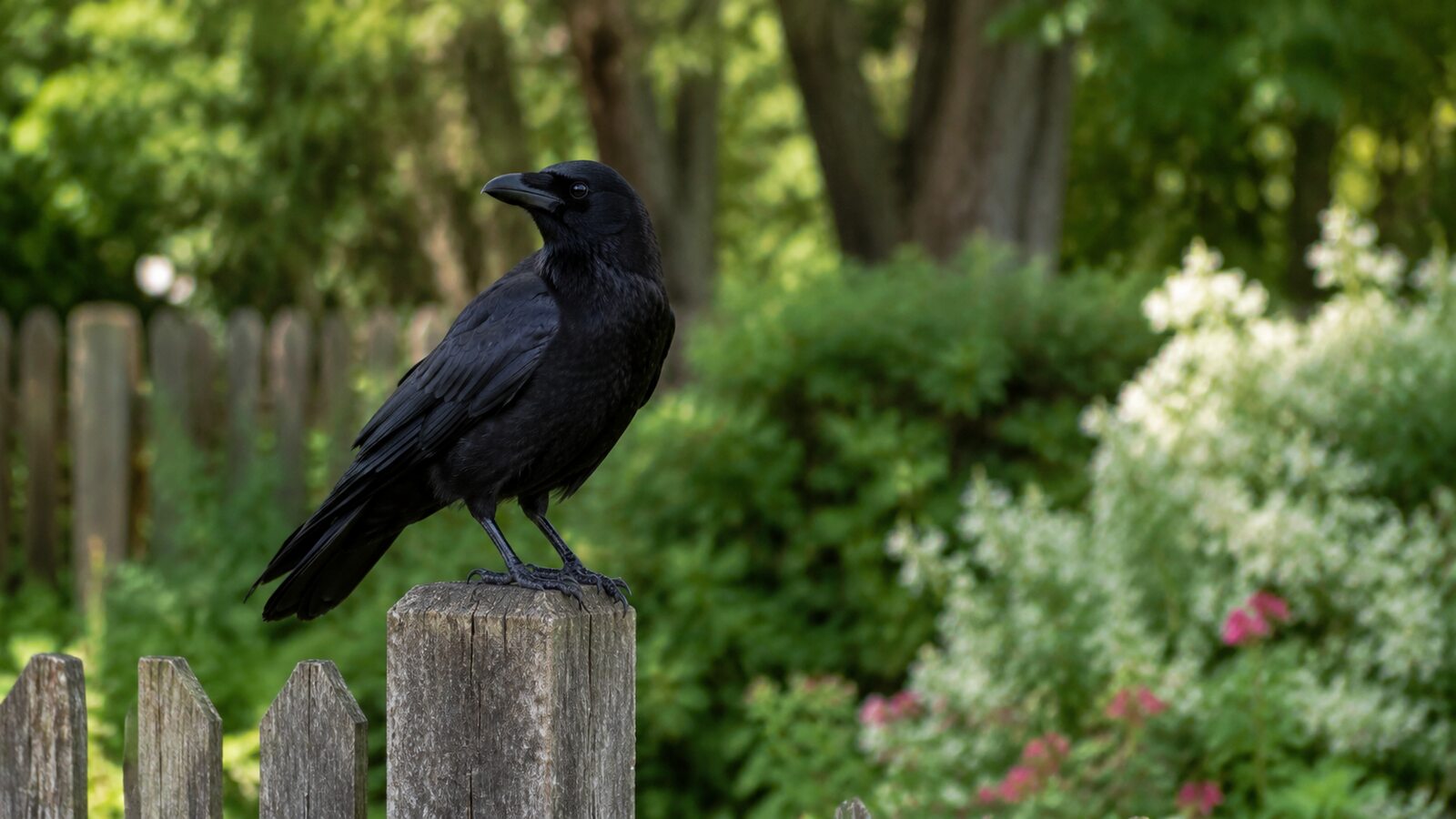
How to identify an American Crow
American Crows are big songbirds. That sounds odd if you are used to thinking of songbirds as chickadees and sparrows, but crows belong to the order Passeriformes too.
The plumage is black from bill to tail. In good light, the feathers can show a blue, purple, or green sheen. The eye is dark. The legs and bill are black as well.
Shape matters more than subtle colour. An American Crow has a thick body, a fairly strong bill, broad wings, and a medium-length tail. The throat usually looks smoother than the shaggy throat of a Common Raven.
When the bird flies, watch the tail. A crow's tail tends to look rounded or somewhat squared. A raven's tail is longer and usually tapers into a wedge.
The caw is often the easiest clue
You may hear a crow before you see it.
The classic call is a harsh, carrying caw. American Crows have a much larger vocabulary than that single sound, including rattles, clicks, softer calls, alarm notes, and family vocalizations, but the basic caw remains a very good field clue.
If you keep hearing different caws from the same group, that does not mean every sound has a simple English translation. Context matters. So does the individual bird.
We dig deeper into that on Why Do Crows Caw?.
Where American Crows live
American Crows are widespread across much of the continental United States and southern Canada. They do especially well where open ground and trees occur together.
That can mean farmland, parks, neighbourhoods, cemeteries, golf courses, beaches, roadsides, river edges, fields, and open woodland. They are very comfortable around people when food and safe places to perch are available.
They usually avoid huge stretches of unbroken forest and the driest desert country, although local habitat patterns vary.
What American Crows eat
Almost anything they can handle.
American Crows eat insects, earthworms, seeds, grains, nuts, fruit, carrion, eggs, nestlings, small animals, fish, and human food. That list sounds chaotic, but it tells you something important about the bird. Crows are opportunists.
They often forage on the ground, walking with a confident stride and checking lawns, fields, shorelines, roadsides, and other open areas.
If you are curious about what is safe around a yard, see our fuller page on what crows eat.
Crow families can stay together for years
This is one of the things I find most interesting about them, especially because Robin watches a multi-generation crow family around our home.
American Crows often live in extended family groups. Young birds may remain with their parents for several years, and older offspring can help feed and defend younger nestlings.
That means a small group of crows in the same neighbourhood may not be a random flock. It may be a family.
Outside the breeding territory, crows can also gather in much larger numbers. Winter roosts may contain hundreds, thousands, or far more birds.
Where do American Crows nest?
Crows usually build a bulky stick nest high in a tree. Both members of the pair may bring material, while the female does much of the detailed construction.
The nest has a sturdy outer platform of sticks and a softer inner cup lined with materials such as bark, grass, moss, plant fibres, hair, or other soft material.
A typical clutch is several eggs. Incubation is roughly two and a half weeks, and the young remain in the nest for several more weeks before fledging.
Do not approach an active nest just to get a better look. Crows are alert parents, and disturbing a nest helps nobody.
American Crow behaviour
Crows notice things. People. Cars. Dogs. Hawks. New objects. Changes in routine.
Research has shown that American Crows can recognize individual human faces and remember threatening people for years. They also learn socially, meaning information can spread through a group.
They mob predators, cache food, solve problems, investigate unfamiliar objects, and watch other animals for opportunities. None of this makes every crow a tiny genius solving puzzles all day. It does make them unusually flexible birds.
Robin has been offering our visiting crows food puzzles made for dogs. That personal experience belongs on our About page, while the broader science is covered in How Smart Are Birds?, Can Birds Solve Problems?, and Do Birds Play?.
American Crow vs Common Raven
Black bird. Big bill. Corvid. Easy to mix up at a distance.
Common Ravens are much larger. They have heavier bills, shaggy throat feathers, longer wings, and a wedge-shaped tail. Ravens often soar and glide more, while crows tend to flap steadily.
Sound can settle it quickly. Crow: harsh caw. Raven: deeper croak.
See the full Crow vs Raven comparison for side-by-side clues.
How long do American Crows live?
Many young crows do not survive their first years, so a simple average can be misleading. Birds that make it through those early risks can live much longer than people expect.
Banding records show that some wild American Crows have lived well into their teens. Longevity records are impressive, but they are not promises about a typical bird.
Frequently asked questions
Are American Crows male and female different colours?
No obvious plumage difference separates adult males and females. Males average larger, but size overlaps enough that it is usually not a reliable way to sex a lone crow in the field.
What is a group of crows called?
A traditional collective noun is a murder of crows. In normal bird watching, flock, family group, and roost often tell you more about what the birds are actually doing. See What Is a Group of Crows Called?.
Do crows remember people?
At least some do. Research on American Crows has shown long-term recognition of individual human faces associated with danger.
Are American Crows protected?
In the United States, American Crows are covered by the Migratory Bird Treaty Act, although regulated hunting seasons exist in some states. In Canada, legal protection and hunting rules vary by province and territory. Check current local regulations before taking any action involving wild crows.
More crow and raven pages
Continue with Common Raven, Crow vs Raven, Why Do Crows Caw?, What Do Crows Eat?, or browse all Common Birds.