
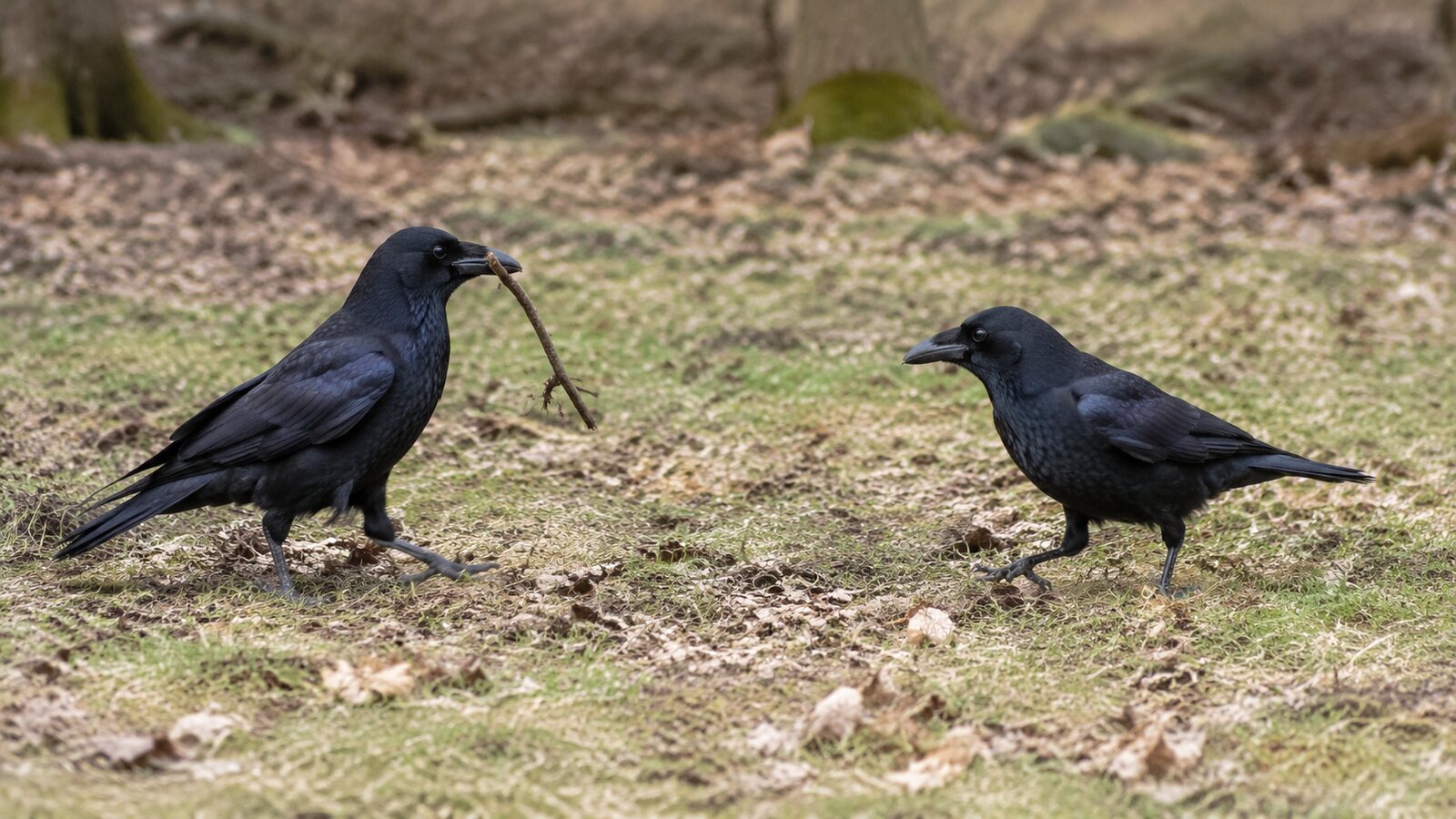
What does bird play look like?
Sometimes it looks exactly like what you would expect.
A raven picks up an object, drops it, grabs it again, and keeps going. A young owl pounces on leaves. Gulls have been seen carrying objects into the air, dropping them, and catching them again. Some ducks repeatedly ride fast-moving water.
That does not mean every strange bird movement is play. A bird may be practising a feeding technique, testing an object, defending something, or reacting to another bird.
Context matters.
What kinds of play do birds show?
Researchers often divide animal play into three broad types.
Object play involves picking up, moving, carrying, dropping, pulling, or otherwise experimenting with something.
Locomotor play is about movement. A bird may slide, swoop, tumble, hang, or repeat a flight manoeuvre without an obvious practical reason.
Social play involves another bird. That can include chasing, wrestling, exchanging objects, or other interactions that are different from serious aggression.
One bird can mix all three.
Do crows play?
They do, and corvids are among the bird groups most often discussed in research on play.
Crows, ravens, jays, and their relatives are curious, flexible problem solvers. Young birds in particular may spend a lot of time manipulating objects and exploring how things work.
This question feels less theoretical around our house. Robin has been giving the visiting crows food puzzles made for dogs. Watching a crow stop, inspect the puzzle, try one approach, and then switch tactics makes you appreciate how much is going on behind that black bill.
If you are curious about the everyday side of their lives too, start with what do crows eat?.
Is every interaction with a puzzle play? No. Food is a real reward, so some of that behaviour is problem solving and foraging. But corvid research shows that object play and exploration are genuine parts of their behavioural toolkit too.
Why would play be valuable to a bird?
Play may give a young animal a safe way to practise.
Moving an object can improve coordination. Chasing another bird may sharpen flight and social skills. Exploring unfamiliar things can teach a bird what can be moved, opened, carried, hidden, or used later.
There probably is not one single benefit that explains every case.
That is part of what makes play interesting. The activity may look pointless in the moment while still helping a bird become more flexible later.
Do only smart birds play?
No, although some of the most elaborate bird play is reported in groups known for flexible behaviour, including corvids and parrots.
Researchers have also described play in gulls, owls, ducks, hornbills, and other birds.
Bird intelligence is not one simple ladder anyway. A species can be exceptional at navigation, song learning, food caching, social recognition, or tool use without behaving like a crow.
Our how smart are birds? page looks at those different kinds of ability.
Do baby birds play more than adults?
Often, yes.
Young animals have a lot to learn, and play gives them room to experiment before every movement has to be efficient.
That said, adult birds can play too. Research on ravens and several other groups has recorded playful behaviour beyond the juvenile stage.
Age changes the pattern. It does not necessarily switch play off.
How can you tell play from fighting?
This can be tricky when two birds chase each other.
Serious aggression often has a clear resource or threat behind it: a nest, mate, food source, territory, or predator. The interaction may be one-sided, intense, and end with one bird driven away.
Play tends to be looser. Birds may switch roles, repeat the interaction, return voluntarily, or pause without the tension you would expect from a real fight.
Still, do not assume every chase is friendly. Our why do birds chase each other? page covers the more common reasons for chasing.
Can birds play with toys?
Some can.
Captive parrots and corvids often manipulate objects, and researchers use puzzle boxes and novel items to study exploration and problem solving.
Wild birds may investigate human-made objects too. That does not mean every wild bird wants a toy placed in its habitat. Watching what birds choose to interact with on their own is often more revealing.
Do birds play for fun?
That is the tempting question.
Behavioural scientists can describe what a bird does and measure when, how often, and under what conditions it happens. Saying exactly what the bird feels while doing it is harder.
So it is fair to call well-defined behaviour play. It is harder to prove that a crow experiences “fun” exactly the way you or I do.
Maybe it does. We just cannot ask.
Frequently asked questions
Do crows play with each other?
Yes. Corvids have been observed in social play as well as object and movement play.
Do ravens play?
Yes. Ravens are especially well known for object manipulation, sliding, aerial play, and social interactions that meet common definitions of play.
Do birds get bored?
That is harder to measure in wild birds. Captive birds can show behavioural problems when they lack stimulation, but boredom is an internal state that researchers have to infer rather than ask about directly.
Is curiosity the same as play?
Not exactly. Exploration gathers information about something new, while play is usually defined by repeated behaviour without an immediate practical goal. In real birds, the two can be difficult to separate.
Keep following the question
Bird play connects naturally to memory, problem solving, and affective states. Read do birds have emotions?, do birds recognize people?, how smart are birds?, or head back to the Bird Facts hub.