
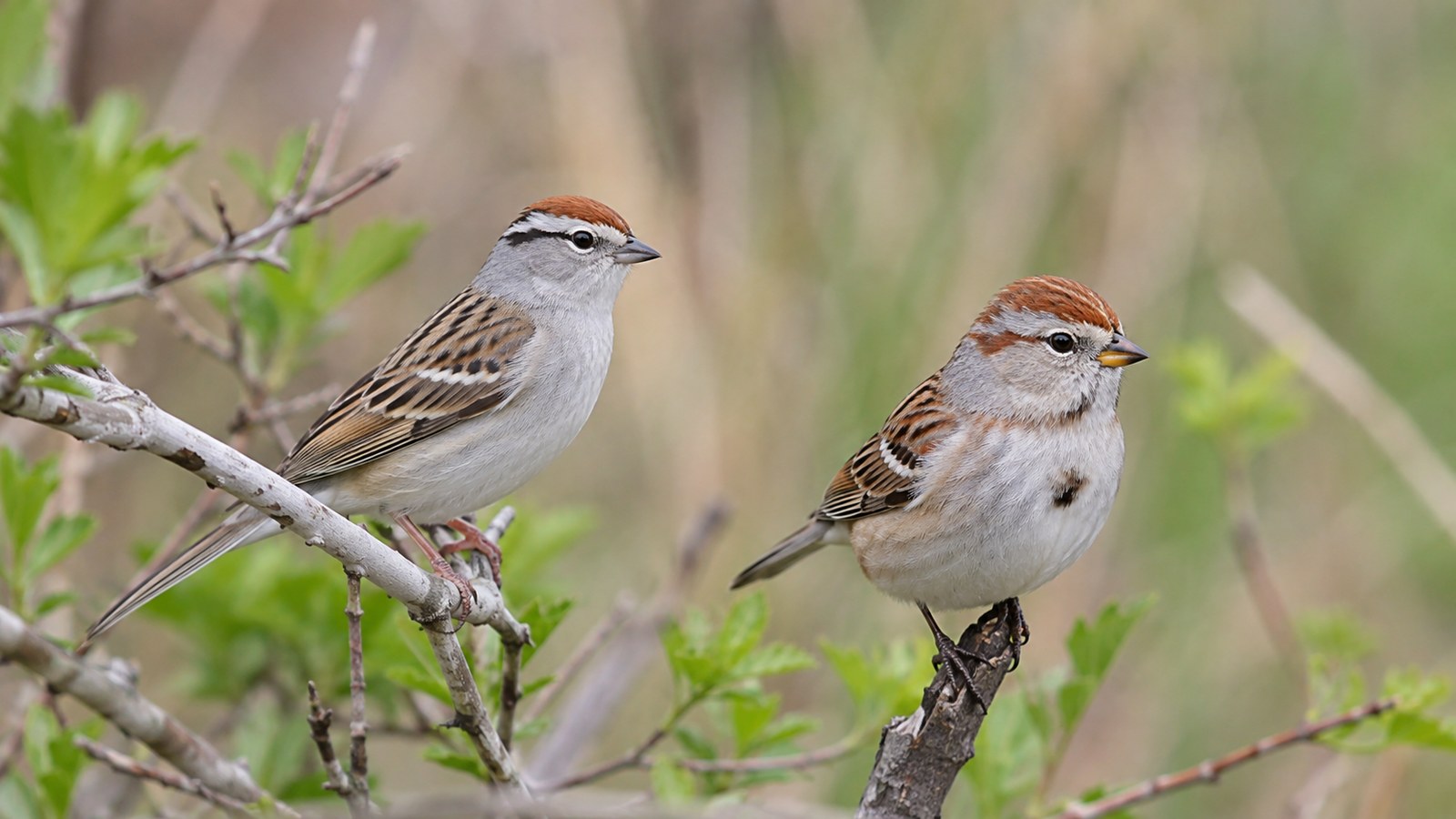
The rusty cap creates the first confusion
Both species can show a rusty crown, pale breast, brown patterned back, wing bars, and a dark mark near the eye. At a feeder or in a quick photograph they may appear nearly identical.
The solution is to stop treating the cap as the deciding mark. Eye-line colour, bill pattern, breast, body shape, date, location, habitat, and sound provide a dependable group of clues.
Side-by-side comparison
| Feature | Chipping Sparrow | American Tree Sparrow |
|---|---|---|
| Overall build | Small, trim, slender, and fairly long-tailed | Slightly plumper, rounder, and fuller-bodied |
| Eye line | Crisp black or very dark line through the eye in breeding plumage | Softer rusty or reddish-brown line through the eye |
| Bill | Dark in breeding season; pinkish or dusky outside breeding season | Two-toned, with dark upper bill and yellowish lower bill |
| Breast | Usually plain and clean | Often a small dark central spot, though it may be weak or hidden |
| Crown | Bright rusty breeding cap; duller and streakier in nonbreeding plumage | Rusty cap with softer facial contrast |
| Face | Crisp contrast with pale eyebrow and dark eye line | Gentler rusty-and-gray face pattern |
| Typical season | Widespread breeding-season bird in much of its range | Winter visitor across much of southern Canada and the United States |
| Habitat | Open woods, lawns, parks, gardens, and grassy clearings | Brush, weedy fields, winter gardens, shrubby edges, and feeder ground |
| Song | Long, dry, even trill | Clear musical notes and twittering phrases |
The eye line is one of the strongest visual clues
A breeding Chipping Sparrow has a narrow, crisp black line passing through the eye, set beneath a pale eyebrow and below a bright rusty cap. The face looks sharply drawn.
An American Tree Sparrow has a rusty or reddish-brown eye line. Its face is softer and warmer, without the same black-and-white contrast.
The two-toned bill strongly supports American Tree Sparrow
The American Tree Sparrow normally has a dark upper bill and yellowish lower bill. This black-and-yellow or dark-and-yellow pattern is one of the most dependable close-view clues.
A Chipping Sparrow’s bill changes with season. It’s usually dark during breeding and can become pinkish or dusky outside breeding season, but it doesn’t have the same clean dark-upper and yellow-lower division.
The breast spot helps but not required
American Tree Sparrows often show a small dark spot in the centre of an otherwise pale breast. The spot may be tiny, covered by feathers, hidden by posture, or lost in a distant photograph.
Chipping Sparrows usually have a clean unmarked breast. Treat a visible spot as supporting evidence for American Tree Sparrow, but don’t rule the species out when the spot can’t be seen.
Compare body shape before fine markings
Chipping Sparrows are trim and neat, with relatively long tails and a lightly built body. They may perch upright on branches or move across open lawns with a tidy profile.
American Tree Sparrows often look rounder and fuller, especially in cold weather. Fluffed feathers can exaggerate this difference, so shape should support the bill, eye line, and season rather than replace them.
Breeding Chipping Sparrows are the easiest to recognise
In breeding plumage, a Chipping Sparrow combines a bright rusty cap, black eye line, pale eyebrow, gray face and underparts, and dark bill. The high-contrast face is often visible even at moderate distance.
Outside breeding season, the cap and eye line become duller, the head may appear streakier, and the bill can look pinkish. This softer plumage is more easily confused with American Tree Sparrow.
American Tree Sparrows are winter sparrows for many observers
American Tree Sparrows breed in northern tundra and shrubby northern habitats. Across much of southern Canada and the United States, they’re mainly seen in winter and during migration.
This seasonal pattern makes the date unusually powerful. A rusty-capped sparrow in midwinter may favour American Tree Sparrow, while a crisp black-eyed bird singing from a lawn edge in breeding season may favour Chipping Sparrow.
Migration creates overlap
Season isn’t an absolute rule. Chipping Sparrows move through many regions during spring and fall, and American Tree Sparrows are also travelling at those times. Both can appear in the same general area.
During overlap, return to the eye line, bill, breast, shape, and sound. A current regional checklist can show whether both species are expected on the observation date.
Habitat adds context
Chipping Sparrows favour open woodlands, forest clearings, lawns with scattered trees, parks, cemeteries, campuses, gardens, and residential edges. They often feed on open ground and sing from trees or shrubs.
American Tree Sparrows use brushy fields, weedy edges, shrubby winter habitat, garden borders, and the ground beneath feeders. Despite the name, they’re not defined by living high in trees.
Watch flock behaviour
American Tree Sparrows often appear in winter flocks, sometimes with juncos and other sparrows. They feed on weed seeds and spilled feeder seed close to cover.
Chipping Sparrows can also form flocks outside breeding season. During breeding, pairs and singing males may be more conspicuous around open wooded habitat.
The songs differ when heard clearly
A Chipping Sparrow’s breeding song is a long, dry, even trill. It can resemble an insect or other trilling sparrow, so note the steady speed and connect it with the crisp-faced bird.
American Tree Sparrow songs and calls sound more musical, with clear notes and twittering phrases. Because it sings most often on northern breeding grounds, many winter observers hear only calls.
Juvenile and worn birds require extra care
Young Chipping Sparrows can be streaked below and lack the clean adult face. Worn adults may have faded crown and eye-line contrast. American Tree Sparrows can also appear variable as feathers wear.
When age is uncertain, record structure, bill pattern, date, habitat, nearby adults, and voice. Don’t force an adult comparison onto a clearly streaked juvenile.
Photographs can reveal the bill pattern
Take several photographs from the same respectful position. A side view may show the eye line, while a slight head turn may reveal whether the lower bill is yellow.
Don’t brighten an image so aggressively that the bill and eye line change colour. Compare the original photograph and processed copy, and use more than one frame.
Check the date before opening a field guide
A strong seasonal clue
Across much of southern Canada and the United States, American Tree Sparrow is primarily a winter visitor, while Chipping Sparrow is commonly associated with the breeding season. Migration can create overlap, so use the date to narrow the choices and field marks to finish the identification.
What to check first
- Is the eye line crisp black? Chipping Sparrow becomes more likely.
- Is the eye line rusty or reddish brown? American Tree Sparrow becomes more likely.
- Does the bill have a dark upper half and yellowish lower half? That strongly supports American Tree Sparrow.
- Is the breast clean or marked with a small central spot? Use this as supporting evidence, not a final rule.
- Does the bird look trim or plump?
- Does the date favour breeding Chipping Sparrow or wintering American Tree Sparrow?
- Confirm with habitat, sound, and current regional range.
What to record during a brief view
- Black or rusty eye line
- Dark, pinkish, or two-toned bill
- Plain breast or small central spot
- Trim or rounded body
- Bright or dull rusty crown
- Open wooded lawn or brushy winter field
- Single singing bird or winter flock
- Date, location, song, and call
Frequently asked questions
What should I look at first when comparing a Chipping Sparrow and an American Tree Sparrow?
Compare the eye line and bill. A Chipping Sparrow usually has a crisp dark eye line. An American Tree Sparrow has a softer rusty eye line and a two-toned bill with a dark upper half and yellowish lower half.
Do American Tree Sparrows always have a breast spot?
No. The small central spot can be faint, hidden, or absent from a poor view. Use the rusty eye line, two-toned bill, shape, season, and habitat with the breast pattern.
Can a Chipping Sparrow have a pink bill?
Yes. A breeding Chipping Sparrow usually has a dark bill, while a nonbreeding bird can have a pinkish bill. It doesn’t show the American Tree Sparrow’s strong dark-upper and yellow-lower bill pattern.
Why is season so important for this comparison?
American Tree Sparrows breed in the far north and are mainly seen farther south during winter and migration. Chipping Sparrows are widespread breeding-season birds through much of Canada and the United States, although overlap can occur during migration.