
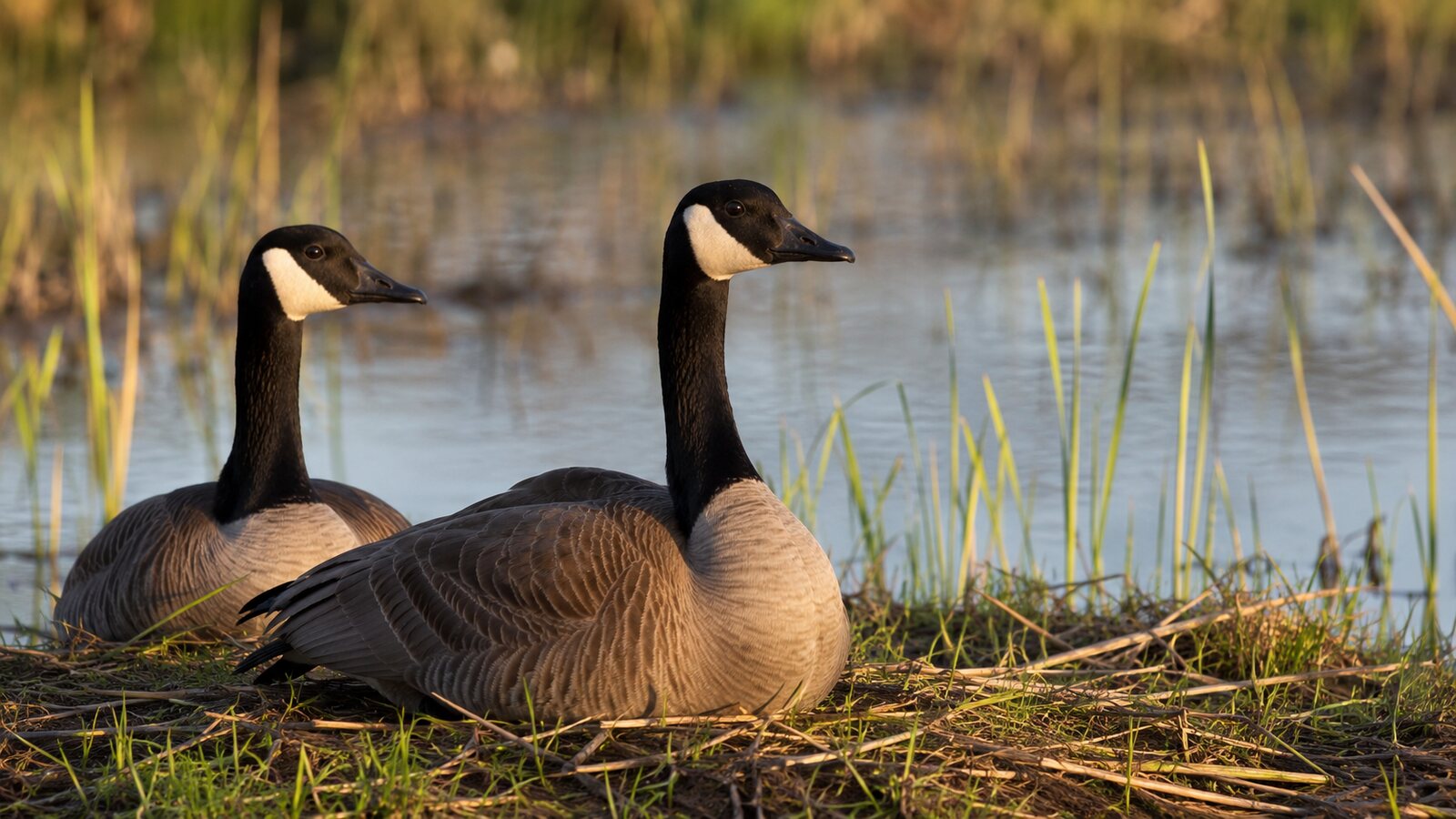
What does "mate for life" actually mean?
Usually, people mean that the same two birds remain a pair from year to year.
That is a pair bond. The birds may defend territory together, court each other, build or defend a nest, share incubation, feed young, or stay associated outside the breeding season.
Some pair bonds last a long time. Others are seasonal.
The courtship that begins a partnership can include sound, displays, food, and territory. See how birds find and assess mates for that earlier stage.
And there is another wrinkle. A pair can be socially monogamous without being sexually exclusive.
Social monogamy and sexual monogamy are not the same thing
Bird biology uses the word monogamy in a fairly specific way.
Social monogamy means one male and one female form a pair for breeding or social life. They may share a territory and raise chicks together.
Sexual monogamy means the pair also mates only with each other.
Those two things do not always line up. Genetic studies have found extra-pair young in many bird species that look like tidy two-parent families from the outside.
Nature rarely reads our labels.
Which birds are known for long pair bonds?
Long-term partnerships are especially familiar in several groups.
- Geese and swans: many species form strong pair bonds that can persist for years.
- Albatrosses: long-lived birds may spend years developing a partnership and reunite across breeding seasons.
- Eagles: some established pairs return to the same territory and nesting area year after year.
- Some gulls: long-term pair bonds occur in species such as the Short-billed Gull.
- Some corvids: jackdaws and several jay species are examples of birds with durable pair relationships.
Even here, "for life" is not a guarantee for every individual.
Why would two birds stay together?
There can be practical advantages.
A pair that already knows each other does not have to start every breeding season from zero. They may already know the territory, nest area, routines, and each other's behaviour.
For species that take a long time to raise one chick, cooperation can be especially valuable. Albatrosses are a good example. Their breeding cycle is demanding, and coordination between partners matters.
Staying together can save time. It can also make parental care more coordinated.
Do birds ever "divorce"?
Yes.
Ornithologists really do use the word divorce for a pair bond that ends while both birds are still alive.
The chance of switching partners differs among species. Breeding failure, poor timing, the availability of other mates, and individual condition can all be involved.
A long pair bond is not an unbreakable contract.
What happens when one bird dies?
The surviving bird can form a new pair.
How quickly that happens depends on the species, season, age of the bird, and whether other unpaired adults are nearby. A bird with a territory and a strong drive to breed may pair again sooner than we expect.
That does not tell us what the bird felt about losing its previous partner. Behaviour and inner experience are different questions. We look at that more carefully in do birds grieve?.
Do birds stay together outside the breeding season?
Some do. Some don't.
A pair may remain together year-round, separate after breeding and reunite later, or form a completely new partnership the next season.
Migratory birds make this even more interesting. Two birds can spend months apart and still return to the same territory, while another species may arrive and start fresh with a new mate.
Does returning to the same nest mean it is the same pair?
Not automatically.
Good nest sites are valuable. A nest, cavity, ledge, or territory may be reused even if one member of the pair has changed.
If you watch a backyard nest from one year to the next, markings, bands, or careful individual recognition may be needed before you can say the exact same two birds returned.
See do birds reuse nests? for the nest side of that question.
Do all songbirds choose a new mate every year?
No.
Songbirds cover a huge range of social systems. Some pairs remain together longer than a season. Others re-pair regularly. Some species have cooperative groups, multiple mates, or extra-pair mating layered on top of an apparent pair bond.
There is no single "songbird marriage system."
Frequently asked questions
Do robins mate for life?
Robins can form seasonal pair bonds, but they are not a classic example of birds that reliably remain paired for life. A bird may have a different partner in a later breeding season.
Do crows mate for life?
American Crows form strong social and family relationships, and breeding pairs can remain together for years. Their family groups can also include older offspring that help around the territory.
Do geese mate for life?
Many geese form long-term pair bonds. If one partner dies, the surviving bird may eventually pair again.
Do birds know who their mate is?
Birds in established pairs recognize and respond to their partners through voice, appearance, behaviour, location, and repeated social interaction. Exactly which cues matter most varies by species.
Keep following the question
Bird relationships connect courtship, food, nesting, and social behaviour. Continue with how do birds mate?, why do birds feed each other?, or return to Bird Facts.