
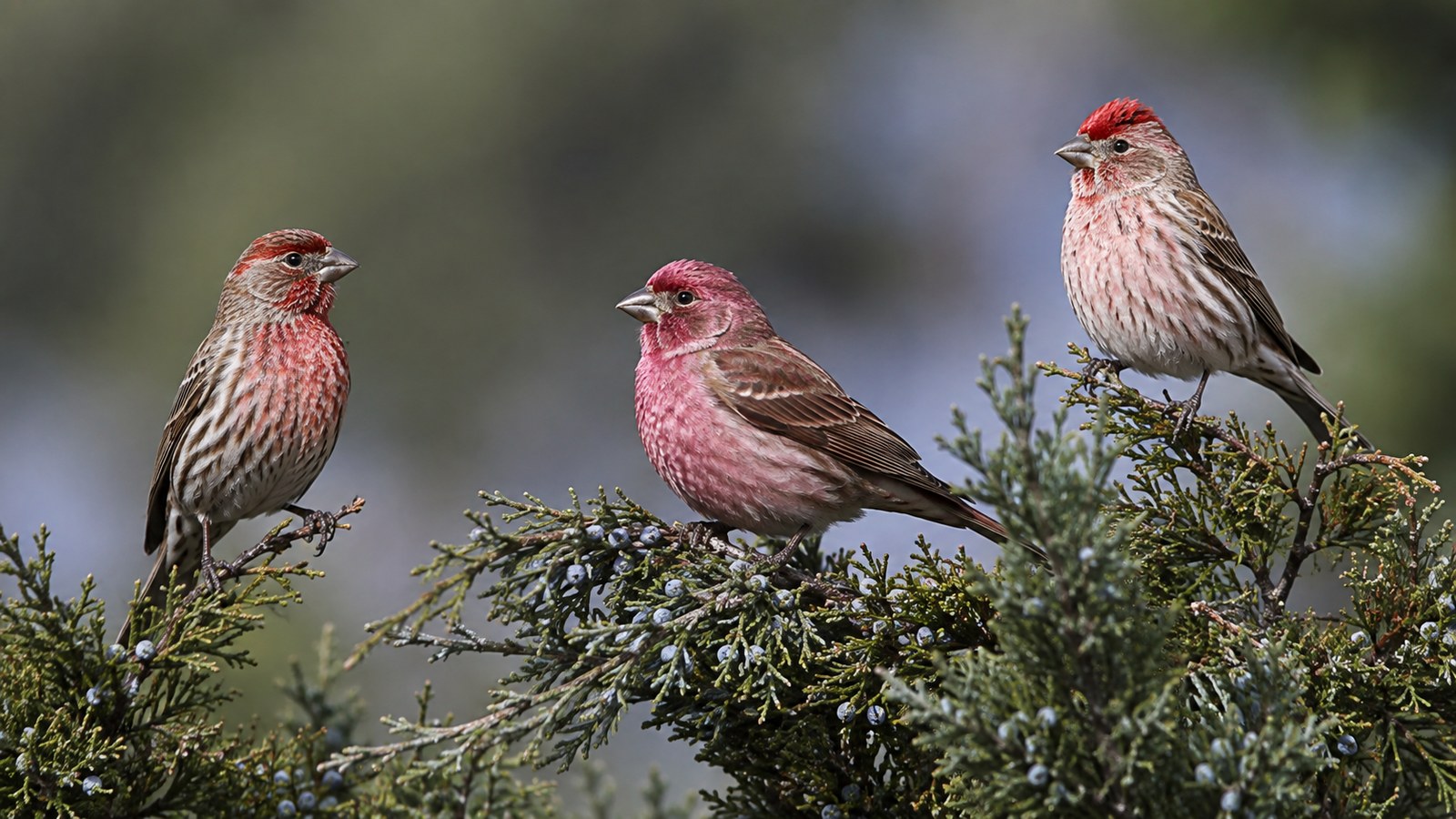
Why these three finches are confused
Adult males of all three species can show red, pink, orange, or raspberry tones. Females and immature males are brown and streaked. All have thick seed-eating bills, notched tails, musical songs, and a habit of feeding in trees or at seed feeders. A brief view can therefore produce the unhelpful conclusion of “red finch” or “brown streaked finch.”
The safest identification begins before plumage. Check whether each species is expected in the location and season. Cassin’s Finch is strongly associated with western mountain forests. Purple Finch has eastern and Pacific populations with different appearances. House Finch is widespread in settled habitats across much of southern Canada and the United States. Once the range makes sense, structure and pattern matter more.
Three-species comparison
| Feature | House Finch | Purple Finch | Cassin’s Finch |
|---|---|---|---|
| Typical range clue | Widespread in settled areas | Canada, northeastern United States, and Pacific regions, often seasonal | Western mountain regions and conifer country |
| Overall build | Slender and longer-looking | Chunkier and deeper-chested | Sturdy, long-winged, and mountain-adapted |
| Head shape | Smoothly rounded or slightly flat | Large and rounded, sometimes a little crested | Often distinctly peaked |
| Bill | Fairly large conical bill | Broad and powerful | Long, heavy, and fairly straight-sided |
| Adult male colour | Red, orange, or yellow focused on face and upper breast | Eastern male raspberry wash across head, breast, and back | Brightest red on crown with paler pink face and body |
| Male back | Mostly brown and streaked | Eastern bird often visibly red-washed | Brownish with some rosy wash, usually less fully coloured than eastern Purple Finch |
| Female face | Plain and low-contrast | Eastern bird has bold pale eyebrow and cheek stripes | Patterned but usually less strongly contrasted than eastern Purple Finch |
| Underparts | Blurry, broad streaks | Crisper streaks in females; eastern male often cleaner below | Crisp dark streaking in females and immature birds |
| Undertail coverts | Usually streaked | Generally white and unstreaked | Streaked |
| Tail and wings | Longer-looking tail with shallow notch; shorter wings | Shorter-looking, clearly notched tail | Clearly notched tail and long wings that project far down the tail |
Start with range and habitat
A finch on an apartment roof, farm wire, patio feeder, or city tree is often a House Finch. The species thrives around buildings, parks, neighbourhoods, farms, and other settled places. This doesn’t make every urban red finch a House Finch, but it sets a starting probability.
Purple Finches are more closely tied to coniferous and mixed forests, wooded edges, orchards, and feeders near trees. They can move widely outside the breeding season, so some areas receive many in one winter and few in another. Pacific Purple Finches occur from coastal British Columbia southward and differ from classic eastern photographs.
Cassin’s Finches are mainly birds of western mountain conifers. They may visit towns, parks, and feeders, especially near mountain forest, but a low-elevation eastern yard isn’t a normal setting. Range should never replace visual clues, yet it prevents an attractive but improbable identification.
Head shape helps before colour
House Finches often show a smooth curve from forehead to crown. The head can look somewhat long or flat, and the body remains relatively slim. Their short wings make the tail appear long.
Purple Finches usually look larger-headed and fuller through the chest. The crown is rounded and may look slightly raised when the bird is alert. The strong bill adds to a compact, powerful impression.
Cassin’s Finches are best known for a peaked crown, especially adult males. The peak can flatten when feathers are sleek, so it’s not an absolute mark. Support it with the long straight-sided bill, long wings, strong tail notch, mountain range, and plumage pattern.
Map where the red appears
Male House Finches usually concentrate colour on the forehead, eyebrow, face, throat, and upper chest. Brown remains obvious on the crown, back, wings, belly, and flanks. Some males are orange or yellow, so exact hue is less reliable than placement.
Eastern male Purple Finches often look dipped in raspberry colour. The wash extends across the head, neck, breast, and back. The lower belly is usually paler and less heavily streaked than a typical House Finch. Pacific males can be more olive-brown and streaked, which reduces the value of this classic red-washed look.
Male Cassin’s Finches often show the brightest red on the crown, producing a strong cap or peak. The face and chest are paler pink, and the back usually retains more brown than an eastern Purple Finch. Ask whether the crown seems brighter than the rest of the bird rather than merely whether the bird is red.
Female and immature finches need their own comparison
Female House Finches have plain faces with little contrast around the eye and cheek. Their breast and flank streaks are often broad or blurry. A generally even brown-and-streaked appearance strongly supports House Finch when the range and habitat also fit.
Eastern female and immature Purple Finches usually show a bold pale eyebrow, a pale moustache stripe, and a darker cheek between them. Their breast and flank streaks look crisp. Pacific birds may be more olive and less strongly patterned, so the face clue is weaker along the West Coast.
Female and immature Cassin’s Finches are also crisply streaked. Their facial pattern is often less contrasting than an eastern Purple Finch, and the undertail coverts are streaked rather than plain white. The long bill, peaked head, long wings, mountain setting, and call help complete the identification.
Undertail coverts are a supporting clue
The small feathers beneath the base of the tail are called undertail coverts. Purple Finches generally show pale, unstreaked coverts. House and Cassin’s Finches usually show streaking there. This can be valuable in a clear photograph or when a perched bird raises its tail.
Don’t make the identification depend on this one area. The coverts may be hidden, shaded, wet, worn, or blurred by movement. Treat them as confirmation after range, body shape, head, bill, face, and main underpart pattern already point in the same direction.
Bill, wing, and tail proportions refine the choice
House Finches have sturdy bills, but their overall shape is slimmer. Their wings are relatively short and the tail looks long with only a shallow notch.
Purple Finches have broad, strong bills and a stockier body. The tail looks shorter and more clearly notched. These proportions help when plumage is hidden by backlighting.
Cassin’s Finches have long, fairly straight-sided bills, long wings, and an obvious tail notch. When perched, the wing tips extend farther down the tail than on the other two. A side photograph is especially handy for recording these proportions.
Sound and behaviour can confirm the visual clues
All three can produce rich, warbling songs, so a general description of “musical” isn’t enough. Record the complete phrase when possible. House Finch songs often sound jumbled and may end or pause with a buzzy note. Purple Finch songs can sound smoother and more flowing. Cassin’s Finch songs are rich and may include copied phrases, while its call is often described as sweet and rising.
Use recordings passively. Don’t approach nests or use playback to force a response. Compare the recording with the date, location, elevation, habitat, flock companions, and visible structure.
A dependable identification routine
- Check whether all three species are realistic for the region and elevation.
- Decide whether the bird looks slim, chunky, or long-winged and peaked.
- Compare the bill profile and tail notch.
- For males, map colour across the crown, face, breast, back, and flanks.
- For females, compare facial contrast and streak sharpness.
- Look for white or streaked undertail coverts when the view allows.
- Record habitat, date, flock size, behaviour, and sound.
- Leave the record as “red finch species” when the evidence remains incomplete.
Frequently asked questions
What is the fastest way to separate the three red finches?
Check range first, then head shape and colour placement. House Finch is smooth-headed with colour concentrated forward, Purple Finch is chunkier with a broader wash, and Cassin’s Finch often has a bright peaked crown in western mountain country.
How do females differ?
House Finch females are plain-faced and blurry-streaked. Eastern Purple Finch females have bold pale facial stripes and crisp streaking. Cassin’s Finch females are crisp-streaked with a less contrasting face and streaked undertail coverts.
Can House Finches be orange or yellow?
Yes. Use placement and structure rather than shade. Orange or yellow colour concentrated on a smooth-headed, brown-backed, heavily streaked finch still supports House Finch.
Is a peaked crown always Cassin’s Finch?
No. Feather position changes with posture and wind. A peak should agree with western mountain range, long bill, long wings, clear tail notch, and the rest of the plumage.