
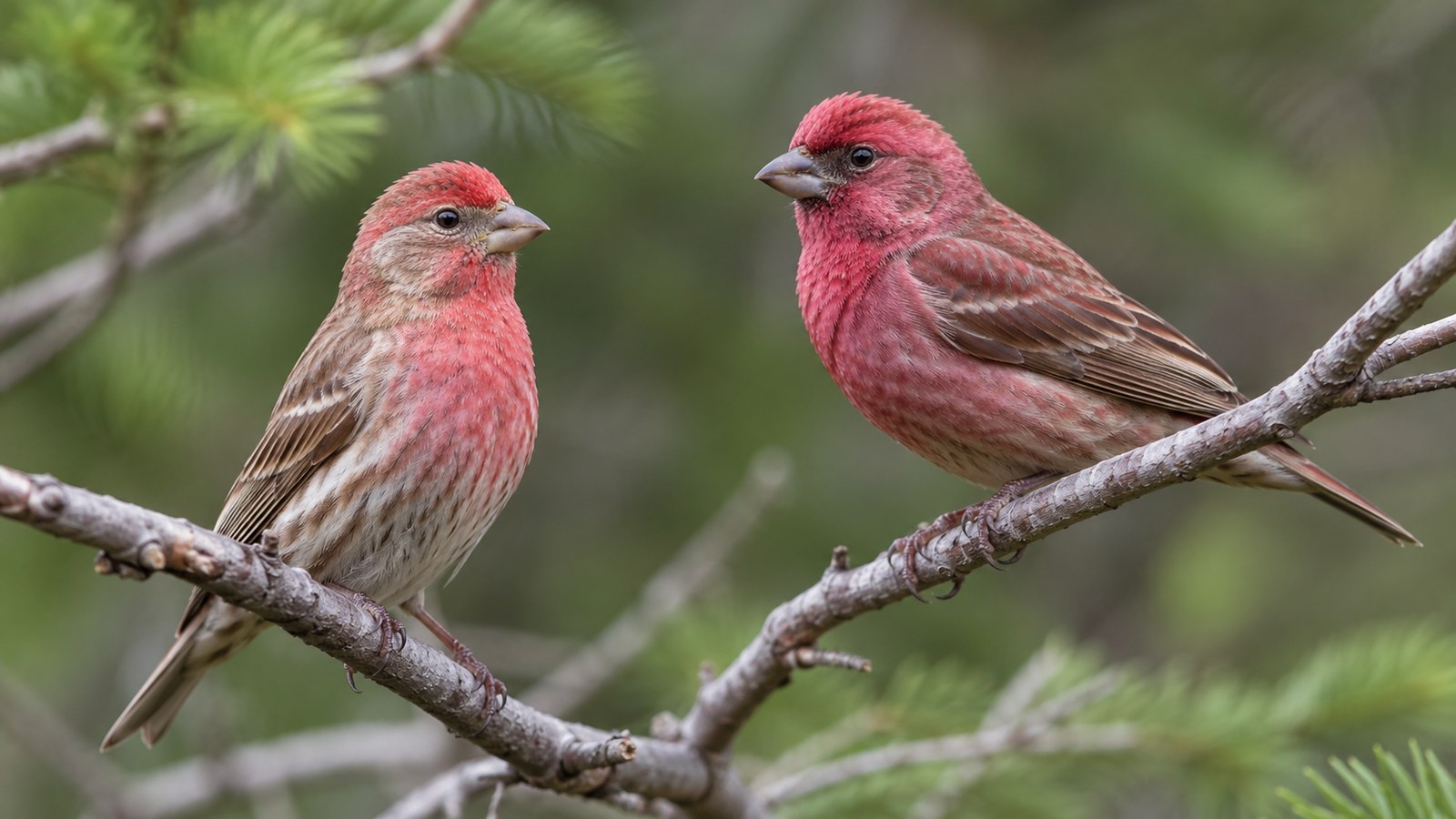
Why House and Purple Finches are confused
Both are sparrow-sized finches with conical bills and notched tails. Adult males can look red, while females and immature birds are brown and streaked. Both may visit seed feeders, sing from exposed perches, and appear in mixed neighbourhood or woodland settings.
Names and colour labels aren’t enough. A Purple Finch isn’t simply a darker purple bird, and a House Finch isn’t always bright red. Body build, head shape, bill, tail, face pattern, back colour, streaking, habitat, region, and season create a safer answer.
Side-by-side comparison
| Feature | House Finch | Purple Finch |
|---|---|---|
| Overall build | Slender, fairly long-bodied, and often upright | Chunkier, deeper-chested, and more powerful-looking |
| Head | Longer, flatter, smoothly rounded profile | Larger, rounder head that can look slightly crested |
| Bill | Fairly large conical bill, but usually less deep | Broad, powerful conical bill |
| Male colour | Red, orange, or yellow concentrated on face, throat, and upper chest | Eastern male has raspberry wash across head, neck, breast, and back |
| Male back | Mostly brown and streaked | Eastern male shows clear reddish wash through the back |
| Female face | Plain, with weak contrast around eyebrow and cheek | Bold pale eyebrow and moustache stripe framing a darker cheek |
| Underpart streaks | Usually blurry and broad, especially on lower belly and flanks | Usually crisper and better defined, especially on breast and flanks |
| Tail | Relatively long with a shallow notch | Shorter-looking with a clearer notch |
| Typical setting | Buildings, parks, farms, patios, wires, and neighbourhood feeders | Conifer and mixed forest, edges, orchards, and wooded feeders |
| Occurrence | Often dependable and resident | Often seasonal or irregular away from breeding areas |
Male colour placement is better than exact shade
Male House Finches usually show their brightest colour on the forehead, eyebrow, face, throat, and upper breast. Brown remains obvious on the crown, back, wings, and heavily streaked lower underparts. Some males are orange or yellow rather than red.
An eastern male Purple Finch often looks more thoroughly washed in raspberry. Red extends across the crown, face, neck, breast, and onto the back. The belly becomes cloudy white with less bold lower streaking than a typical House Finch.
Western Purple Finches require more care. They can show more olive on the back, more brown along the sides, and less dramatic facial or body contrast. A broad red wash may therefore be less obvious along the Pacific coast than in classic eastern photographs.
Female face pattern is one of the strongest clues
Female and immature House Finches have relatively plain faces. Their brown streaking continues through the head without creating a bold pale eyebrow or sharply framed cheek. The overall impression is evenly brown and blurry-streaked.
Female and immature Purple Finches usually show a pale eyebrow above the eye and a pale moustache stripe below a darker cheek patch. These stripes frame the face and create much stronger contrast. Their breast and flank streaks also tend to look crisper.
Don’t rely on one line seen for a second. Turn the clue into a pattern: bold eyebrow, dark cheek, pale moustache stripe, crisp streaking, chunkier body, and strong bill together support Purple Finch.
Head and bill shape support the plumage clues
A House Finch often looks longer-headed, with a smooth curve from forehead to crown. The bill is substantial, but the whole bird remains relatively slim. The short wings make the tail appear long.
A Purple Finch usually looks larger-headed and deeper through the chest. The strong conical bill seems broad at the base, and the forehead may rise more steeply. Some birds look slightly crested when alert, though posture can change the effect.
Tail proportion changes the silhouette
The House Finch’s tail often looks long compared with its short wings, and the notch is shallow. A perched bird may therefore appear stretched from bill to tail.
The Purple Finch’s tail looks shorter and more clearly notched. Combined with the larger head and deeper chest, this creates a more compact, powerful silhouette.
Streaking differs in clarity and location
House Finches commonly show blurry brown streaks down the belly and flanks. Male colour often stops above this heavily marked lower area. Females can look streaked from throat to undertail with little facial contrast.
Purple Finch streaks are usually cleaner and sharper in females and immature birds. Eastern adult males often have a cleaner pale belly, though some markings remain along the sides. Western birds may show more brown and streaking, so combine this clue with face, bill, body, and tail.
Habitat can change the probability
House Finches are strongly associated with people. Look for them on buildings, wires, rooflines, farms, parks, gardens, and busy feeding stations. They often nest around structures and may remain in the same general area year-round.
Purple Finches breed mainly in coniferous and mixed forests. In winter they may move into forest edges, shrublands, orchards, old fields, and backyards, especially where trees and natural foods remain nearby.
A red finch singing from an apartment roof is more likely to be a House Finch, while a chunky finch feeding in conifers beside a wooded yard may deserve closer study. Habitat supports identification but never replaces plumage and structure.
Range and season should be checked early
House Finches are widespread across southern Canada and most of the United States, with many populations present through the year. Purple Finches breed broadly in Canada, the northeastern United States, and parts of the Pacific coast and mountains, then move irregularly in response to food.
In some regions Purple Finches are regular breeders. In others they appear mainly during migration or winter, and their numbers can differ sharply between years. A current local checklist or range map prevents a visually possible bird from becoming an unlikely conclusion.
Sound helps after you’ve narrowed the visual choice
Both species produce musical warbles. House Finch song often sounds jumbled and may include a sharp, buzzy note. Purple Finch song tends to flow through a smoother sequence of rich warbled phrases, but individuals and regions vary.
Record the bird if you can do so without approaching. Compare the complete phrase, calls, location, date, habitat, and visible features. A sound application suggestion should be treated as a lead rather than proof.
When Cassin’s Finch becomes a third possibility
In western mountain regions, Cassin’s Finch can overlap with House and Purple Finches. Adult males often show a bright red peaked crown with paler pink through the face and chest. The back is washed red but usually not as extensively as an eastern male Purple Finch.
Cassin’s Finches have long, straight-sided bills, obviously notched tails, and long wings. Female and immature birds are crisply streaked but tend to have less facial contrast than eastern female Purple Finches. Range, elevation, conifers, and sound become especially important.
The dedicated three-red-finch comparison gives Cassin’s Finch equal space, including female pattern, undertail coverts, wing length, and western range.
A dependable identification routine
- Check whether the bird is slim and long-tailed or chunky and short-tailed.
- Compare the bill and forehead profile.
- For males, map red across the face, breast, back, and flanks.
- For females, look for a bold eyebrow, dark cheek, and pale moustache stripe.
- Compare blurry versus crisp underpart streaking.
- Record habitat, region, date, flock size, and sound.
- Consider Cassin’s Finch in suitable western mountain range.
More about House Finches
If the bird is a House Finch, our full House Finch species guide covers song, food, nesting, range, feeder behaviour, and why some males look orange or yellow.
Frequently asked questions
What should I look at first when comparing a male House Finch and a male Purple Finch?
A House Finch usually has red concentrated on the face and upper breast with a brown back and strong flank streaking. An eastern Purple Finch carries raspberry red onto the back and looks chunkier.
How do female House and Purple Finches differ?
Female Purple Finches usually show bold pale facial stripes around a darker cheek and crisper streaking. Female House Finches have plainer faces and blurrier streaks.
Can House Finches be orange or yellow instead of red?
Yes. Male House Finch colour varies from red through orange to yellow. Shade alone is therefore unreliable.
When should I consider Cassin’s Finch?
Consider it in western mountain regions, especially when the bird has a peaked crown, long straight-sided bill, obvious tail notch, and long wings.