
12 beautiful North American birds
1
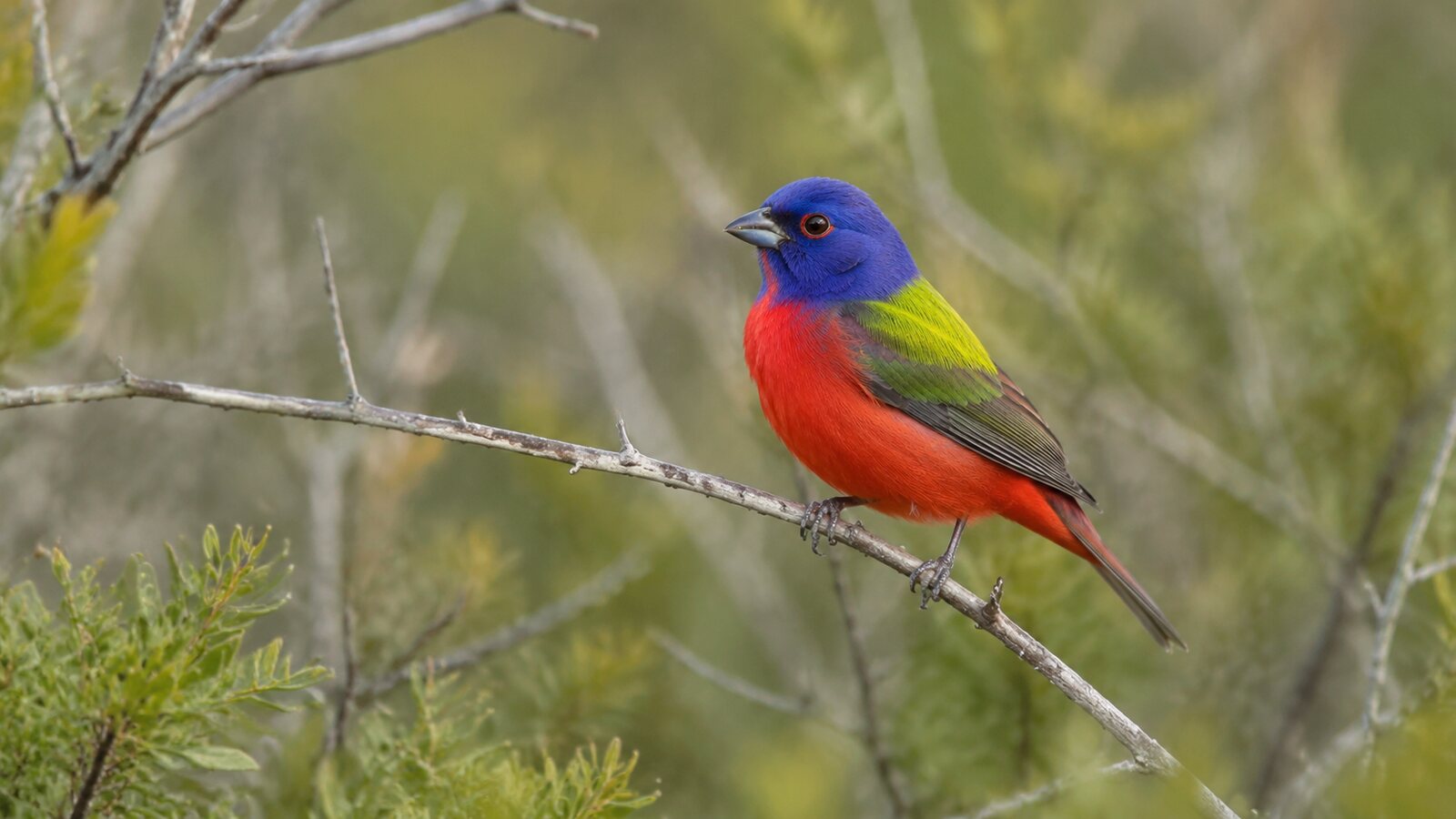
Painted Bunting
Rainbow colour
An adult male Painted Bunting can look almost unreal: blue head, red belly, green back, and patches of yellow-green. Females and young birds are bright green, which is unusual among North American songbirds.
The colours are strongest in good light. In shade, the same bird can look much darker and less flashy.
2
Wood Duck
Pattern and shape
The male Wood Duck combines a swept-back green crest with white face lines, a red eye, a chestnut breast, and patterned sides. Females are softer gray-brown but have their own elegant shape and a clear white eye patch.
Look for them on wooded ponds, quiet rivers, and wetlands with tree cavities nearby.
3
Northern Cardinal
Brilliant red
A male Northern Cardinal is one of the easiest bright birds to recognize. Its red body, black face, thick orange-red bill, and pointed crest stand out even in winter.
Females trade most of the red for warm brown and tan, with red on the wings, tail, and crest.
4
Roseate Spoonbill
Pink plumage
Roseate Spoonbills bring tropical colour to warm coastal wetlands. Adults are pale pink with deeper pink on the wings and rump, plus a long flat bill shaped like a spoon.
The colour comes partly from pigments in their food. Young birds are paler than mature adults.
5
American Goldfinch
Summer yellow
A breeding male American Goldfinch is bright lemon yellow with a black cap and black wings crossed by white bars. The bird becomes much duller in winter after replacing those showy feathers.
That seasonal change can make the same species look surprisingly different.
6
Anna's Hummingbird
Iridescent rose
The male Anna's Hummingbird has a rose-pink crown and throat that can blaze in direct light. Turn the head a little, and those feathers may look dark brown or black.
Iridescence depends on angle, so patience often gives a better view than moving closer.
7
Mountain Bluebird
Clear sky blue
Male Mountain Bluebirds are blue from head to tail, with the strongest colour on the back and wings. Females are mostly gray-brown with blue in the wings and tail.
They favour open western country, where a blue male on a fence post can be visible from a long way off.
8
Scarlet Tanager
Red and black
A breeding male Scarlet Tanager has a red body with black wings and tail. The clean blocks of colour make it one of the most striking birds in eastern forests.
It can still be hard to spot because it often stays high in leafy trees. Its burry song may reveal it first.
9
Hooded Merganser
Bold crest
The male Hooded Merganser has a large black-and-white fan-shaped crest, golden eyes, rusty sides, and fine black lines across a white breast. Females have warm cinnamon crests with a loose, swept-back shape.
These small diving ducks favour wooded ponds and slow waterways.
10
Lazuli Bunting
Blue, orange and white
Male Lazuli Buntings mix turquoise-blue upperparts with a warm orange breast and white belly. White wing bars break up the blue wings.
They live mainly in brushy western habitats and can be easier to hear than see when singing from a high perch.
11
Baltimore Oriole
Orange and black
Male Baltimore Orioles have fiery orange underparts and shoulders set against a black head and back. Females range from yellow-orange to deeper orange, with brown or black in the wings.
Watch high in deciduous trees, especially around flowering trees and open woodland edges.
12
Harlequin Duck
Painted markings
A male Harlequin Duck has slate-blue plumage crossed by white crescents, stripes, and chestnut sides. The pattern looks carefully painted rather than grown.
These compact sea ducks use rough coastal water in winter and fast mountain streams during the breeding season.
Why bright birds can look dull
Light changes bird colour. Pigment colours stay fairly steady, although shade can mute them. Iridescent feathers are different. Their microscopic structure reflects light, so a hummingbird throat can flash pink or red and then look almost black a second later.
Season and age matter too. An American Goldfinch changes dramatically between summer and winter. Young birds may not have adult colour yet. Worn feathers can also fade before the next molt.
How to identify a colourful bird
Start with size, shape, bill, behaviour, habitat, and location. Then use colour. A bright red bird isn’t automatically a cardinal, and a blue bird isn’t automatically a bluebird.
Our guide to identifying birds by colour and field marks shows how to combine those clues. You can also start with the full bird identification hub.