
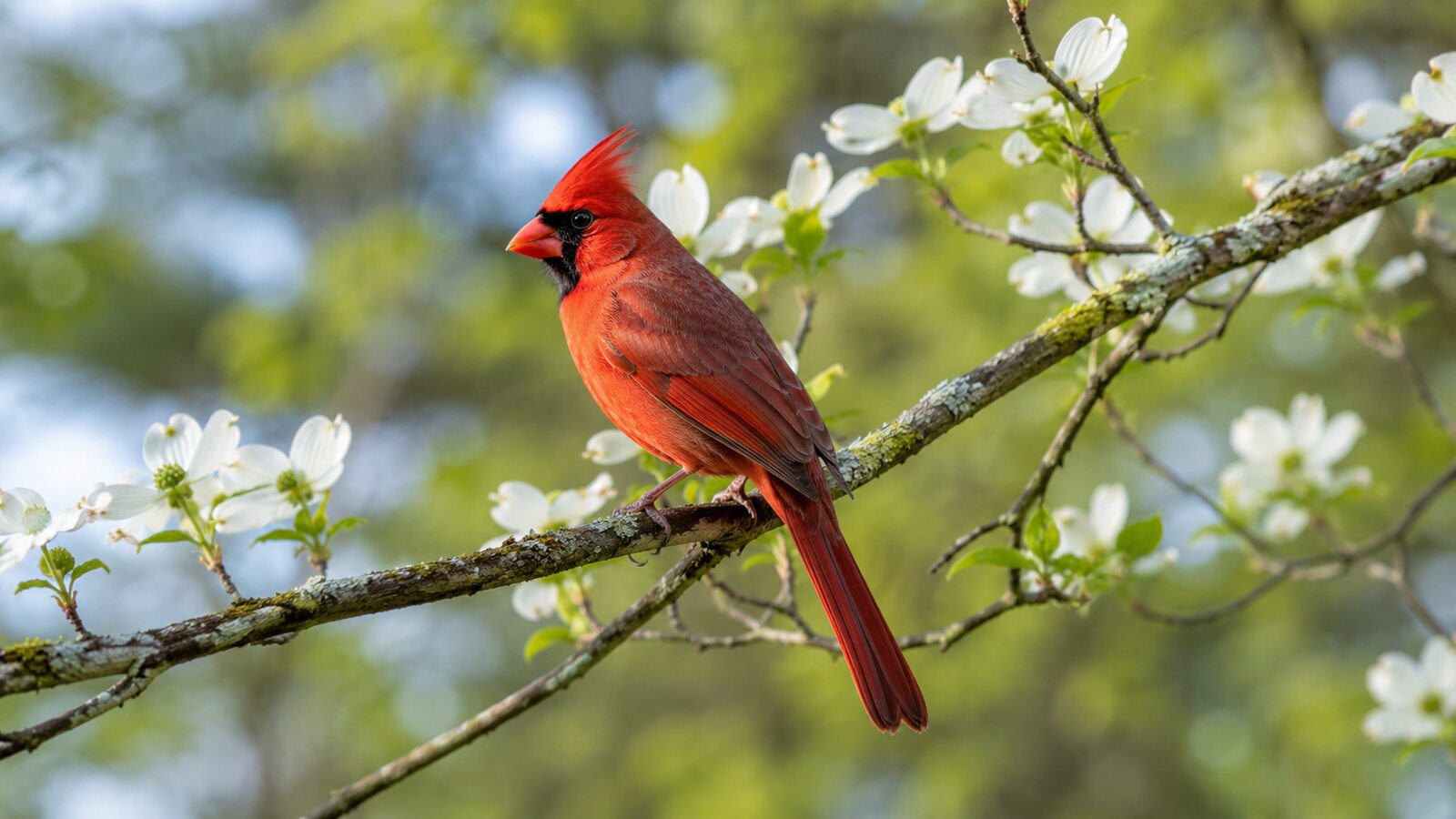
How to identify a Northern Cardinal
The shape is almost as important as the colour. Northern Cardinals are medium-sized songbirds with a long tail, rounded body, obvious crest, and heavy seed-cracking bill.
An adult male is hard to mistake. Most of the plumage is vivid red, with a black mask around the bill and throat.
Females are more subtle. They are mostly warm tan or brown, but the crest, wings, and tail carry reddish tones. The bill is still bright and thick.
Juveniles resemble females but start with a dark bill that becomes orange-red as they mature.
What does a Northern Cardinal sound like?
Cardinal songs are clear, strong whistles. The phrases are repeated, easy to hear, and often carry from a hidden perch in thick vegetation.
Both males and females sing. That is worth remembering. In many familiar North American songbirds, most singing comes from males, but female cardinals regularly sing too.
The sharp chip call is another excellent clue. You may hear that single metallic note long before you spot the bird.
Where Northern Cardinals live
Northern Cardinals are common across much of eastern and central North America and have expanded northward over time.
They like edges and cover: hedgerows, thickets, woodland margins, overgrown fields, parks, gardens, and suburban yards.
They do not make a regular seasonal migration. If cardinals live in your area, you can usually look for them throughout the year.
What do Northern Cardinals eat?
Seeds and fruit make up much of the adult diet, with insects adding important protein. Nestlings are fed mostly insects.
At bird feeders, black oil sunflower seed is a reliable choice. Cardinals also take safflower and other larger seeds.
They often prefer feeding on a platform, hopper, or on the ground rather than clinging to a narrow feeder.
Native shrubs and fruiting plants can help too. Food does not have to come from a feeder.
Where do Northern Cardinals nest?
Dense shrubs, vines, and low trees are classic nesting places.
The female does most of the nest building. The nest is an open cup made with twigs, bark, grasses, leaves, and finer material inside.
Cardinals usually do not reuse the same nest. A pair can raise more than one brood in a season, building again for the next attempt.
Typical clutches contain two to five eggs. Incubation is usually around 11 to 13 days, and nestlings may leave after only another week or two.
Why do cardinals attack windows?
They are seeing a reflection and treating it like another cardinal.
This happens most often during the breeding season when territorial behaviour is strong. Both males and females can do it.
If a cardinal keeps fighting a window or mirror, cover or break up the outside reflection. Our guide Why Is a Bird Attacking My Window? explains the options.
Do cardinals stay together?
Pairs often remain together through the breeding season and may stay associated into winter.
That does not mean every pair remains together for life. Cornell notes that some pairs split before the next breeding season.
In fall and winter, cardinals can also gather in looser groups, sometimes feeding with sparrows, chickadees, titmice, and other familiar birds. Dense shrubs and evergreens can provide the protected cover described in where birds shelter during snowstorms.
Northern Cardinal look-alikes
The Pyrrhuloxia is the closest classic look-alike in the Southwest. It has a similar crest and shape but is grayer overall, with a different bill shape and more limited red.
Scarlet and Summer Tanagers are red too, but they lack the cardinal's crest and thick orange-red bill. Their body shape is different as well.
A female cardinal can be overlooked because she is brown. The combination of crest, red tail and wings, and heavy bill usually gives her away.
How long do Northern Cardinals live?
Most wild birds face their highest risks when young, so many do not reach old age.
Still, cardinals can live well beyond a few seasons. Cornell reports an oldest recorded Northern Cardinal of 15 years and 9 months.
Frequently asked questions
Why are male cardinals red?
The red colour comes from carotenoid pigments tied to diet and feather growth. Males use that bright plumage in social and breeding displays. Compare this familiar pair in the guide to why male birds are brighter in some species.
Do cardinals come to feeders?
Yes. Sunflower and safflower seed are good choices, especially on feeders with enough room for a cardinal to perch comfortably.
Do cardinals lose their red colour in winter?
No. Males remain red year-round, although fresh feathers, wear, light, and viewing angle can change how intense the colour looks.
Do cardinals live in Canada?
Yes, in parts of southern Canada within their range, especially around the Great Lakes and other suitable eastern areas.
More familiar birds
Continue with Blue Jay, Black-capped Chickadee, Mourning Dove, or browse all Common Birds.