
How to identify a Black-capped Chickadee
Black-capped Chickadees are small. Very small.
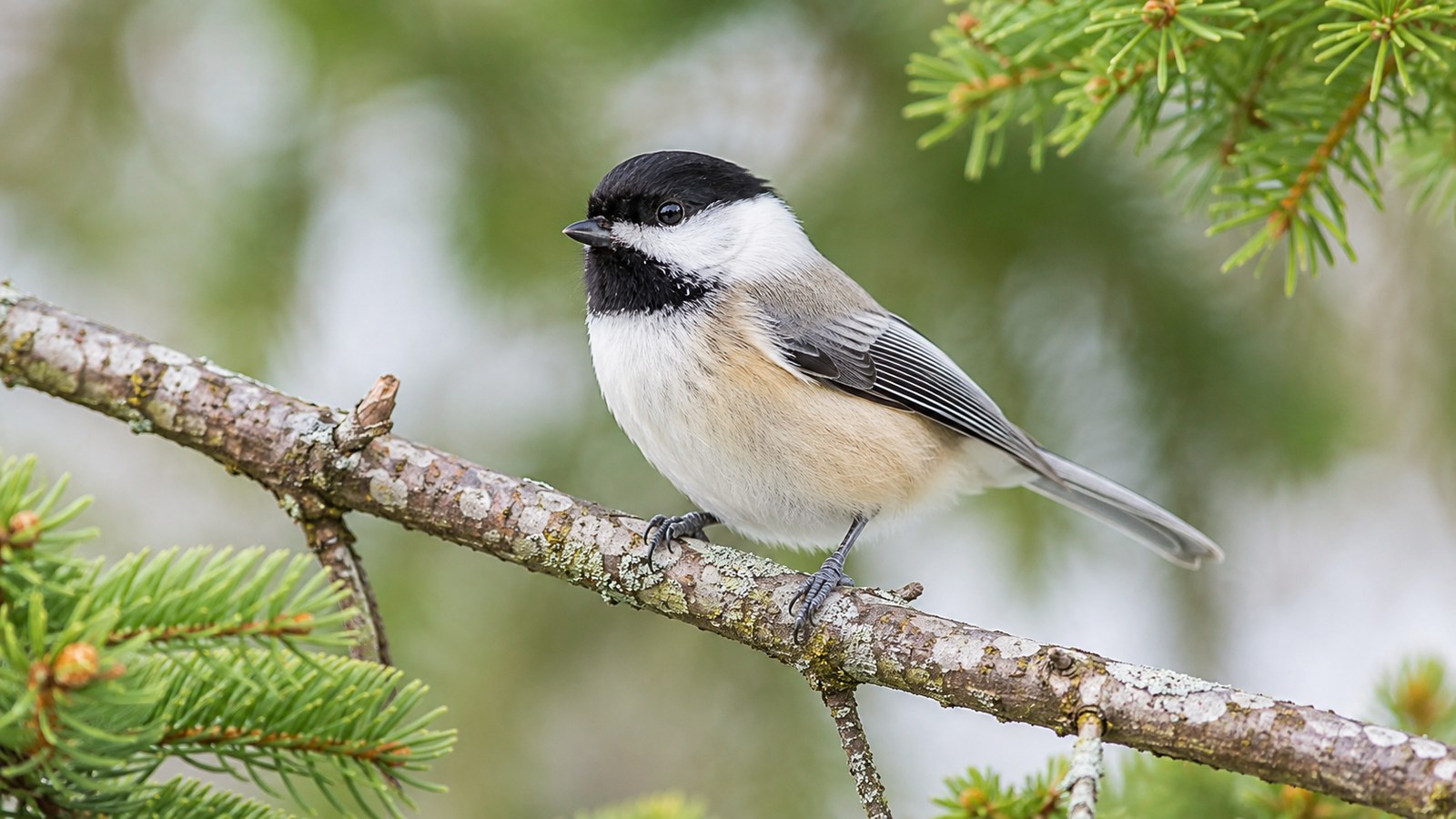
The head looks large for the body, which gives the bird its round, friendly shape. A black cap covers the top of the head. A black bib sits under the bill. Bright white cheeks separate those two dark areas.
The back is gray, the wings and tail are darker gray, and the underside is pale with warm buff along the flanks.
They rarely sit still for long. Chickadees hop through branches, hang at odd angles, inspect bark and leaves, then dart to the next spot.
What does a Black-capped Chickadee sound like?
The call gave the bird its name: chick-a-dee-dee-dee.
The number of dee notes can change with the situation. Cornell notes that chickadees often add more of them in alarm calls.
They also sing a clear whistled song. Across much of the range it sounds like two or three clean notes, often remembered as fee-bee or hey, sweetie.
That whistle can surprise people who expect a chickadee to make only its name-like call.
What do Black-capped Chickadees eat?
Insects and spiders are especially important during the warmer months. Seeds, berries, and other plant foods become more important in winter.
At feeders, chickadees readily take black oil sunflower seed, peanuts, suet, and mealworms.
They often grab one seed and fly away rather than sitting in the feeder. The bird may hold the seed with its feet and peck it open on a branch.
Chickadees also cache food. They hide small items in many places and return to them later using strong spatial memory. The guide to how birds remember hidden food follows that process.
Where Black-capped Chickadees live
Black-capped Chickadees live across much of Canada, Alaska, and the northern United States.
They use deciduous and mixed forests, woodland edges, parks, willow thickets, and suburban areas with enough trees and shrubs.
Adults usually remain within the same broad area year-round. In some years, young birds move farther in irregular irruptions.
Where do Black-capped Chickadees nest?
They are cavity nesters.
A pair may use an old woodpecker hole, another natural cavity, or excavate its own cavity in soft, decaying wood. Nest boxes can work too when the entrance size and placement suit chickadees.
The female builds a soft nest inside with moss, bark, plant fibres, fur, and other fine material.
If you find an active cavity, give it space. Small birds can be remarkably tolerant of people, but nesting is still a demanding time.
Why are chickadees so curious?
They often investigate new objects, sounds, feeders, and people within their territory.
That does not mean every chickadee is tame. It means their feeding style rewards close inspection. They spend much of the day searching tiny spaces for food.
Once a chickadee finds a reliable feeder, it may return again and again.
How chickadees survive winter
A bird this small loses heat quickly, yet Black-capped Chickadees live through very cold winters.
They fluff their feathers for insulation, seek sheltered roosts, eat heavily during the day, and can lower body temperature at night to conserve energy.
For the broader picture, see how small birds survive winter and learn where chickadees and other small birds roost.
Black-capped Chickadee look-alikes
Carolina Chickadee is the main eastern look-alike. The two overlap in a narrow zone, and voice can be important there.
Chestnut-backed Chickadees of the Pacific Northwest show rich chestnut on the back and sides. Mountain Chickadees have a bold white eyebrow through the dark cap.
We already have a direct comparison in Chestnut-backed Chickadee vs Black-capped Chickadee, plus a broader backyard chickadee identification guide.
How long do Black-capped Chickadees live?
Most small birds face heavy mortality when young. A long-lived chickadee is unusual.
Even so, banding records show that some individuals survive for many years. The important point is not to treat a maximum record as an average life expectancy.
Frequently asked questions
Do Black-capped Chickadees come to feeders?
Yes. Sunflower seed, peanuts, suet, and mealworms are all attractive, especially when a feeder is close to safe cover.
Do chickadees remember people?
They can learn routines and become familiar with a reliable food source. Evidence for individual human recognition is much stronger in some corvids, so it is better not to assume every familiar chickadee is identifying you personally.
Why do chickadees say chick-a-dee-dee-dee?
The call serves social and alarm functions. The number and pattern of notes can change with context.
Are Black-capped Chickadees aggressive?
They can be. Chickadee flocks have social ranks, and birds use calls and brief disputes to sort out access to food and space.
More familiar birds
Continue with Blue Jay, Northern Cardinal, Mourning Dove, or browse all Common Birds.