
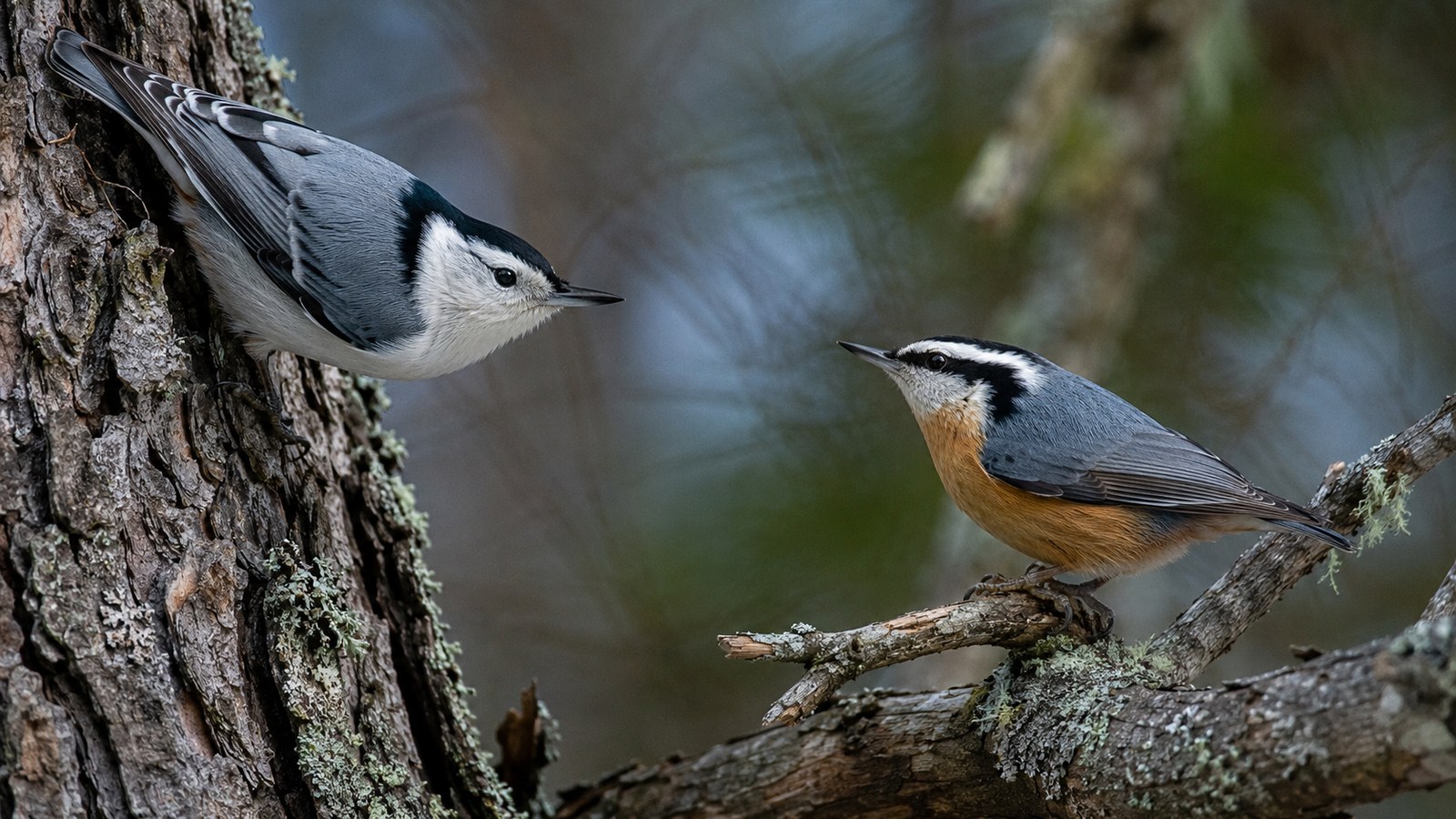
White-breasted Nuthatch at a glance
Look for a small, compact bird with almost no visible neck, a long pointed bill, blue-gray back, white face and white underparts. Males usually have a black cap and nape, while females often have a grayer cap. Rusty colour can show near the lower belly and undertail.
How to identify a White-breasted Nuthatch
Shape and movement usually give the first clue. White-breasted Nuthatches have a big-looking head, almost no neck, a short tail, and a long straight or slightly upturned bill. They cling easily to bark and can travel down, up, sideways, and around a trunk.
The colour pattern is clean. The back is blue-gray, while the face and most of the underparts are white. A dark cap frames the top of the head. Males tend to have a black cap; females often have a grayer one. A wash of rusty colour may show near the rear, so a little orange underneath does not automatically make the bird a Red-breasted Nuthatch.
Our backyard nuthatch guide compares all four common North American nuthatches when the first look is not enough.
How big is a White-breasted Nuthatch?
It is the largest North American nuthatch, but it is still a small songbird. Cornell lists a length of about 5.1 to 5.5 inches, a weight of roughly 0.6 to 1.1 ounces, and a wingspan around 7.9 to 10.6 inches.
Size helps most when two nuthatches visit the same feeder. White-breasted looks longer and heavier than Red-breasted, with a longer bill. When the bird is alone, face pattern and habitat are easier to trust than a size guess.
What does a White-breasted Nuthatch sound like?
The call many people learn first is a loud nasal yank, often repeated. The bird may be hidden behind a trunk when you hear it, then pop into view on the other side.
Males also sing in late winter and spring. Cornell describes a rapid series of low nasal notes lasting only a few seconds. Voice varies by region, so compare the pace and tone with birds expected where you live.
Why do nuthatches walk down trees headfirst?
That headfirst movement is one of the joys of watching them. A nuthatch can grip bark with strong feet and search cracks from angles that many other bark-feeding birds do not use as often.
It does not spend every second upside down. A White-breasted Nuthatch may climb up or sideways too. The important pattern is how comfortably it works around a trunk without bracing on a stiff tail the way a woodpecker often does.
What do White-breasted Nuthatches eat?
They eat insects and spiders as well as seeds and nuts. During the warmer months, insects can be an important part of the diet. In cooler seasons they make more use of seeds, acorns, and other plant foods.
The name nuthatch comes from the habit of wedging a nut or seed into bark and hammering it open with the bill. They also store food. If one makes repeated feeder trips without stopping to eat, it may be hiding seeds in bark for later. See how birds remember hidden food for the spatial memory behind caching.
Do White-breasted Nuthatches visit bird feeders?
Yes. Sunflower seeds, peanuts, and suet can all attract them where the surrounding habitat is right. Mature trees nearby matter because the feeder is only one stop in a day spent searching bark and branches.
Clean food and clean feeding surfaces are more important than trying to keep a bird at the feeder longer. The site's Backyard Birds section covers feeder placement, cleaning, seed, and water in more detail.
Where do White-breasted Nuthatches live?
They are strongly associated with mature woods and woodland edges, especially deciduous forest. Oak, maple, hickory, and other large broadleaf trees are good places to look. They also use mixed woods, parks, wooded suburbs, and yards with older trees.
In winter they may join mixed flocks with chickadees and titmice. That is a good time to slow down when one small bird appears. The next bird moving through the same branches may be a different species. See how small birds balance food, shelter, and overnight heat loss.
How do White-breasted Nuthatches nest?
They nest in cavities. A natural hole or an old woodpecker cavity can work, and they may also use a suitable nest box. They do not normally excavate a full new cavity in solid wood the way a woodpecker does.
Cornell lists five to nine eggs, with incubation around 13 to 14 days. The young remain in the nest for about 26 days. Pairs may use the same general territory for a long time and sometimes reuse a nest hole.
White-breasted vs Red-breasted Nuthatch
The face is usually the fastest separator. A Red-breasted Nuthatch has a bold white eyebrow over a dark eye stripe and warm rusty colour through much of the underparts. White-breasted has a broader open white face and is mostly white below.
White-breasted is also larger. Habitat helps too: White-breasted is often tied to deciduous and mixed woods, while Red-breasted is more strongly associated with conifers. Our White-breasted vs Red-breasted Nuthatch page goes clue by clue.
How long do White-breasted Nuthatches live?
Cornell reports the oldest known White-breasted Nuthatch at at least 9 years and 9 months. That is a banding record rather than a typical lifespan, but it gives a sense of what a small bird can achieve when it survives the hazards of each season.
Frequently asked questions
Are White-breasted Nuthatches woodpeckers?
No. They are songbirds in the nuthatch family. Their bark-climbing behaviour can look woodpecker-like, but their body shape, bill, tail, voice, and nesting biology are different.
Do White-breasted Nuthatches stay all winter?
Across much of their range they are year-round residents. Local movement can still occur, and winter is a good time to see them in mixed flocks with chickadees and titmice.
What should I feed a White-breasted Nuthatch?
Sunflower seeds, peanuts, and suet are common feeder foods for this species. Keep feeders clean and remember that mature trees and natural food remain the main habitat.
Do male and female White-breasted Nuthatches look different?
They look very similar. Males usually have a darker black cap and nape, while females often have a grayer crown. Both keep the white face, blue-gray back, short tail, and pointed bill.
More familiar birds
Compare it with the Red-breasted Nuthatch, work through all common backyard nuthatches, or continue with the Black-capped Chickadee.