
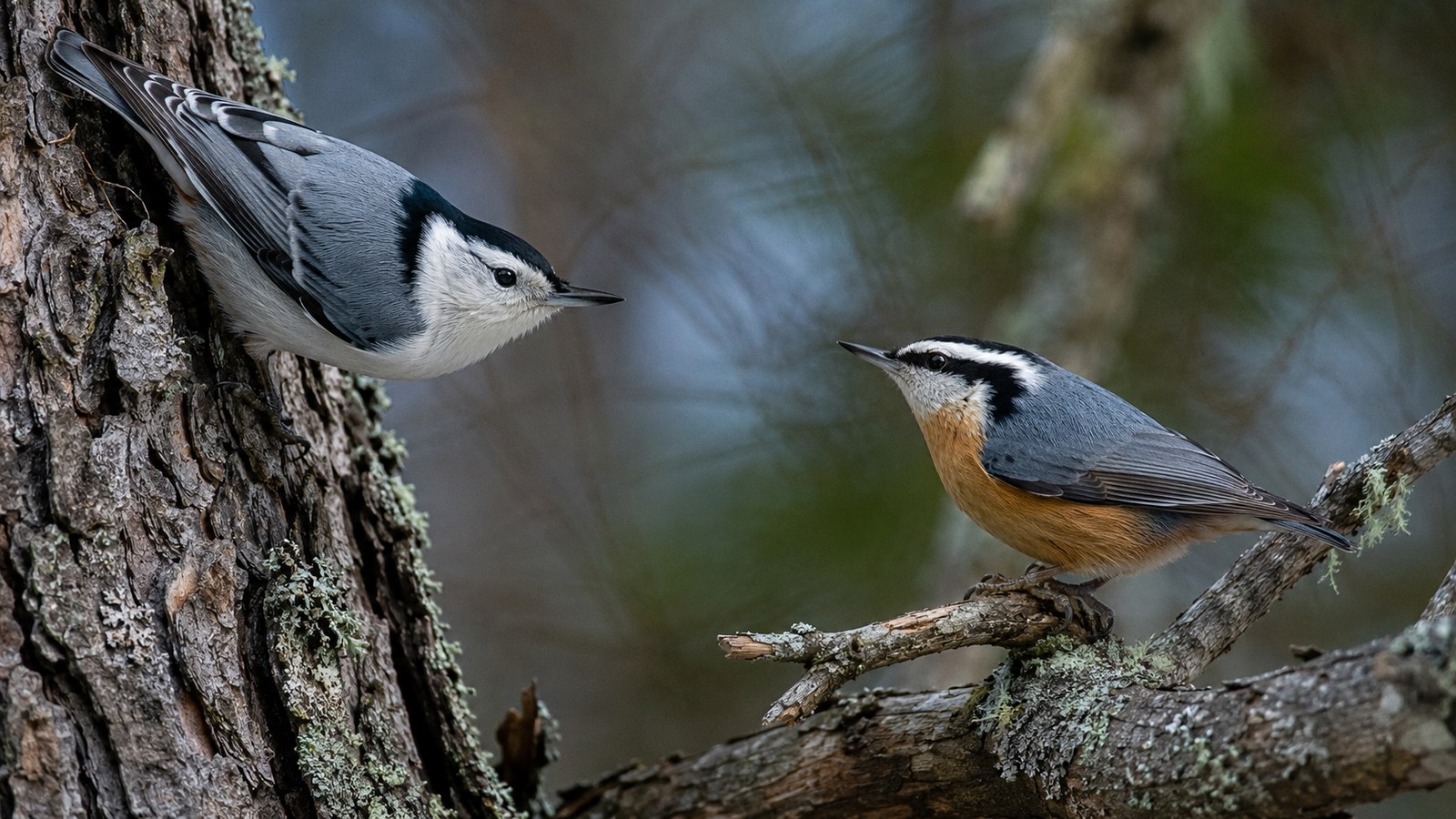
Side-by-side comparison
| Clue | White-breasted Nuthatch | Red-breasted Nuthatch |
|---|---|---|
| Face | Broad white cheek and face | Bold white eyebrow with dark eye stripe |
| Underparts | Mostly white, with rusty colour near the rear | Warm rusty or cinnamon across much of the breast and belly |
| Size | Larger and longer-billed | Smaller and more compact |
| Cap | Black on males, grayer on females | Blacker on males, grayer on females |
| Back | Blue-gray | Blue-gray |
| Habitat | Often deciduous and mixed woods, parks, wooded neighbourhoods | Especially conifer forests, though eastern birds can use mixed and deciduous woods |
| Voice | Often quicker repeated nasal notes | Often slower, more drawn-out nasal notes |
| Movement | Regular across much of its range | Numbers can shift strongly southward or into new areas in some fall and winter seasons |
Look for the eyebrow and eye stripe
For most sightings, the Red-breasted Nuthatch’s face is the fastest clue. A clean white eyebrow sits above a dark line that runs through the eye. That gives the head a striped appearance even when the bird is moving quickly.
White-breasted Nuthatches lack that pattern. Their face looks much more open and white, with the dark cap sitting above a broad white cheek. Cornell specifically uses the Red-breasted’s white eyebrow as a key difference from White-breasted.
The belly colour is the next strong clue
Red-breasted Nuthatches usually show warm cinnamon or rusty colour across much of the underparts. The shade can range from pale buff-rust to richer orange depending on sex, light, and individual bird.
White-breasted Nuthatches are mostly white below. They can show rusty patches near the lower belly and undertail area, so a little warm colour doesn’t make a bird Red-breasted. Pay attention to how much of the breast and belly is coloured.
White-breasted is the larger bird
White-breasted Nuthatches are noticeably larger when the two species are together or using the same feeder. They also have a longer, heavier-looking bill. Red-breasted Nuthatches are smaller, tighter-bodied, and shorter-billed.
Size is harder to judge when the bird is alone. A close Red-breasted can look bigger than a distant White-breasted. A feeder port, suet cage, tree trunk, or second bird gives you a better scale reference.
Both have blue-gray backs
The back doesn’t separate these birds nearly as well as the face or belly. Both species can look blue-gray above, especially in cool forest light. If you only see a bird from behind, don’t try to decide from back colour alone.
Instead, add body size, bill length, cap, forest type, and voice. Then wait for the bird to turn its head. One clear side view can reveal the eyebrow and eye stripe immediately.
Male and female White-breasted Nuthatches
Male White-breasted Nuthatches generally have a black crown and nape. Females often have a grayer cap, though the difference can be subtle at a distance. Both sexes keep the broad white face and mostly white underparts that separate the species from Red-breasted.
Don’t mistake a gray-capped female White-breasted for another species. The large size, long bill, white cheek, white belly, and lack of a dark eye stripe still fit White-breasted.
Male and female Red-breasted Nuthatches
Adult male Red-breasted Nuthatches tend to have a blacker crown and richer rusty underparts. Females usually have a grayer crown and paler cinnamon below. The white eyebrow and dark eye stripe remain important in both sexes.
A pale female can look much less “red-breasted” than the name suggests. Use the complete face pattern rather than expecting a deep orange chest on every bird.
Habitat often gives you the right starting point
White-breasted Nuthatches are common in mature deciduous woods, mixed forests, wooded parks, and neighbourhoods with large trees. They often appear in yards where mature oaks, maples, or other broadleaf trees remain nearby.
Red-breasted Nuthatches are more strongly associated with conifer forests, including spruce, fir, pine, hemlock, larch, and western red cedar. They aren’t restricted to evergreens, especially in the East and during movement, but a small striped-faced nuthatch in dense conifers should put Red-breasted high on the list.
Season can change how likely Red-breasted is
White-breasted Nuthatches are fairly steady residents across much of their range. Red-breasted Nuthatches can be much less predictable. In some years, many move south or into areas where they were scarce the previous winter.
That means last year’s feeder list isn’t always a good guide. If a small nuthatch appears during fall migration or winter, check it carefully even if Red-breasted isn’t a regular visitor in your yard.
Listen to pace, not just the nasal quality
Both species can sound nasal, which is why a one-word description such as “honk” or “yank” isn’t enough. White-breasted Nuthatch calls often come in quicker repeated notes. Red-breasted calls are often thinner and more drawn out, with more space between notes.
Individual birds vary, and distance changes how a call sounds. Record several notes when possible. Compare pace, repetition, tone, habitat, and the visual face pattern rather than deciding from one syllable.
Flight and tail shape can support a distant view
Both species have short tails and usually make quick, direct flights between trunks, branches, and feeders. White-breasted Nuthatches often look a little more substantial in flight because of their larger body and longer bill. Red-breasted Nuthatches can look especially compact, with the head, body, and short tail forming a tight shape.
Flight should stay low on the checklist unless you know the birds well. Distance and angle can change the apparent size quickly. A clear view of the face or underparts is still much stronger than trying to judge a fast bird crossing the yard.
When both species are in the same area
There are many parts of Canada and the United States where both species can occur, especially during fall and winter. That overlap helps rather than confusing because a direct comparison can make the size, face pattern, and belly colour much easier to see.
If two nuthatches visit the same feeder, note whether one is larger, whether either has a white eyebrow, and how much warm colour covers the belly. A photograph of both birds on the same feeder can be better than several isolated close-ups.
What to photograph for a later identification
Try for one side view that includes the eye, eyebrow area, breast, belly, bill, and tail. A second rear or top view can help with cap colour and overall size. Keep a wider frame too, because the feeder, tree species, and surrounding habitat can provide context.
Don’t delete a dark or distant frame too quickly. A poor photo may still preserve the eyebrow, eye stripe, belly colour, or a direct size comparison that you missed in the moment.
Feeder behaviour is similar
Both nuthatches can visit sunflower seed, peanuts, suet, and suitable mixes. They often grab one item and leave, carrying it to bark or a branch. That makes feeder behaviour less reliable for separating the species than face, belly, size, and habitat.
Feeder placement can still affect what you see. A feeding station near mature trees and cover gives nuthatches quick access to the bark and canopy they use throughout the day. The bird feeder placement guide covers visibility, cover, windows, and cleaning access.
What if the bird is in poor light?
Warm sunset light can make a White-breasted Nuthatch look buff or rusty. Deep shade can make a Red-breasted Nuthatch’s belly look dull gray-brown. Cameras can also shift white balance enough to change the apparent colour.
The face pattern usually survives those colour changes. Look for the white eyebrow and dark eye stripe. If the bird is backlit, use the silhouette, bill, size, habitat, and voice until it moves into better light.
What if you only see the bird from behind?
A rear view hides the best field marks. White-breasted often looks larger and longer-billed, while Red-breasted looks smaller and more compact. Forest type can also help, especially a conifer-heavy setting for Red-breasted.
Don’t force the identification from a blue-gray back. Follow the bird for a few seconds and wait for a side view of the head or belly. Nuthatches often circle around trunks, so the missing face pattern may appear quickly.
Don’t confuse them with Pygmy or Brown-headed Nuthatches
Pygmy and Brown-headed Nuthatches are both tiny, brown-capped species. They lack the Red-breasted Nuthatch’s strong white eyebrow and dark eye stripe. They’re also much smaller than White-breasted. For western birds, see Pygmy vs Red-breasted Nuthatch.
Region makes those brown-capped birds easier. Pygmy Nuthatches live in western pine forests, especially ponderosa pine. Brown-headed Nuthatches live in southeastern pine forests. The common backyard nuthatch guide compares all four species in one place.
Chickadee or nuthatch?
Chickadees often share feeders and mixed flocks with nuthatches. A chickadee usually has a shorter bill and longer tail and spends more time hopping through twigs, leaves, and cones. Nuthatches look more compact and spend more time moving along trunks and larger branches.
If the bird has a black cap and white cheek but the bill looks short and the tail long, check the chickadee identification guide before deciding it’s a White-breasted Nuthatch.
A seven-clue field routine
- Confirm a compact nuthatch shape with a short tail and pointed bill.
- Look for a bold white eyebrow and dark eye stripe.
- Check whether most of the breast and belly are white or rusty.
- Judge size only if you have a feeder, branch, or second bird for scale.
- Record whether the surrounding trees are mainly deciduous, mixed, or coniferous.
- Listen to the pace and spacing of several nasal calls.
- Use date and location to judge whether seasonal Red-breasted movement is likely.
Frequently asked questions
Which field mark should I check first?
Check the face. A strong white eyebrow and dark eye stripe point to Red-breasted. A broad white face without that stripe points to White-breasted.
Can a White-breasted Nuthatch have rusty feathers?
Yes. White-breasted Nuthatches can show rusty colour near the lower belly and undertail. Red-breasted Nuthatches usually carry warm colour across much more of the breast and belly.
Are female Red-breasted Nuthatches still reddish?
Usually, but females are often much paler than males. Their grayish crown, white eyebrow, dark eye stripe, and warm underparts still separate them from White-breasted.
Can both species appear at the same feeder?
Yes, where their ranges overlap. A shared feeder gives you a good direct size comparison, but the face and underparts remain the best species clues.
Full species guides
Continue with White-breasted Nuthatch or Red-breasted Nuthatch.