
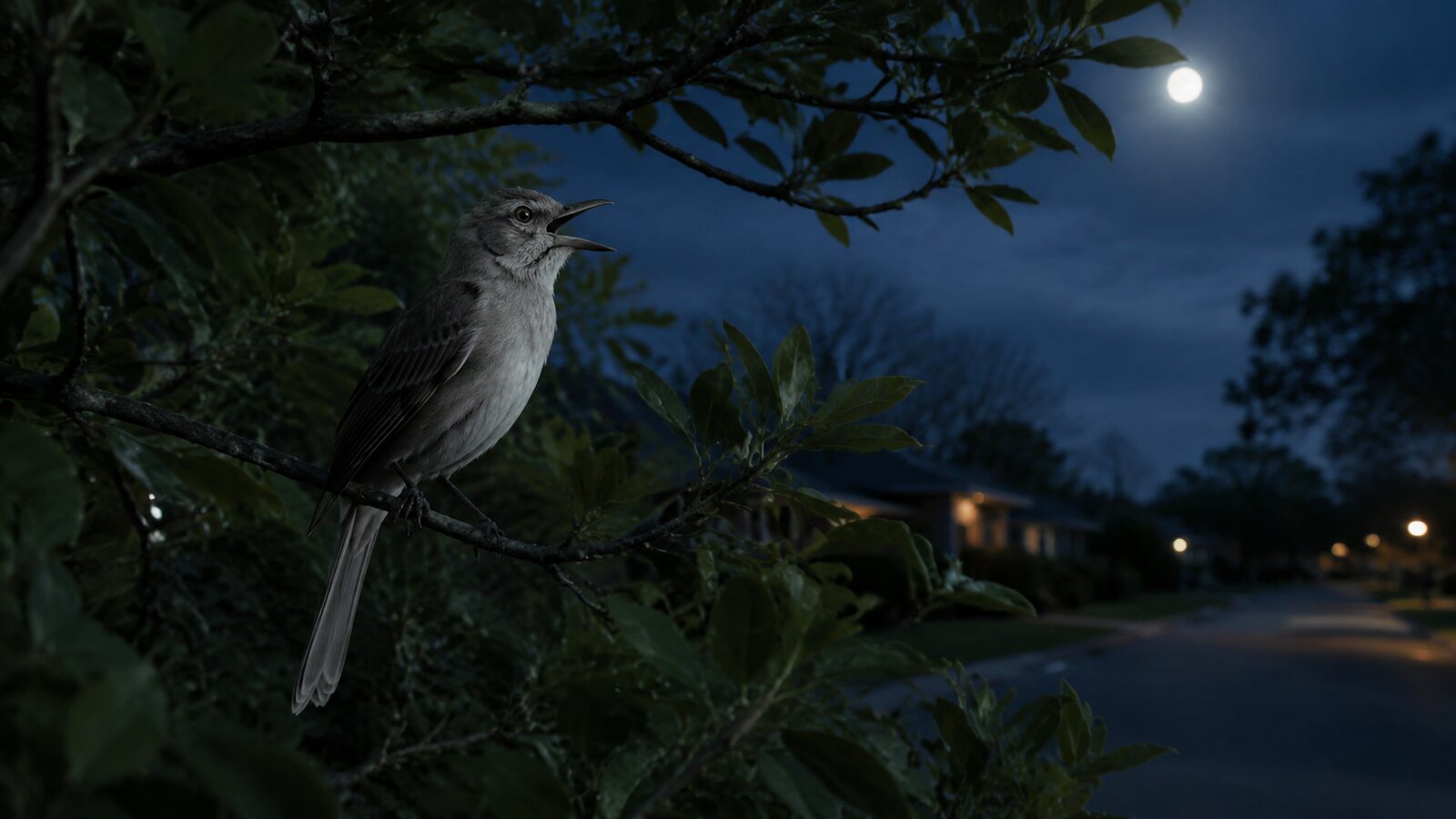
First, is it really chirping?
“Chirp” is a handy word, but birds make a lot of different sounds after dark. A short chip overhead is different from a mockingbird singing for an hour. An owl hoot is different again.
Before trying to explain the sound, listen for its pattern. Is it one note every few seconds? A long song? A flock of tiny calls moving across the sky? Does it come from the same tree, or does it seem to drift?
Those details narrow the possibilities quickly.
Some birds are supposed to be awake at night
Not every bird follows a daytime schedule.
Owls are the obvious example, but nightjars, poorwills, some rails, and other birds are active after sunset too. Their calls can carry a surprising distance when traffic and daytime noise drop away.
A nighttime sound can seem louder partly because the neighbourhood is quieter. The bird may not be calling any more loudly than it would at dusk. You are simply hearing it better.
Mockingbirds can sing through the night
If the sound is a long, varied performance that seems to come from the same perch, a Northern Mockingbird is worth considering in areas where the species occurs.
Cornell notes that all-night mockingbird singers are often unmated males. The bird keeps advertising, even when the humans nearby would prefer a little less enthusiasm.
Mockingbirds imitate other birds and many non-bird sounds, so one individual can seem like several different species taking turns.
Many songbirds migrate after dark
This is one of my favourite explanations because you may hear birds you cannot see at all.
Large numbers of songbirds migrate at night in spring and fall. Thrushes, warblers, sparrows, and other migrants can make brief flight calls as they pass overhead. Cornell's BirdCast work describes these night flight calls as short vocalizations made during sustained nocturnal migration.
On a good migration night, the sky can sound faintly alive. A soft seep or peep may last less than a second.
If the sounds are moving rather than staying in one tree, migration becomes a strong possibility.
Why do migrating birds call in the dark?
Scientists are still studying all the functions of night flight calls.
They may help birds maintain contact, coordinate with other migrants, or respond to conditions in the air. Calling can also increase when birds encounter poor visibility or artificial light.
That last point matters around cities. A bright night is not the same night birds evolved with.
Artificial light can change when birds sing
Streetlights, parking lots, illuminated buildings, porch lights, and other nighttime lighting can affect a bird's daily clock.
Studies of urban birds have found earlier dawn singing where artificial light at night is stronger. That does not mean every 3 a.m. bird has been “confused by a streetlight,” but light pollution can shift normal timing.
Some birds start before sunrise anyway. Add bright urban light and the dawn chorus can creep even earlier.
Are birds chirping because they are scared?
Sometimes.
A roosting bird may give an alarm call if a cat, raccoon, owl, person, or other disturbance gets too close. One bird calling can wake others, and a quiet yard can become noisy very quickly.
These sounds are usually shorter and more urgent than a full territorial song.
Baby birds can make noise after dark too
Nestlings and fledglings beg and give contact calls, although activity often drops after nightfall.
If you hear repeated calls from one shrub or nest area during nesting season, young birds may be involved. Resist the urge to investigate with a flashlight unless there is a real reason to think a bird is in trouble. Active nests are best given space.
Why do birds chirp just before sunrise?
That is usually part of the dawn chorus rather than true middle-of-the-night activity.
Many songbirds begin before the sun appears. Males may be advertising territory and breeding status while conditions are still cool and dim. Our page on why birds sing in the morning looks at that behaviour in more detail.
Why did the bird start singing at night all of a sudden?
Season can change everything.
Spring brings territorial song and courtship. Late summer and fall bring migration. Young birds appear. Flocks reorganize. A bird that was silent outside your bedroom in January can be impossible to ignore in May.
Changes around your home can matter too. A new security light, tree removal, construction, or a new roost nearby may alter what you hear.
Can I identify a bird from its nighttime sound?
Often, yes, but give yourself more than one clue.
Record the sound if you can. Note the exact time, month, habitat, repetition, pitch, and whether the sound stays put or moves. Then compare it with species expected in your region.
The general bird sound identification guide gives you a repeatable way to describe what you heard before guessing at a species.
Frequently asked questions
Is it normal for birds to chirp all night?
It is normal for some species and situations, but not for every bird. A nocturnal species, mockingbird, migrant, alarmed roost, or brightly lit urban setting can all produce nighttime sounds.
What is that tiny chirp in the sky at night?
During spring or fall migration, it may be a night flight call from a songbird passing overhead. These calls can be very brief.
Do robins sing at night?
They can, especially around artificial lighting and during the breeding season. Timing varies with location, season, and local light conditions.
Do birds sleep at night if they are chirping?
Most daytime birds still spend much of the night resting. A bird can wake briefly to call, while nocturnal species follow a different schedule. See where birds sleep at night.
Listen before you look
The next time a bird wakes you up, listen for thirty seconds before reaching for an identification app. Is it singing from one spot? Flying overhead? Calling once, then going quiet?
At night, the pattern is often the best clue you have.
Compare these nighttime causes with why birds chirp during everyday communication, then see where birds sleep when they are not calling.